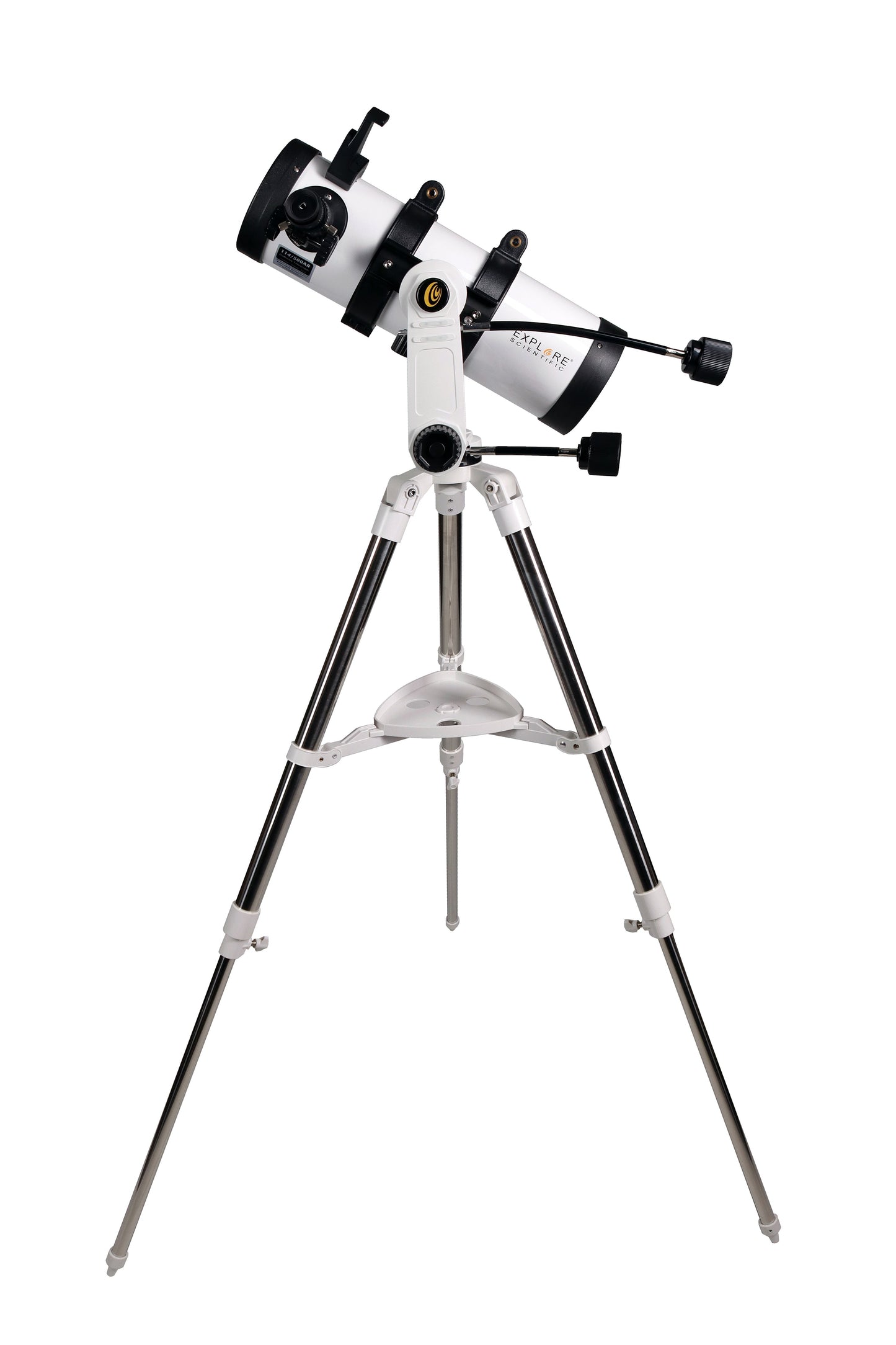
Big views in a compact package. The Explore Scientific Sidara Nano pairs a 114mm mirror with the lightweight SkyAssist mount to give new stargazers a portable telescope that actually shows you something worth seeing. The free SkyAssist smartphone app guides you to the Moon, planets, star clusters, and nebulae — just follow the arrows on your phone screen and the object appears in the eyepiece.
Unlike basic 114mm reflectors with clunky full-size tripods, the Sidara Nano's compact form factor means it sets up in minutes anywhere — backyard, balcony, camping trip, dark-sky site. The 114mm aperture collects enough light to show Jupiter's cloud bands, Saturn's ring gap, and the glow of the Orion Nebula even from a suburban backyard.
What you'll see
-
The Moon — craters, mountains, and the terminator in sharp high-contrast detail
-
Saturn's rings and the ring gap — clearly separated on steady nights
- Jupiter's cloud bands and four Galilean moons
-
The Orion Nebula (M42) — visible as a glowing cloud even from suburban skies
-
Globular clusters like M13 — beginning to resolve at higher magnification
-
Bright galaxies like Andromeda — soft glow with visible core
What's in the box
- 114mm Newtonian reflector OTA — fully coated mirrors
- SkyAssist Nano alt-azimuth mount — app-guided, compact and lightweight
- Tripod
- Eyepiece
- SkyAssist App — free, guides you to targets with on-screen arrows
| Specifications |
| Optical design |
Newtonian reflector |
| Aperture |
114 mm (4.5 inches) |
| Focal length |
500 mm (f/4.4) |
| Mount |
SkyAssist Nano alt-azimuth — app-guided pointing |
| App |
SkyAssist — free, guides you to celestial objects with on-screen navigation |
| SKU |
ES-N114500-MAZ-NANO |
Backed by Telescope Wolves' price match guarantee and free US shipping. Questions about the SkyAssist system? We're happy to explain how it works.
Frequently asked questions
How does the SkyAssist app guide me to objects?
You enter an object ("Orion Nebula", "Saturn", "M13") into the app, and it uses your phone's sensors and GPS to show directional arrows telling you which way to move the telescope. When the arrows stop, the object should be in the eyepiece. It's not GoTo (the mount doesn't move itself), but it makes finding targets dramatically faster for beginners who haven't learned to star-hop yet.
What makes this "compact" compared to other 114mm reflectors?
Most 114mm reflectors ship on heavy full-size equatorial mounts that weigh 15–20 lbs fully assembled. The Sidara Nano's SkyAssist mount is significantly lighter and more portable, making it practical to carry to a dark-sky site or set up quickly in the backyard without a major production. The trade-off is that it's a manual alt-azimuth rather than a tracking equatorial, but for visual observing that's a reasonable compromise.
Can I use this for astrophotography?
The Sidara Nano is designed for visual observing. You can take smartphone photos of the Moon and bright planets through the eyepiece (afocal photography), but the manual mount isn't suited for long-exposure deep-sky imaging. For serious astrophotography, you'd want a motorized equatorial mount.
What else can I add to this telescope?
Additional 1.25" eyepieces expand your magnification range. A 2× Barlow doubles any eyepiece's magnification. A collimation tool (around $20) makes mirror alignment quick. A red flashlight lets you read star charts without ruining your dark adaptation.
New to astronomy? Read our beginner's guide to choosing your first telescope or our Astronomy 101 guide to get started.