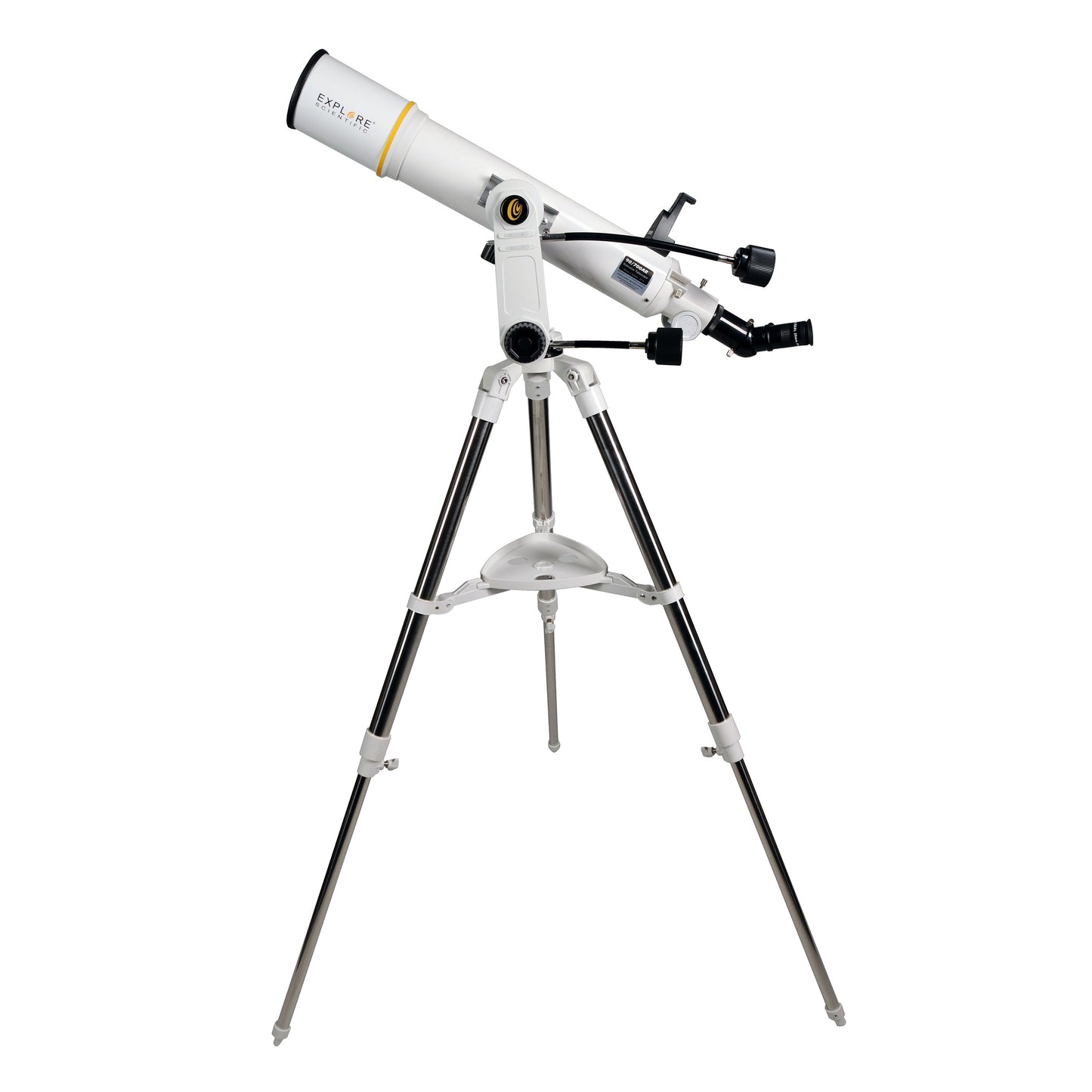
The Explore Scientific Sidara Nano 90mm Refractor is the grab-and-go telescope for beginners who want real views without a complicated setup. The 90mm aperture and f/7.8 focal ratio sit in a compact, lightweight tube that sets up in minutes anywhere — backyard, rooftop, camping trip. The free SkyAssist smartphone app guides you to any target with on-screen arrows: type in "Orion Nebula" or "Saturn," follow the arrows, and the object appears in the eyepiece.
Unlike standard 90mm refractors that come on bulky EQ mounts that require polar alignment before you can observe, the Sidara Nano's SkyAssist mount is intuitive and compact. The refractor design means no mirror collimation, no cool-down wait, and sharp star images right out of the box — just point, focus, and look.
What you'll see
-
The Moon — craters, mountains, and rilles in sharp refractor contrast
-
Saturn's rings — clearly visible with the ring gap on steady nights
-
Jupiter's cloud bands and the four Galilean moons
-
The Orion Nebula (M42) — glowing gas cloud visible even from suburban skies
-
Open clusters like the Pleiades — resolved into individual stars in wide-field views
-
Bright galaxies — Andromeda visible as an elongated glow
What's in the box
- 90mm f/7.8 achromatic refractor OTA — fully coated optics, no collimation needed
- SkyAssist Nano alt-azimuth mount — app-guided, compact and lightweight
- Tripod
- Eyepiece
- SkyAssist App — free for iOS and Android, guides you to any target with on-screen arrows
| Specifications |
| Optical design |
Achromatic refractor — no collimation required |
| Aperture |
90 mm (3.5 inches) |
| Focal length |
700 mm (f/7.8) |
| Mount |
SkyAssist Nano alt-azimuth — app-guided target finding |
| App |
SkyAssist — free iOS and Android |
| SKU |
ES-AR90700-MAZ-NANO |
Backed by Telescope Wolves' price match guarantee and free US shipping. Questions about refractor vs. reflector at this price point? We'll help you choose.
Frequently asked questions
How does the SkyAssist app work?
You search for an object by name or browse a catalog, and the app uses your phone's GPS and motion sensors to show directional arrows pointing you toward the target. When the arrows center up, the object is in your eyepiece. It works purely as a pointing guide — the mount doesn't move itself, but you don't need to know the night sky to find what you're looking for.
What's the advantage of a refractor over a reflector at 90mm?
Refractors require no collimation, no cool-down time, and no mirror cleaning. The sealed tube keeps optics protected. For grab-and-go use where you want to be observing within 5 minutes of unpacking, a refractor is more convenient. Reflectors at the same price tend to offer more aperture — but refractors offer better contrast for planets and a simpler ownership experience.
Is 90mm enough aperture for serious observing?
For planets and the Moon, absolutely. Saturn's rings and Jupiter's cloud bands are impressive through a good 90mm refractor on a steady night. For deep-sky objects like galaxies and nebulae, 90mm will show you the highlights — the Orion Nebula, Andromeda, the brighter clusters — but a larger aperture reflector will show more. This scope is an excellent long-term companion for planetary and lunar observers.
Can I travel with this telescope?
The Sidara Nano's compact design is intentionally travel-friendly. The lightweight mount and short tube break down to a manageable size for car camping, travel, or taking to a dark-sky site. It's one of the key advantages over full-size telescopes on heavy equatorial mounts.
New to astronomy? Read our beginner's guide to choosing your first telescope or our Astronomy 101 guide to get started.