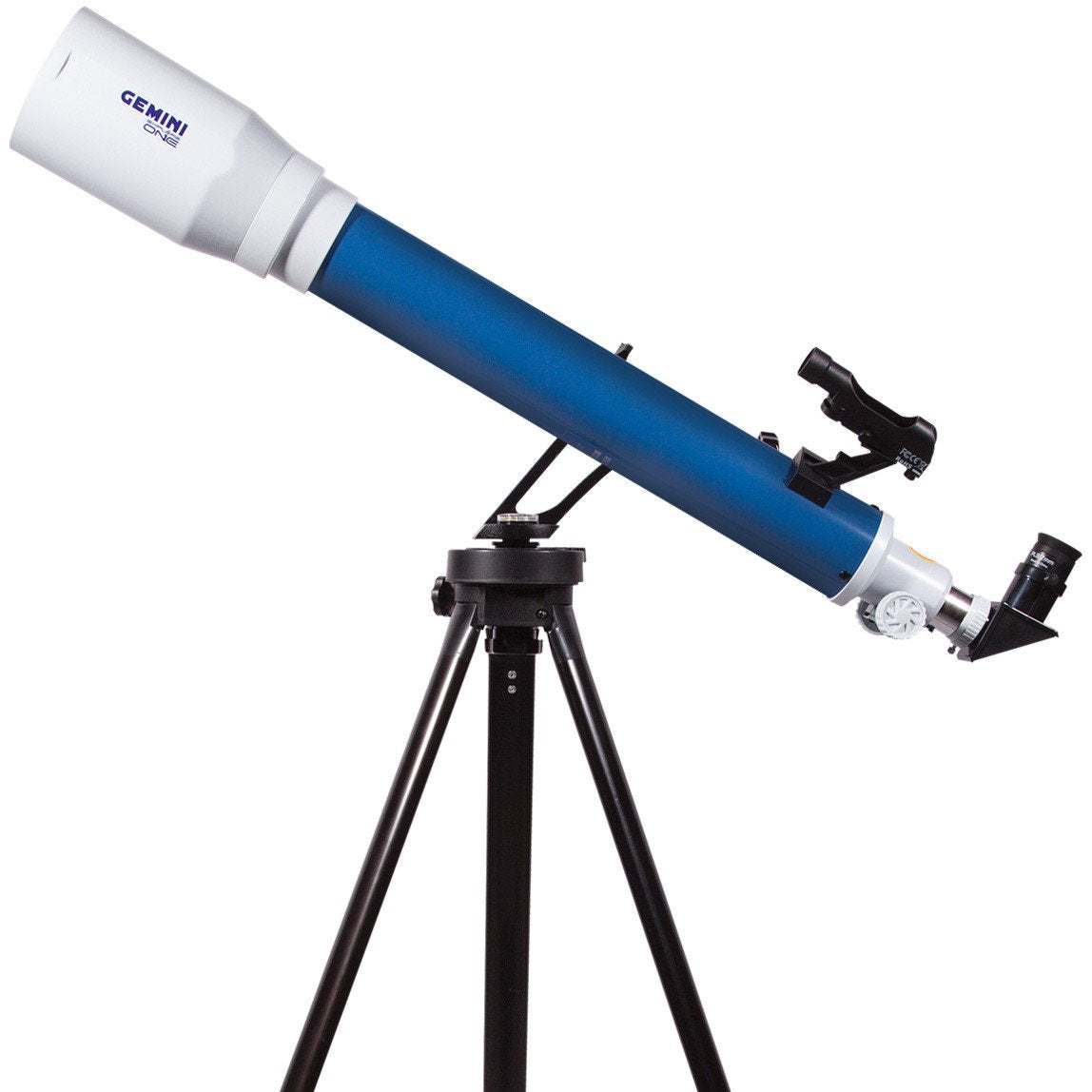
If you want a beginner telescope that can go beyond the Moon and planets and start reaching into deep space, the Aurora II 114mm reflector is one of the best options under $200. Its 114mm aperture gathers noticeably more light than smaller refractors at this price, opening up the Orion Nebula, globular clusters, and even the soft glow of the Andromeda Galaxy on dark nights.
Unlike basic push-and-hunt AZ mounts where every adjustment becomes a guessing game, the Aurora II's slow-motion alt-azimuth controls let you track objects smoothly across the sky — grip the control knobs and nudge the scope while looking through the eyepiece without losing the target. The two included Plössl eyepieces cover wide-field scanning and higher-power planetary views right out of the box.
What you'll see
-
The Moon — craters, valleys, and mountain ranges in rich, high-contrast detail
-
Saturn's rings and the Cassini Division on steady nights
-
Jupiter's cloud bands and the four Galilean moons
-
The Orion Nebula (M42) — a glowing cloud of star-forming gas, visible even from suburbs
-
Globular clusters like M13 — a ball of hundreds of thousands of stars, resolving at the edges
-
The Andromeda Galaxy — a soft elongated glow on good dark nights
What's in the box
- 114mm Newtonian reflector OTA — flat black finish, fully coated mirrors
- Full-size adjustable aluminum tripod with accessory tray
- Slow-motion alt-azimuth mount — smooth manual tracking controls
- Two Plössl eyepieces — wide-field and higher-power views
- Red-dot finder — for quick target acquisition
- 2× Barlow lens — doubles any eyepiece's magnification
| Specifications |
| Optical design |
Newtonian reflector |
| Aperture |
114 mm (4.5 inches) |
| Mount |
Slow-motion alt-azimuth — smooth manual tracking |
| Finish |
Flat black — minimizes stray light reflections |
| Includes |
Two Plössl eyepieces, 2× Barlow, red-dot finder |
| SKU |
88-20114 |
Backed by Telescope Wolves' price match guarantee and free US shipping. Questions about what to expect through a 114mm reflector? Ask us.
Frequently asked questions
What makes a 114mm reflector different from a 50–70mm refractor?
About five times more light-gathering. That difference means deep-sky objects like nebulae and galaxies are genuinely visible rather than theoretical — the Orion Nebula becomes a glowing cloud with visible structure, and the Andromeda Galaxy shows its elongated shape rather than a vague brightening. Planetary views are also sharper and brighter at higher magnifications.
What are slow-motion controls and why do they matter?
Basic AZ mounts let you push the telescope and hope it stops where you want. Slow-motion controls are fine adjustment knobs on each axis that let you make precise small movements while looking through the eyepiece — essential for centering faint objects, keeping a planet in view as the Earth rotates, and showing someone else exactly what you see without the image bouncing around.
What does a 2× Barlow do?
It doubles the magnification of any eyepiece you use it with. Combined with the two included eyepieces, you effectively have four magnification options. It's one of the most useful accessories in the box and makes the Aurora II more versatile than scopes that include only two eyepieces.
Do I need to align the mirrors (collimate)?
Occasionally. Reflectors can drift out of alignment over time, especially if transported or bumped. Checking collimation takes a few minutes with a simple tool and is a skill most beginners learn in their first month. The Aurora II's mirrors are accessible and straightforward to adjust.
New to astronomy? Read our beginner's guide to choosing your first telescope or our Astronomy 101 guide to get started.
Watch it in action