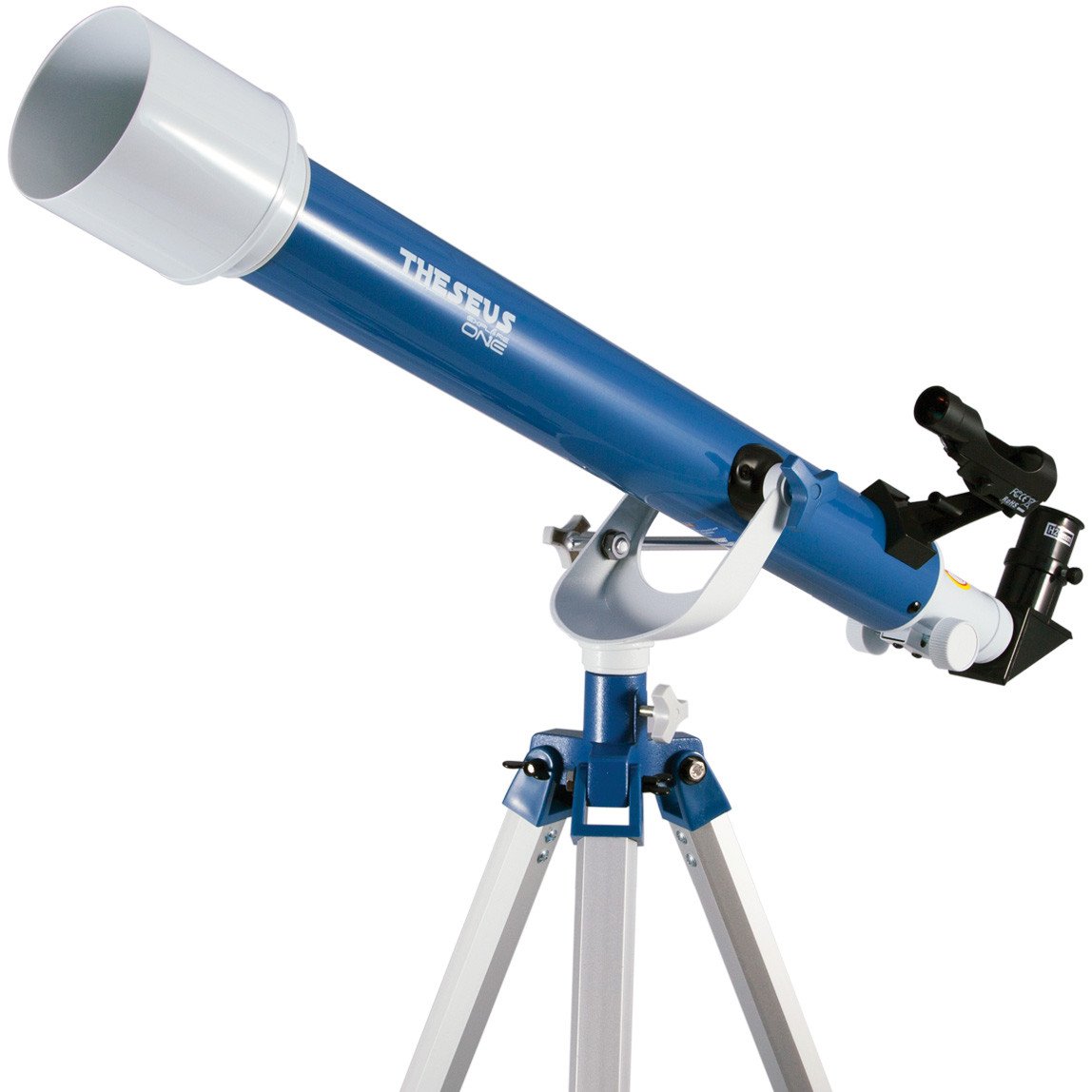
A capable step up from 50mm beginner scopes, the Explore One CF400 puts a 70mm lens in a compact tabletop package wrapped in striking blue carbon fiber. The bigger aperture gathers noticeably more light — you get clearer views of Saturn's rings, the Moon's craters, and star clusters, all without the bulk of a full floor-standing tripod.
Unlike 50mm tabletop scopes where you're right at the edge of what the optics can show, 70mm gives you genuine headroom. The panhandle AZ mount lets you steer with one hand while looking through the eyepiece — far more intuitive than twisting separate knobs, especially for beginners getting their bearings on the sky. And the blue carbon fiber finish looks distinctly better than the plain-white or black-tube budget alternatives.
What you'll see
-
The Moon — craters, rilles, and mountain ranges in sharp relief
-
Saturn's rings — clear and rewarding on good nights
-
Jupiter's cloud bands — a subtle hint, plus the four Galilean moons as bright dots
-
Open star clusters — the Pleiades and Beehive in wide, bright views
-
Double stars — split cleanly at higher magnification
What's in the box
- CF400 70mm refractor OTA — blue carbon fiber wrap, coated glass optics
- Panhandle AZ tabletop mount — smooth, intuitive one-hand control
- Eyepieces for viewing right out of the box
| Specifications |
| Optical design |
Achromatic refractor |
| Aperture |
70 mm — noticeably more light-gathering than 50mm beginner scopes |
| Focal length |
~400 mm |
| Tube finish |
Blue carbon fiber wrap |
| Mount |
Panhandle alt-azimuth tabletop — intuitive one-hand steering |
| Form factor |
Tabletop — sets up on any flat surface, no floor tripod needed |
Backed by Telescope Wolves' price match guarantee and free US shipping. Not sure if tabletop or full-size tripod is right for you? Ask us.
Frequently asked questions
Does a tabletop setup limit where I can use it?
Not much. The tabletop mount works on any stable flat surface — a patio table, picnic bench, car hood, or the roof of a portable cooler. For extended sessions on the ground, you can also place the tabletop mount on a low stool or use any camera tripod with a ¼"-20 thread for floor-standing height.
What's the real advantage of 70mm over 50mm?
A 70mm aperture collects about 96% more light than a 50mm — nearly double. In practice: the Moon looks sharper and brighter, Saturn's rings are clearly defined rather than just hinted at, fainter stars appear, and star clusters resolve into more individual points of light. It's a meaningful step up, not a marginal one.
What makes the panhandle mount better for beginners?
Traditional alt-azimuth mounts use separate knobs for up/down and left/right movement — you have to loosen one, adjust, tighten, then repeat for the other axis. A panhandle is a single handle you push in any direction while looking through the eyepiece. It's much more natural, especially when tracking a moving planet or following the Moon across the sky.
Is the carbon fiber finish just cosmetic?
Mostly cosmetic, but it also keeps the tube lightweight. Carbon fiber wraps weigh less than painted metal tubes and dissipate dew slightly better in humid conditions. The blue color is distinctive — this is the scope that stands out when you bring it to a star party or a family camping trip.
New to astronomy? Read our beginner's guide to choosing your first telescope or our Astronomy 101 guide to get started.
Watch it in action