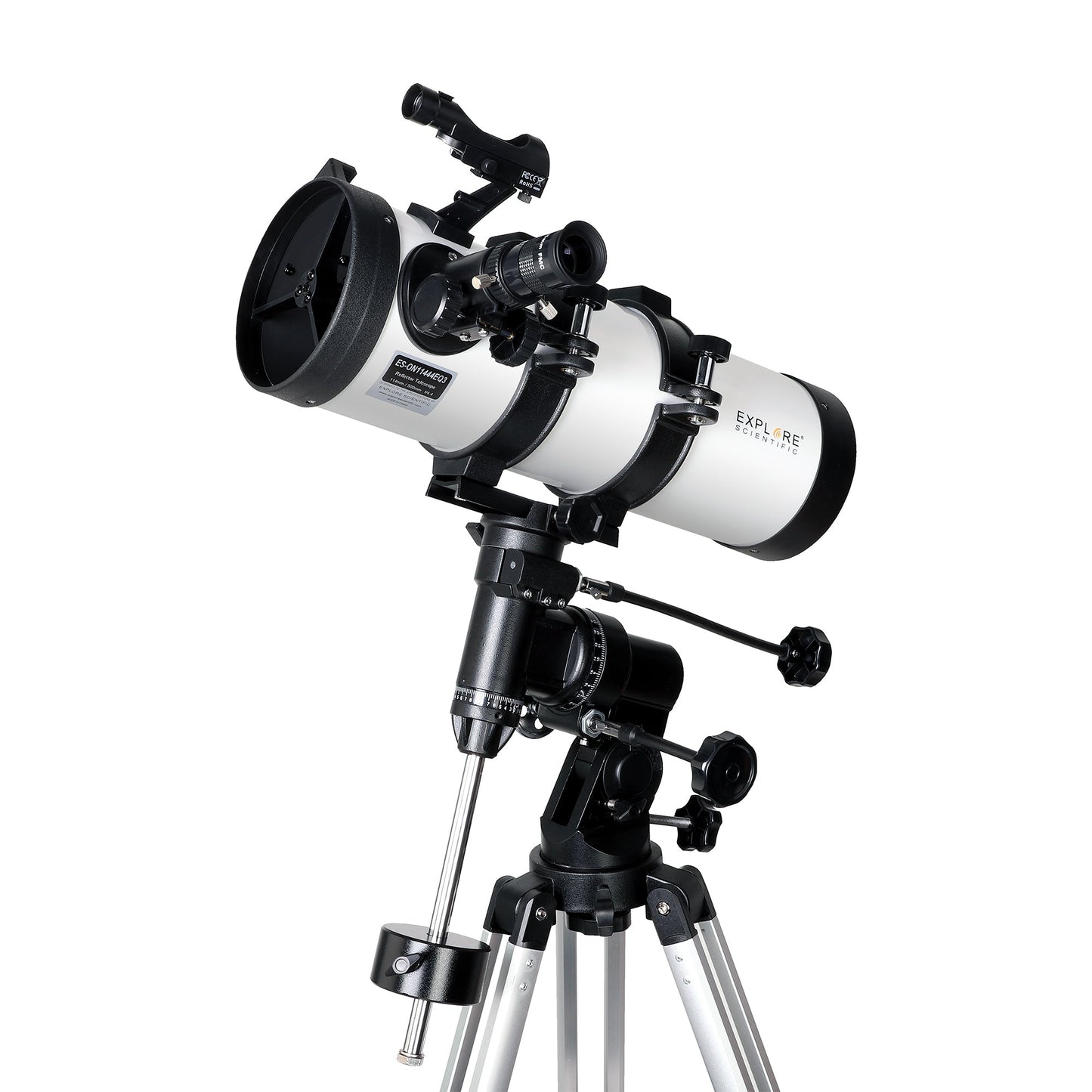
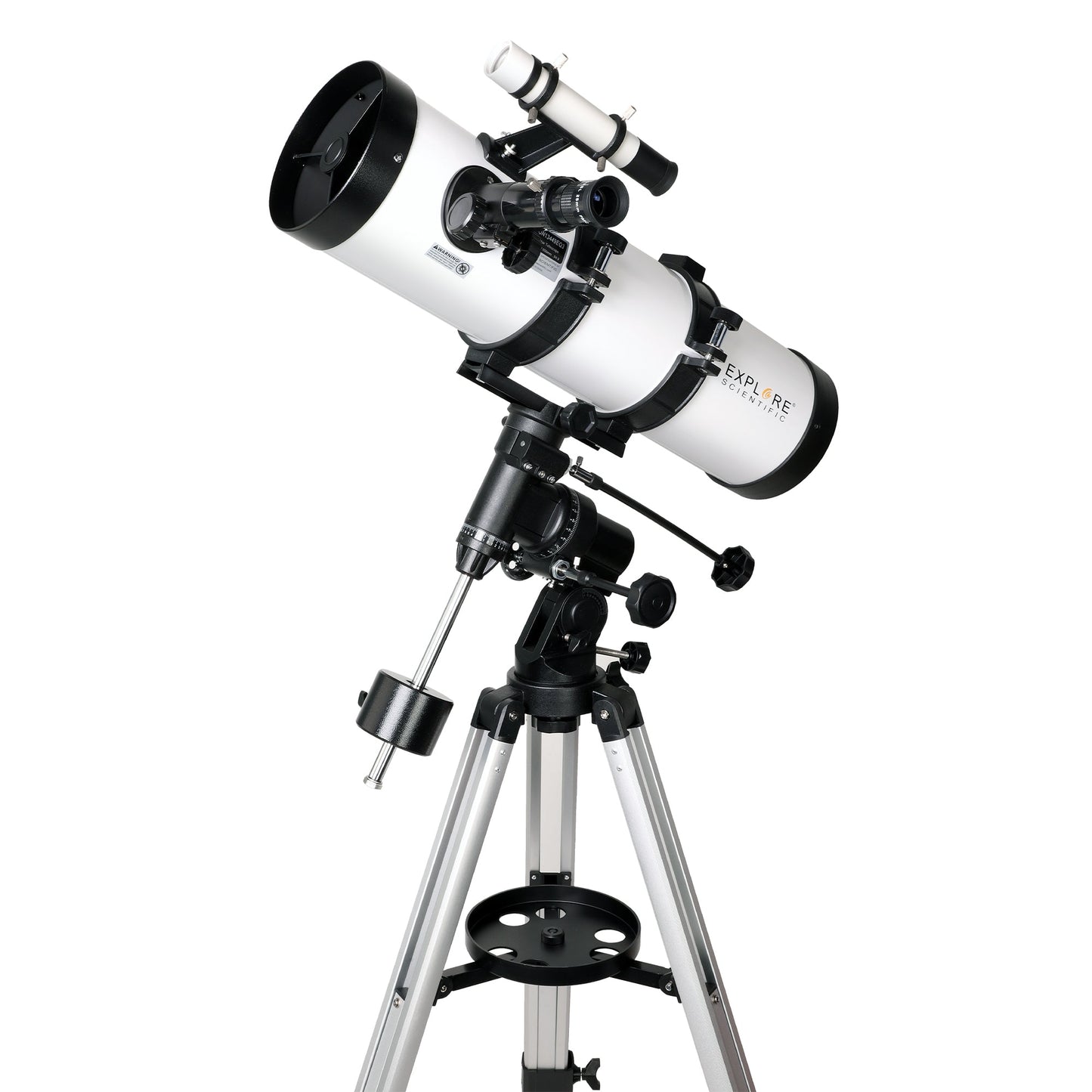
If you're searching for a beginner equatorial mount reflector that doubles as an entry-level astrophotography rig, the Explore Scientific Newtonian Reflector series offers two sizes: the 114mm (f/4.4, 500mm focal length) and the roomier 134mm (f/4.9, 650mm focal length). Both feature fast focal ratios for wide, bright fields and come on smooth EQ mounts with dual slow-motion controls — making it easy to track stars and planets as Earth rotates, or keep a target centered while shooting photos.
Unlike basic beginner scopes not designed with astrophotography in mind, these fast Newtonians are built with imaging in mind from the start. The 114mm model adds a smartphone adapter and ARTelescope App access for constellation identification and a sky encyclopedia — useful for nights when you're still learning the sky. The 134mm model adds aperture for even brighter, wider deep-sky views.
What you'll see
-
The Moon — craters, mountain ranges, and shadowed valleys in sharp relief
-
Jupiter and Saturn — cloud bands and separated rings clearly visible
-
Star clusters — the Pleiades and Beehive resolved into individual stars
-
The Orion Nebula (M42) — visible gas cloud structure from suburban skies
-
The Andromeda Galaxy (M31) — elongated shape with a bright core
What's in the box
- Newtonian reflector OTA — 114mm or 134mm depending on configuration
- EQ mount with dual slow-motion controls on both axes
- Full-size tripod
- Eyepiece(s)
- Smartphone adapter (114mm model)
- ARTelescope App access (114mm model) — free iOS and Android sky identification
| Specifications |
|---|
| Optical design |
Fast Newtonian reflector |
| Aperture options |
114mm f/4.4 (500mm FL) or 134mm f/4.9 (650mm FL) |
| Mount |
EQ mount with dual slow-motion controls |
| Astrophotography |
Entry-level astrophotography capable with fast focal ratios |
| App (114mm) |
ARTelescope — free iOS and Android |
| SKU |
ES-ON13449EQ3 |
Backed by Telescope Wolves' price match guarantee and free US shipping. Questions about which aperture is right for your goals? We're happy to help.
Frequently asked questions
Which should I choose — 114mm or 134mm?
The 134mm gathers about 38% more light than the 114mm, which translates to slightly brighter views of deep-sky objects and marginally sharper planetary detail. Both are capable telescopes. The 114mm model adds the smartphone adapter and ARTelescope App, which is a genuine benefit for beginners learning the sky. The 134mm is the pure aperture upgrade for those who want maximum light-gathering over the guided experience.
What does "entry-level astrophotography capable" mean in practice?
With a DSLR or mirrorless camera (not included) attached at prime focus, you can photograph the Moon, bright planets, and even some deep-sky objects with short exposures. The fast focal ratios (f/4.4 and f/4.9) mean shorter exposure times than longer focal ratio scopes, which matters for managing atmospheric blur. These aren't dedicated astrographs, but they're a real starting point for lunar and planetary imaging.
How do the dual slow-motion controls work?
The EQ mount has separate fine-adjustment knobs for the right ascension (RA) and declination (Dec) axes. Once roughly polar aligned, you turn the RA knob to track objects as Earth rotates, and the Dec knob to make small centering adjustments. It becomes intuitive quickly and makes high-magnification observing much more comfortable than push-to-find mounts.
Do I need to collimate these telescopes?
Occasionally. Fast Newtonians like these are more sensitive to collimation than slower focal ratio scopes. A small drift in mirror alignment has a bigger effect at f/4.4 than at f/8. Checking collimation before each session (using a simple collimation cap or tool) takes two minutes once you've learned the process, and is a standard part of owning a fast Newtonian.
New to astronomy? Read our beginner's guide to choosing your first telescope or our Astronomy 101 guide to get started.
Watch it in action