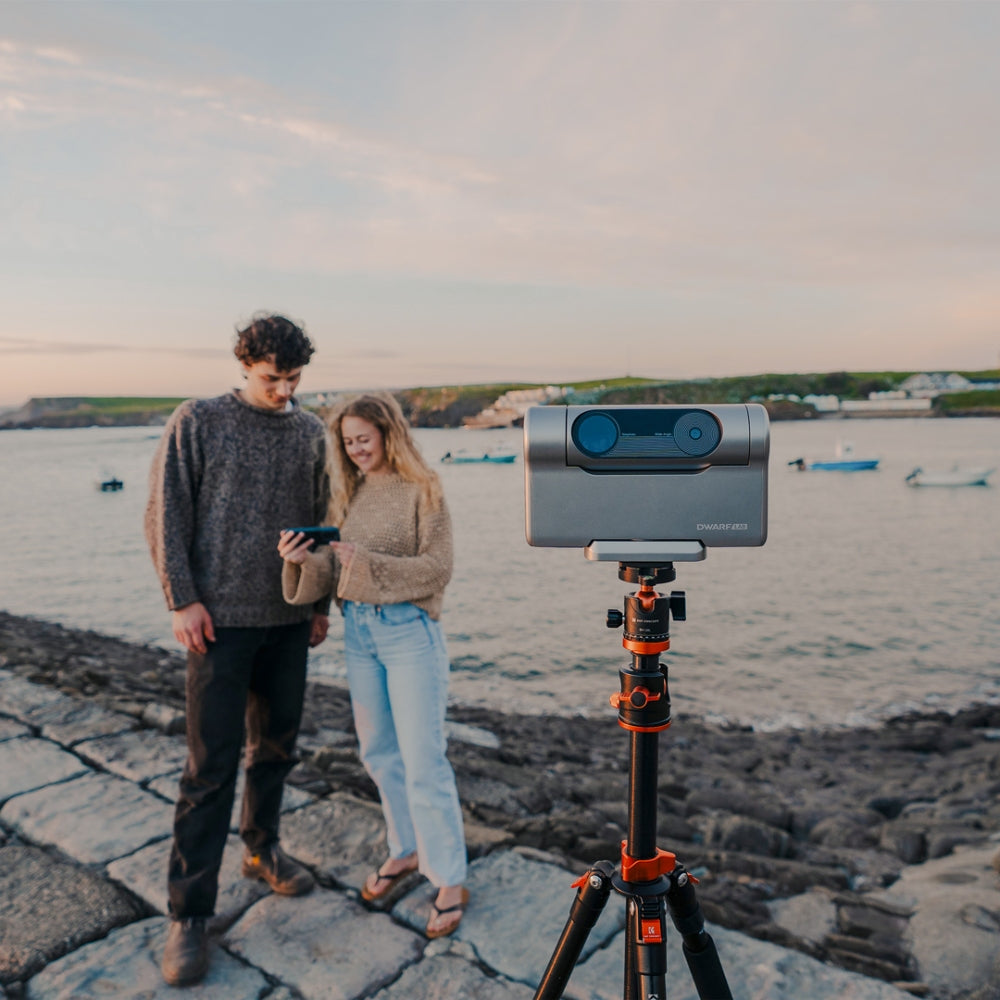
The DWARF 3 is the latest generation of the AI-powered smart telescope that brought astrophotography to beginners — and it's a meaningful upgrade from its predecessor. Improved optics, a higher-resolution sensor, and refined AI tracking make the DWARF 3 noticeably sharper and more capable for deep-sky imaging. Point the app at any object in the sky, let the telescope find and lock on, and watch it stack exposures automatically — delivering finished astrophotos in real time without any processing knowledge required.
Unlike traditional telescopes where astrophotography requires a separate camera, guiding system, laptop, and hours of post-processing, the DWARF 3 handles all of it automatically. For observers who want to see stunning images of nebulae, galaxies, and star clusters — not wrestle with equipment — this is the most direct path available at any price. The dual-camera design also makes it genuinely useful for daytime wildlife and landscape photography, giving it a second life outside of astronomy sessions.
What you'll capture and see
-
Deep-sky objects — the Orion Nebula, Andromeda Galaxy, Pleiades, globular clusters, and more; AI stacking builds the image automatically over 5–30 minutes
-
The Moon — high-resolution detail with the telephoto camera
-
Planets — Jupiter and Saturn visible as resolved discs with basic surface detail
-
Milky Way — wide-angle camera captures panoramic star field images
-
Terrestrial — wildlife, landscapes, and sports with the dual-camera system in daytime mode
What's in the box
- DWARF 3 Smart Telescope — improved dual-camera system, higher-resolution imaging sensor
- Tripod and mount
- DWARF Lab App — free for iOS and Android; AI-assisted target finding, auto-tracking, live stacking
| Specifications |
|---|
| Design |
AI smart telescope — auto-stacking, auto-tracking, app-controlled |
| Cameras |
Dual: improved telephoto for deep-sky, wide-angle for terrestrial/all-sky |
| Generation |
3rd generation — improved optics and sensor over DWARF II |
| App |
DWARF Lab — free iOS and Android |
| Best for |
Beginners who want astrophotos without the complexity of traditional imaging setups |
| SKU |
ES-DWARF3 |
Backed by Telescope Wolves' price match guarantee and free US shipping. Comparing the DWARF 3 to the DWARF II Deluxe, or to a traditional telescope? We'll help you choose the right tool for your goals.
Frequently asked questions
What's the upgrade from the DWARF II to the DWARF 3?
The DWARF 3 has improved optics, a higher-resolution imaging sensor, and refined AI tracking compared to the DWARF II. In practice, this means sharper images, better low-light sensitivity, and more accurate target acquisition. The DWARF II Deluxe bundle includes the solar filter and UHC filter that the DWARF 3 doesn't — so if solar observing or light-pollution filtering are priorities, consider whether those accessories factor into your decision.
How long does it take to get a good image of a nebula?
Most users see recognizable deep-sky images forming on screen within 5–15 minutes of starting a session. The AI stacks exposures continuously, so the image improves over time — a 30-minute session on the Orion Nebula will produce a noticeably better result than a 5-minute session. The practical setup process from app launch to first image is typically 10–15 minutes including object selection and alignment.
Can the DWARF 3 replace a traditional telescope with an eyepiece?
It's a different experience, not a direct replacement. The DWARF 3 shows you processed, stacked images on a phone or tablet screen — much like how a professional observatory shares images. A traditional telescope lets you look directly at the object through an eyepiece in real time. Many observers find the DWARF 3's images more impressive (deeper, sharper colors), while others prefer the immediacy of an eyepiece view. Some own both for different purposes.
Does it work from a light-polluted city?
Yes. The DWARF 3's AI stacking is particularly effective at pulling objects out of light-polluted skies. By combining many short exposures, it averages out the sky glow and reveals detail that would be invisible in a single frame. Dark-sky sites will always produce better results, but the DWARF 3 is one of the more capable tools for suburban astrophotography.
New to astronomy? Read our beginner's guide to choosing your first telescope or our Astronomy 101 guide to get started.
Watch it in action