The FirstLight 102mm refractor is a 4-inch achromatic telescope on the smooth-operating Twilight Nano alt-azimuth mount — a ready-to-use system that doesn't ask you to learn equatorial alignment before your first night out. The f/9.8 focal ratio delivers sharp, high-contrast views of the Moon, planets, and bright deep-sky objects, and the Twilight Nano's dual slow-motion controls mean you can track objects smoothly while looking through the eyepiece.
Unlike 60–80mm refractors that reach their magnification limits quickly, the 102mm aperture gives you genuine room to explore. Jupiter's cloud belts are distinct, Saturn's Cassini Division is visible on good nights, and the Orion Nebula shows real structural complexity. The long focal length (f/9.8) keeps chromatic aberration — the color fringing common in cheap refractors — well-controlled, so stars look like stars rather than colored blobs.
What you'll see
-
The Moon — craters, rilles, and mountain ranges in sharp high-contrast detail
-
Saturn's rings — Cassini Division visible on steady nights
-
Jupiter's cloud bands and the four Galilean moons
-
The Orion Nebula (M42) — glowing gas cloud with visible structural complexity
-
Open star clusters like the Pleiades — beautifully resolved in wide-field views
-
Globular clusters — partially resolved into individual stars at high magnification
What's in the box
- 102mm f/9.8 achromatic refractor OTA — fully coated optics
- Twilight Nano alt-azimuth mount — dual slow-motion controls, smooth tracking
- Full-size tripod with accessory tray
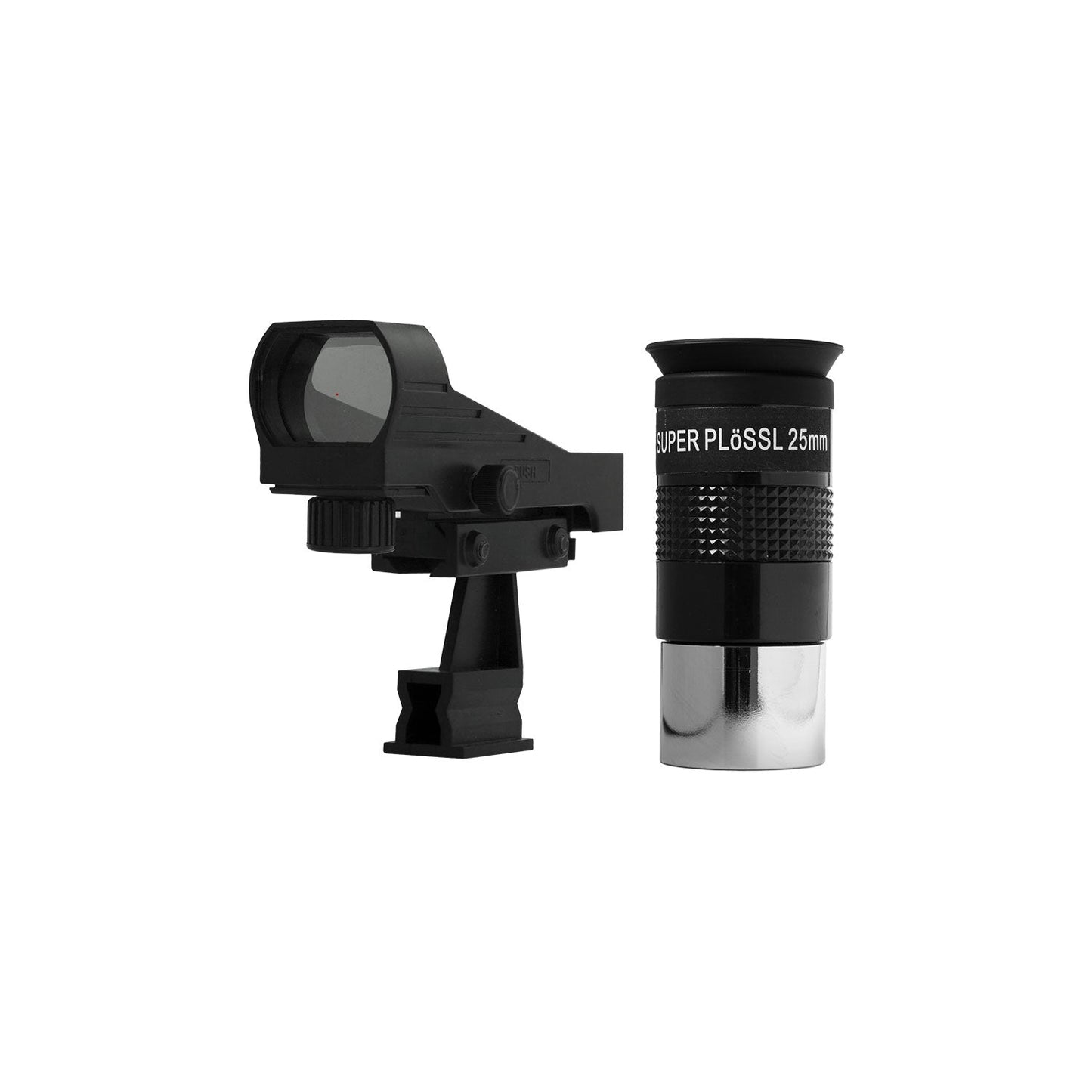
- Eyepiece(s)
- Red-dot finder
- Diagonal
| Specifications |
|---|
| Optical design |
Achromatic refractor |
| Aperture |
102 mm (4 inches) |
| Focal ratio |
f/9.8 — long focal length for high contrast, controlled color |
| Mount |
Twilight Nano alt-azimuth — smooth, lockable, dual slow-motion controls |
| Best for |
Moon, planets, bright deep-sky objects, visual observing |
| SKU |
FL-AR102600TN |
Backed by Telescope Wolves' price match guarantee and free US shipping. Questions about the Twilight Nano vs. other mounts? We'll walk you through the differences.
Frequently asked questions
Why choose an alt-azimuth mount for a beginner?
Alt-azimuth mounts move up-down and left-right — directions that match intuition. You point the telescope where you want to look, turn the slow-motion knobs to center the target, and start observing. No polar alignment, no counterweights, no jargon. For new stargazers who want to start looking at the sky the same night the telescope arrives, an alt-azimuth is the fastest path.
Why is f/9.8 better for visual observing than f/5 or f/6?
Longer focal ratio refractors produce less chromatic aberration (color fringing around bright objects) than faster ones. At f/9.8, the Moon and planets look sharp and contrasty without a distracting purple halo around them. The trade-off is a physically longer tube and narrower field of view — worth it for visual observers who prioritize clean, sharp planetary views.
Can I upgrade to an equatorial mount later?
Yes. The OTA (optical tube) is compatible with standard equatorial mounts using a Vixen-style dovetail plate. If you decide you want to track objects automatically or move toward astrophotography, you can add an EQ mount without replacing the telescope itself.
How does 102mm compare to 114mm reflectors at a similar price?
The 114mm reflector gathers slightly more light, making it better for faint deep-sky objects. The 102mm refractor delivers sharper, higher-contrast planetary views, requires no collimation, and is more durable in transit. Refractors are generally preferred for planets; reflectors for deep-sky objects. Both are excellent beginner scopes — the right choice depends on what you most want to observe.
New to astronomy? Read our beginner's guide to choosing your first telescope or our Astronomy 101 guide to get started.