The FirstLight 114mm is the telescope that changes the scale of what beginners expect to see. A 114mm parabolic mirror — that's 4.5 inches — gathers significantly more light than the 50mm or 70mm refractors most people start with, opening up the Orion Nebula, globular clusters, and the Andromeda Galaxy alongside sharper views of the Moon and planets. At $179, it's one of the most aperture-per-dollar options available for new stargazers.
Unlike beginners scopes with slow alt-azimuth knobs that frustrate more than they help, the Twilight Nano mount moves smoothly in both axes and locks where you point it. The fast f/4.3 focal ratio means wide, bright fields of view — great for sweeping through the Milky Way or framing large objects like star clusters and the Orion Nebula.
What you'll see
-
The Moon — craters, valleys, and mountain ranges in rich high-contrast detail
-
Saturn's rings — the Cassini Division visible on steady nights
-
Jupiter's cloud bands — distinct equatorial belts and the four Galilean moons
-
The Orion Nebula (M42) — a glowing cloud of star-forming gas, visible from suburbs
-
Globular clusters like M13 — a ball of hundreds of thousands of stars, resolving at the edges
-
The Andromeda Galaxy — a soft elongated glow, visible with the naked eye in dark skies
What's in the box
- 114mm f/4.3 parabolic Newtonian reflector OTA — fully coated mirrors
- Twilight Nano alt-azimuth mount — smooth manual movement, locks in position
- Full-size tripod with accessory tray
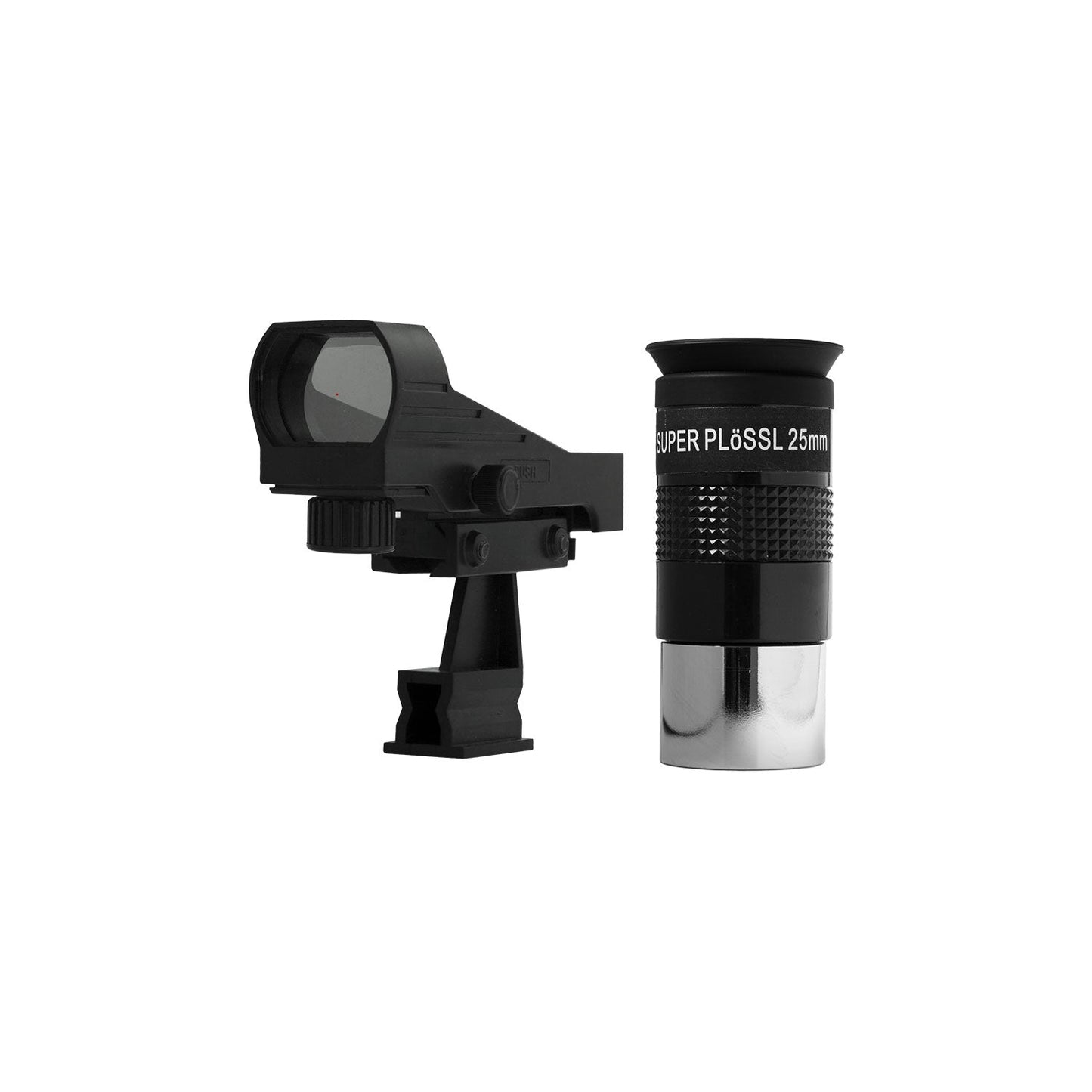
- 25mm Plössl eyepiece (20×) — good wide-field starting point
- Red-dot finder — for quick target acquisition
- Smartphone adapter — for through-the-eyepiece photography
- Downloadable astronomy software
| Specifications |
|---|
| Optical design |
Parabolic Newtonian reflector |
| Aperture |
114 mm (4.5 inches) |
| Focal length |
500 mm (f/4.3) |
| Magnification (included eyepiece) |
20× with 25mm Plössl |
| Mount |
Twilight Nano alt-azimuth — smooth, lockable |
| SKU |
FL-N114500TN |
Backed by Telescope Wolves' price match guarantee and free US shipping. Questions about reflectors vs. refractors? We're happy to help you choose.
Frequently asked questions
Why choose a 114mm reflector over a smaller refractor?
Aperture is the most important factor in what a telescope can show you. A 114mm mirror collects about five times more light than a 50mm lens. That difference means the Orion Nebula transforms from a faint smudge into a glowing cloud with visible structure, and faint star clusters become fields of distinct stars rather than a blur. At the same price, a reflector simply shows more sky.
What is a parabolic mirror and why does it matter?
Cheap reflectors use spherical mirrors that produce slightly blurry stars at the edge of the field. Parabolic mirrors are precisely shaped to bring all light to a single sharp focus — the FirstLight 114mm uses a fully parabolic primary, which is uncommon in this price range and means genuinely sharp star images across the field of view.
Does a reflector need more maintenance than a refractor?
Occasionally, yes. Reflectors have a secondary mirror that can drift out of alignment (called collimation) over time. Checking and correcting collimation takes about five minutes with a simple tool once you know how, and the FirstLight's design makes this straightforward. Most beginners only need to collimate a few times per year.
What eyepieces should I add first?
The included 25mm Plössl gives a nice wide view. Adding a 10mm Plössl (~50×) gives better planetary detail, and a 6mm (~83×) works well for the Moon's craters and Saturn. A 2× Barlow doubles any eyepiece's magnification and is one of the most cost-effective first accessories.
New to astronomy? Read our beginner's guide to choosing your first telescope or our Astronomy 101 guide to get started.
Watch it in action