Five inches of aperture at f/14.96, 1900mm focal length, and a Maksutov-Cassegrain optical design built specifically for high-power planetary and lunar work — all on the Twilight I alt-az mount with a complete beginner kit included. The Explore Scientific FirstLight 127mm Mak-Cass (FL-MC1271900MAZ01) is a closed-tube, low-maintenance telescope that delivers exceptional views of the planets and Moon without any of the collimation hassle of a reflector. If Saturn, Jupiter, Mars, and the Moon are your primary targets, this is the telescope designed for exactly that.
Unlike refractors and reflectors at this price
The Maksutov-Cassegrain design folds 1900mm of focal length into a compact, sealed tube. A Newtonian reflector with equivalent focal length would be over 7 feet long and require regular collimation. A refractor at 1900mm would cost several times more and still produce some chromatic aberration. The Mak-Cass does none of those things: the sealed corrector plate keeps dust out and collimation stable, the folded optics keep the tube compact, and the all-mirror design is inherently free of chromatic aberration. At this price point, no other design delivers this combination of high focal length, aperture, and low maintenance.
What you'll see
The 127mm Mak-Cass at high power is stunning on solar system targets. Jupiter shows the Great Red Spot, multiple cloud belts, and festoons on good nights. Saturn's Cassini Division is wide and obvious; the Crepe Ring and shadow detail on the planet's disc are visible at 150–200×. The Moon is a lifetime of exploration — craterlets within craters, mountain ranges, rilles, and dome fields in fine detail. Mars during opposition shows the polar ice caps and surface albedo markings. On the deep sky, this scope excels at compact objects — tight globular clusters, planetary nebulae, and double stars resolve crisply at the focal lengths this design commands.
What's in the box
- 127mm f/14.96 Maksutov-Cassegrain OTA
- Twilight I alt-az mount with slow-motion controls
- Steel tripod with accessory tray
- 2-inch diagonal and 1.25-inch adapter
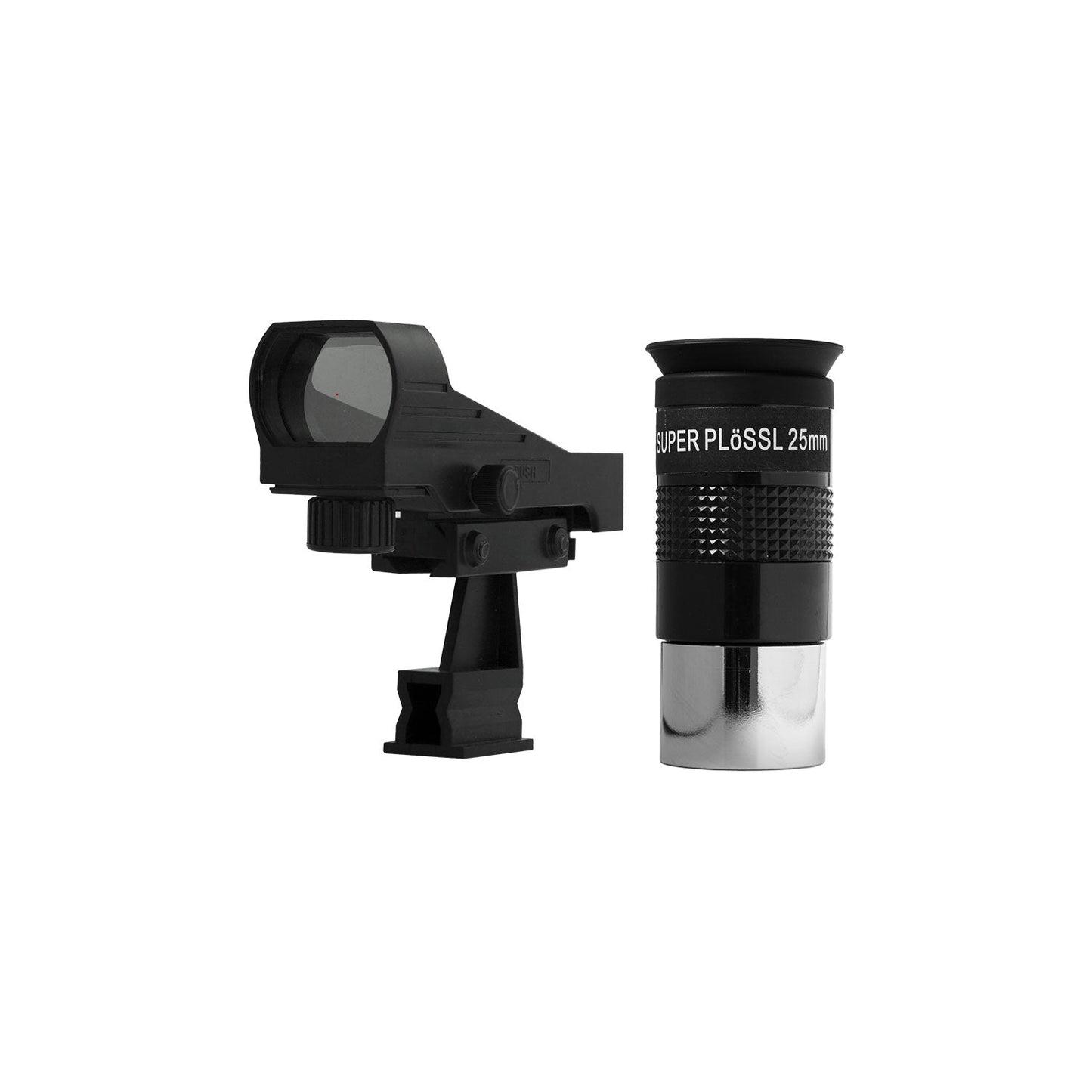
- Two 1.25-inch eyepieces (wide-field and high-power)
- Red dot finderscope
| Spec |
Value |
| SKU |
FL-MC1271900MAZ01 |
| Optical Design |
Maksutov-Cassegrain |
| Aperture |
127mm (5 inches) |
| Focal Length |
1900mm |
| Focal Ratio |
f/14.96 |
| Mount Type |
Twilight I Alt-Az with slow-motion controls |
Price Match, Shipping & Questions
We price-match any authorized Canadian or US retailer. Ships free to the contiguous US. Questions? Email us at support@telescopewolves.com or visit our contact page.
Frequently Asked Questions
Is the Twilight I mount sturdy enough for the 127mm Mak-Cass at high magnification?
The Twilight I is a solid manual alt-az with slow-motion controls on both axes. For visual planetary viewing at 150–250×, the vibration damping and slow-motion controls are adequate for comfortable observation. It won't match a heavy-duty equatorial mount for long-exposure tracking, but for visual high-power work, it's the right pairing.
How does this compare to the 127mm achromatic refractor sold here?
They're fundamentally different instruments for different purposes. The 127mm refractor at f/9.4 is more versatile — better wide-field performance and a more usable focal ratio for a range of targets. The 127mm Mak-Cass at f/14.96 is optimized specifically for high-power planetary and lunar work. The Mak-Cass also wins on tube length (compact vs. a long refractor tube). Choose the refractor for all-around observing; choose the Mak-Cass if planets and the Moon are your primary focus.
Does the Maksutov-Cassegrain need collimation?
Rarely. The sealed corrector plate design keeps the optical alignment stable indefinitely under normal use — unlike Newtonian reflectors, which need collimation regularly. If the scope is dropped or shipped roughly, realignment may be needed, but for routine observation sessions it's a set-and-forget design.
Is it usable for astrophotography?
At f/14.96, it's a narrow-field imaging scope. It can capture excellent planetary images with a webcam-style camera. For deep-sky imaging, the very narrow field and slow focal ratio require long exposures with a tracking mount — the Twilight I alt-az is not tracking-capable. If deep-sky imaging is your goal, a different optical design and equatorial mount combination is more appropriate.
New to telescopes?
Our beginner guides walk you through everything — from setting up your first scope to finding objects in the night sky.
Watch it in action