The FirstLight 127mm Maksutov-Cassegrain is the most powerful planetary telescope in the FirstLight beginner lineup — a 5-inch sealed catadioptric scope with a 1900mm focal length (f/15) that delivers high-magnification views of the Moon and planets that most beginner scopes simply can't match. Saturn's rings are sharp and detailed, Jupiter's cloud belts are distinct, and the Moon reveals extraordinary crater and rille complexity. The Twilight Nano alt-azimuth mount keeps setup simple — no polar alignment required, just point and observe.
Unlike smaller 100mm Maks where you're at the edge of the telescope's high-magnification comfort zone, the 127mm gives you genuine headroom. At 190–250×, the image stays crisp and bright on good nights. The sealed tube requires no collimation and virtually no maintenance — the optics stay aligned through transport, temperature changes, and months of storage without intervention.
What you'll see
-
Saturn's rings and Cassini Division — sharp, finely detailed; cloud belts on excellent nights
-
Jupiter's cloud structure — multiple bands, the Great Red Spot, and festoons visible under good seeing
-
The Moon — extraordinary crater and rille detail at 150–200×; a landscape you can explore for hours
-
Mars — polar ice cap and dark surface markings at opposition
-
Venus phases — the illuminated crescent in sharp silhouette
-
Double stars — tight pairs cleanly resolved at high magnification
What's in the box
- 127mm f/15 Maksutov-Cassegrain OTA — sealed tube, no collimation ever required
- Twilight Nano alt-azimuth mount — smooth, lockable slow-motion controls
- Full-size tripod
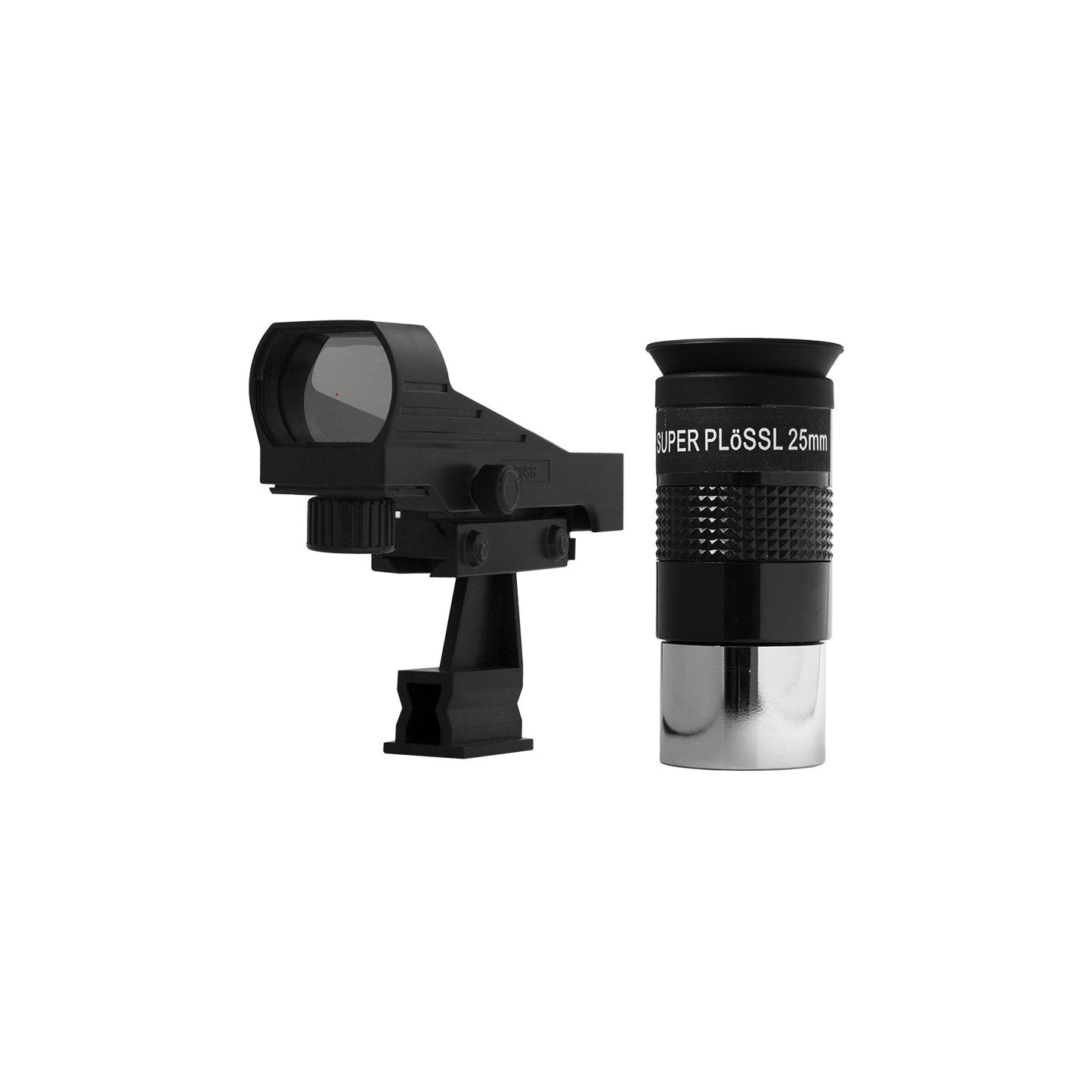
- Eyepiece(s)
- Red-dot finder
- Diagonal
| Specifications |
| Optical design |
Maksutov-Cassegrain (sealed tube, no collimation) |
| Aperture |
127 mm (5 inches) |
| Focal length |
1900 mm (f/15) |
| Mount |
Twilight Nano alt-azimuth — smooth, lockable, no polar alignment needed |
| Best for |
Planets, Moon, double stars — top planetary performer in the FirstLight range |
| SKU |
FL-MC1271900TN |
Backed by Telescope Wolves' price match guarantee and free US shipping. Comparing the 127mm Mak to the 100mm Mak or a 130mm Newtonian? We'll help you find the right scope for your goals.
Frequently asked questions
What makes the 127mm Mak better for planets than the 100mm or 114mm alternatives?
Both aperture and focal length matter for planetary observing. The 127mm Mak has 60% more light-gathering than a 100mm scope, and the 1900mm focal length naturally produces high magnification without pushing the optics beyond their comfort zone. At f/15, you're operating in the regime where the optics are sharpest. The 127mm is the step where planetary observing genuinely starts to reveal fine detail — cloud belts on Saturn, storm features on Jupiter — rather than just resolving the disk and rings.
Why use an alt-azimuth mount on a scope this powerful?
The Twilight Nano alt-azimuth is simple, lightweight, and well-suited for visual planetary observing where sessions are focused on a few targets rather than scanning wide fields. At high magnification, you'll need to re-center objects more frequently than on an equatorial mount, but the two-knob alt-az controls are intuitive and fast. If you want hands-free tracking, the EQ version of this scope or a motor-drive-equipped equatorial mount is the next step.
How does the Mak compare to a 130mm Newtonian for planets?
The 127mm Mak wins on planetary contrast and convenience. The sealed tube eliminates internal air currents that slightly degrade contrast in open Newtonian tubes. The 1900mm focal length means high magnification comes naturally. The 130mm Newtonian is better for deep-sky objects — wider field, faster focal ratio, more light for faint objects. If you're primarily a planet observer, choose the Mak. If you want more versatility across planet and deep-sky targets, consider the Newtonian.
Does the 127mm Mak need any maintenance?
Virtually none. The corrector plate at the front of the tube keeps dust and moisture away from the primary mirror, collimation never shifts, and there are no mirrors to clean under normal use. The practical advantage over a Newtonian is that the 127mm Mak is essentially set-and-forget — the only regular action is wiping the corrector plate with a lint-free cloth if dust accumulates visibly.
New to astronomy? Read our beginner's guide to choosing your first telescope or our Astronomy 101 guide to get started.
Watch it in action