Six inches of aperture in a sealed, compact Maksutov-Cassegrain tube — the Explore Scientific FirstLight 152mm Mak-Cass (FL-MC1521900MAZ01) is the largest-aperture telescope in the FirstLight lineup and one of the most powerful visual instruments you can buy in this price range for planetary and lunar observation. The 152mm primary mirror collects 44% more light than the 127mm Mak-Cass, and the 1900mm focal length (f/12.5) keeps the image scale high for detailed planetary work, all in a tube small enough to carry in one arm.
Unlike the 127mm Mak-Cass
The 127mm Mak-Cass is a superb planetary scope — but aperture always matters. The 152mm primary has 44% more mirror area than the 127mm, which means brighter images at equivalent magnifications and the ability to resolve finer planetary detail. On nights of steady seeing, the 152mm shows Jupiter's equatorial jet streams, Jovian moon disc detail at high power, and Saturn's atmospheric color gradients that the 127mm hints at. For globular clusters and compact deep-sky objects that this focal length excels at, the 152mm's extra aperture is consistently rewarding. The trade-off is size and weight — the 152mm Mak-Cass is heavier and requires a more robust mount than the 127mm.
What you'll see
On planets, the 152mm at 1900mm focal length operates at a sweet spot where a 10mm eyepiece gives 190× and a 6mm gives 316×. Jupiter fills the field with cloud belt structure — the equatorial belts, temperate belts, festoons, and Great Red Spot in detail that requires patience and good seeing to fully appreciate. Saturn shows the Cassini Division cleanly, the Crepe Ring, and sometimes hints of the Encke Minima in the A ring. The Moon is a lifetime of exploration — a 10mm eyepiece shows 4km-scale features across the entire disc. On deep sky, compact globulars and planetary nebulae benefit from the focal length: M57 (Ring Nebula), M27 (Dumbbell), and NGC 7293 (Helix Nebula) show internal structure clearly.
What's in the box
- 152mm f/12.5 Maksutov-Cassegrain OTA
- Twilight I alt-az mount with slow-motion controls
- Steel tripod with accessory tray
- 2.5-inch hex focuser
- 2-inch diagonal and 1.25-inch adapter
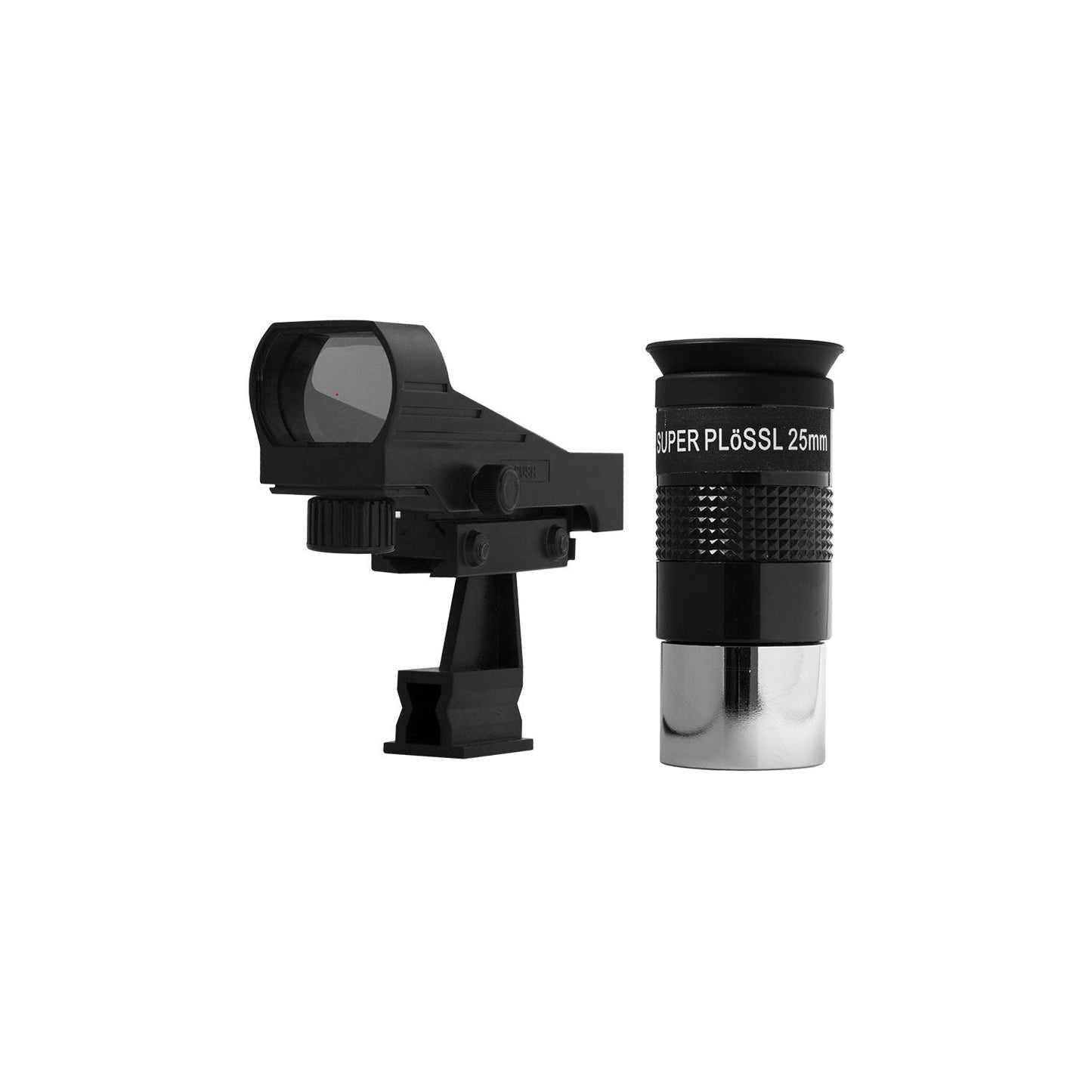
- 25mm Plössl eyepiece
- Red dot finderscope
| Spec |
Value |
| SKU |
FL-MC1521900MAZ01 |
| Optical Design |
Maksutov-Cassegrain |
| Aperture |
152mm (6 inches) |
| Focal Length |
1900mm |
| Focal Ratio |
f/12.5 |
| Focuser |
2.5-inch hex-style |
| Mount Type |
Twilight I Alt-Az with slow-motion controls |
Price Match, Shipping & Questions
We price-match any authorized Canadian or US retailer. Ships free to the contiguous US. Questions? Email us at support@telescopewolves.com or visit our contact page.
Frequently Asked Questions
Is the Twilight I mount adequate for the 152mm Mak-Cass?
The Twilight I is Explore Scientific's robust manual alt-az with altitude and azimuth slow-motion controls. The 152mm Mak-Cass is compact and well-balanced, making it a good match for the Twilight I at visual magnifications. Vibration settles quickly and the slow-motion controls allow precise tracking. For sustained high-power planetary sessions, upgrading to a heavier equatorial or motorized mount is a worthwhile eventual investment.
Does the Mak-Cass need collimation?
Rarely. The corrector plate design stabilizes collimation indefinitely under normal use. Unlike a Newtonian reflector, there are no exposed mirrors to drift out of alignment. The sealed tube also protects the optics from dust and atmospheric contamination. Cool-down time of 20–30 minutes before observing is recommended for thermal equilibrium.
How does this compare to a 6-inch Newtonian Dobsonian at similar aperture?
A 6-inch Dob at f/8 gives 1200mm focal length and a much larger physical tube. The 152mm Mak-Cass folds 1900mm into a compact sealed tube — significantly less bulk with more focal length. The trade-off is the central obstruction from the Mak's secondary, which slightly reduces contrast on very low-contrast extended objects compared to a well-collimated Newtonian. For planetary and lunar work, the Mak's longer effective focal length and sealed design give it a practical edge.
Can I add a GoTo mount later?
Yes. The OTA can be removed from the Twilight I and mounted on any compatible equatorial or alt-az with GoTo capability. The Vixen-style or compatible dovetail interface means the OTA is fully portable to upgrade mounts as your requirements grow.
New to telescopes?
Our beginner guides walk you through everything — from setting up your first scope to finding objects in the night sky.