The FirstLight 80mm on the Twilight Nano EQ3 equatorial mount is a complete refractor system for beginners who want the combination of a sharp, maintenance-free optical tube and a mount that tracks the sky. The 80mm f/11.25 achromatic refractor delivers crisp, high-contrast views of the Moon and planets — no mirror collimation, no cool-down time, sharp from the first look. The Twilight Nano EQ3 adds equatorial tracking, so objects stay centered as Earth rotates without constant two-handed re-centering.
Unlike basic alt-azimuth refractors, the EQ3 mount is a foundation for growth: add a motor drive for automatic tracking, connect a camera for lunar and planetary photography, or use it to learn the equatorial coordinate system that professional and advanced amateur astronomers use. This is a refractor that works for a beginner on night one and stays useful as your astronomy knowledge deepens.
What you'll see
-
The Moon — sharp, high-contrast crater and mountain detail; the terminator in brilliant relief
-
Saturn's rings — clearly separated; Cassini Division on steady nights
-
Jupiter — cloud bands and the four Galilean moons shifting position night to night
-
The Orion Nebula (M42) — glowing gas cloud with visible structure
-
Open clusters — the Pleiades and similar clusters beautifully resolved in wide-field views
-
Double stars — cleanly split at moderate magnification
What's in the box
- 80mm f/11.25 achromatic refractor OTA — fully coated optics, no collimation needed
- Twilight Nano EQ3 German equatorial mount — slow-motion controls on both axes
- Full-size tripod
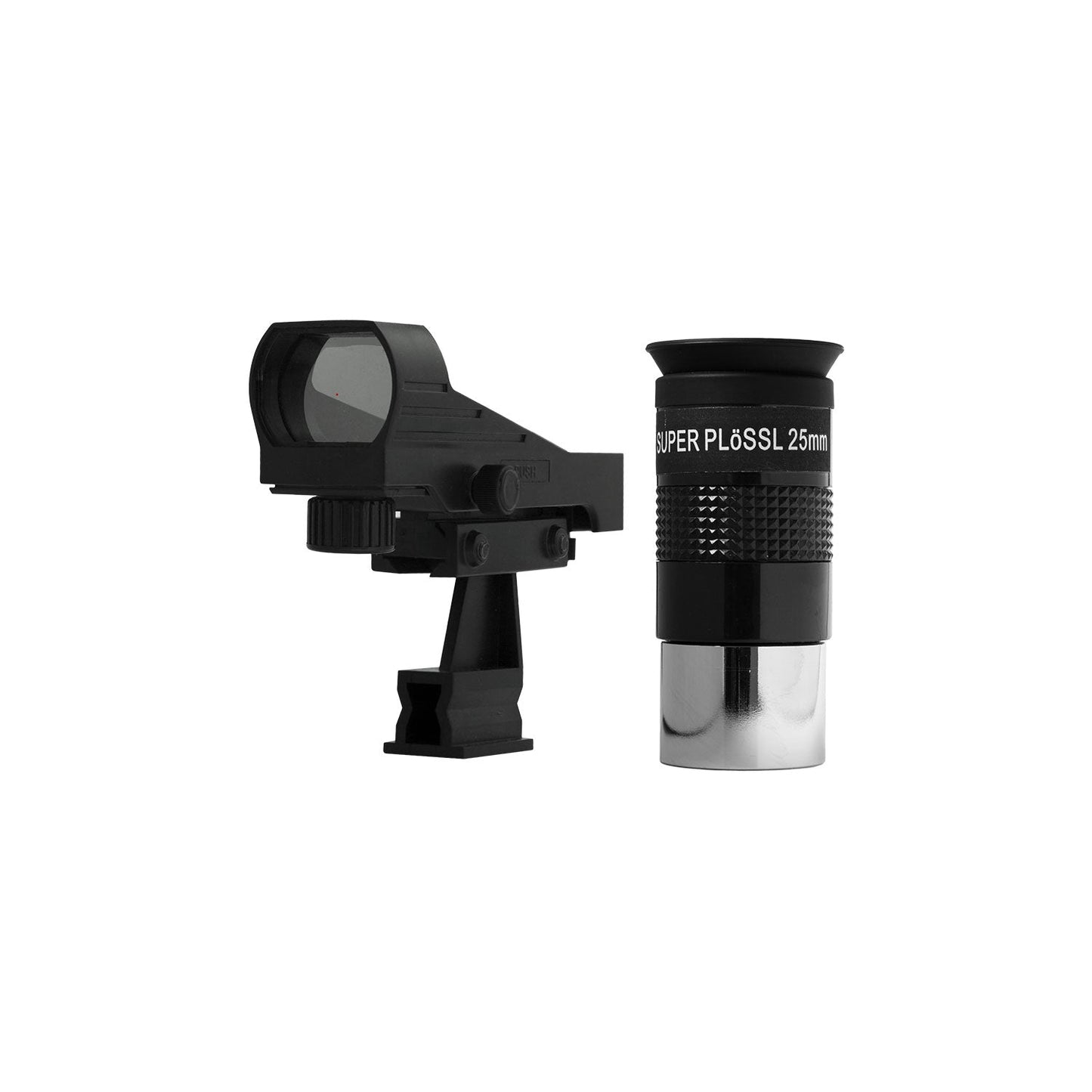
- Eyepiece(s)
- Red-dot finder
- Diagonal
| Specifications |
| Optical design |
Achromatic refractor — no collimation required |
| Aperture |
80 mm (3.1 inches) |
| Focal length |
900 mm (f/11.25) |
| Mount |
Twilight Nano EQ3 German equatorial — slow-motion controls, motor-drive compatible |
| Best for |
Moon, planets, clusters — sharp views, simple maintenance, equatorial learning |
| SKU |
FL-AR80900EQ3 |
Backed by Telescope Wolves' price match guarantee and free US shipping. Comparing this to the 100mm Mak EQ3? We can explain the trade-offs based on your interests.
Frequently asked questions
Why choose an 80mm refractor over the 100mm Mak at a similar price?
This is a real choice worth thinking through. The 100mm Mak has more aperture and excels at planets. The 80mm refractor has a wider field of view, is lighter and more portable, shows a brighter image at lower magnifications (better for open clusters and the Milky Way), and has absolutely no maintenance requirements. If your main interests are planets and the Moon exclusively, the Mak is the better optical choice. If you want versatility — planets AND clusters AND wide-field views — the refractor is worth considering.
What is f/11.25 good for?
A long focal ratio like f/11.25 means high contrast and minimal chromatic aberration (color fringing). Stars look like sharp points rather than colored dots, and planetary views have excellent contrast. The trade-off is a narrower field of view at a given eyepiece — not ideal for large nebulae, but perfect for the Moon, planets, and tight star clusters.
Is the Twilight Nano EQ3 easy to learn?
Yes, particularly if you're patient with the first session. Polar alignment (pointing the mount's axis toward Polaris) takes 2–5 minutes once you've done it once. After that, a single slow-motion knob in the RA axis keeps objects centered as Earth rotates. Most beginners feel comfortable with the EQ3 after two or three outings.
Can I use this for astrophotography?
The 80mm f/11.25 refractor works well for lunar and bright planetary imaging with a smartphone adapter or DSLR. For long-exposure deep-sky astrophotography, f/11.25 is on the slow side and you'd want to add a motor drive for tracking. The EQ3 mount is motor-drive compatible, making this a viable first step into astrophotography without needing to buy a completely new rig.
New to astronomy? Read our beginner's guide to choosing your first telescope or our Astronomy 101 guide to get started.