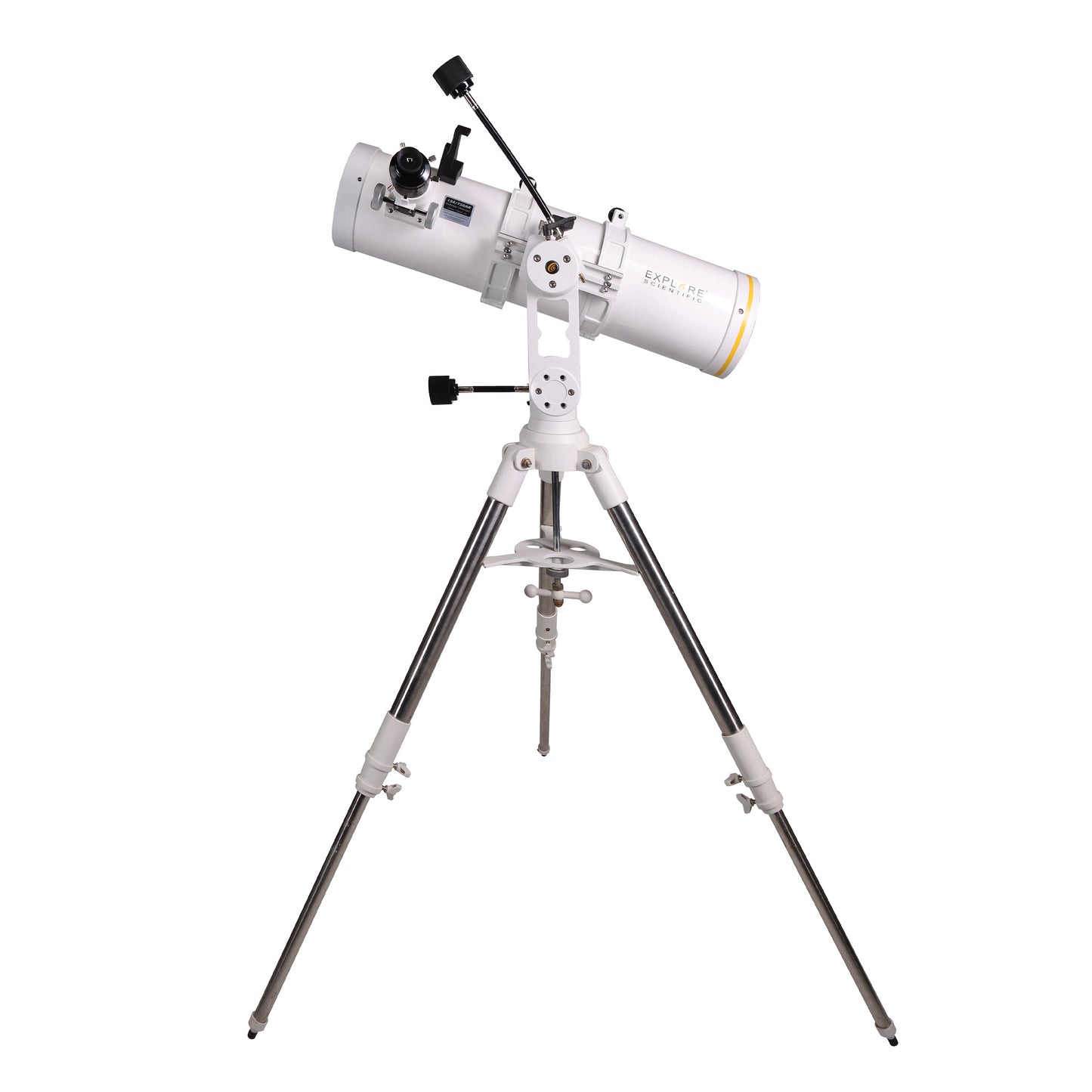
More aperture is the most reliable upgrade in astronomy. The Explore Scientific Sidara Plus 150mm Newtonian Reflector (ES-N150750-MAZ01) gives you 150mm of light-gathering mirror — 33% more collecting area than a 130mm scope — paired with the SkyAssist alt-azimuth mount that guides you to any object using your phone. It's the biggest beginner reflector in the SkyAssist lineup, and the combination of aperture and app-guided pointing makes it the most capable for new observers who want to see more from the start.
Unlike the 130mm SkyAssist reflector
The Sidara 130mm SkyAssist is a strong beginner scope. The 150mm adds a meaningful step up in what you can see: galaxies brighten, globular clusters resolve closer to their cores, and nebulae show more structure. The SkyAssist pointing system is identical — the same app, the same workflow. What changes is how much reward you get at the eyepiece once you arrive at your target.
What you'll see
Jupiter shows distinct color banding across multiple cloud zones; the Great Red Spot is consistently visible on clear nights. Saturn's rings are crisp, the Cassini Division easy, and Titan plus several fainter moons are visible simultaneously. The Andromeda Galaxy spans a wide field with the core clearly brighter than the disk. Globular clusters like M5 and M13 resolve into stellar points from the edges inward. Planetary nebulae — the Ring Nebula, the Dumbbell — show disc shape and color. At dark sites, the Virgo Cluster galaxies become a rich field of distinct objects rather than a smear of faint light.
What's in the box
- 150mm (6-inch) f/5 Newtonian reflector OTA
- SkyAssist alt-azimuth mount (app-guided, manual motion)
- Tripod
- Eyepiece
- Accessories
| Spec |
Value |
| SKU |
ES-N150750-MAZ01 |
| Optical Design |
Newtonian Reflector |
| Aperture |
150mm (6 inches) |
| Focal Length |
750mm |
| Focal Ratio |
f/5 |
| Mount Type |
SkyAssist Alt-Azimuth (app-guided, manual) |
Price Match, Shipping & Questions
We price-match any authorized Canadian or US retailer. Ships free to the contiguous US. Questions? Email us at support@telescopewolves.com or visit our contact page.
Frequently Asked Questions
How does the SkyAssist app guidance work?
The SkyAssist app uses your phone's GPS, compass, and gyroscope to display pointing arrows that guide you to any object in its database. You push the scope by hand following the on-screen arrows until the target is centered. It's faster than star-hopping for beginners and requires no polar alignment or motor calibration.
Is 150mm significantly better than 130mm?
Yes — 150mm has 33% more aperture by diameter, which translates to about 77% more light-collecting area (area scales with the square of diameter). At the eyepiece, this means consistently brighter images and noticeably more detail on objects that were borderline with a 130mm. The step-up is real and visible.
Does a 6-inch Newtonian need collimation?
Periodically, yes. Newtonian reflectors need occasional mirror alignment to maintain peak sharpness. Most scopes ship collimated; collimation takes 5–10 minutes with an inexpensive collimation cap or laser collimator. Our beginner guides walk through the process.
Can I use this for astrophotography?
Smartphone eyepiece photography works well for the Moon and bright planets. Long-exposure deep-sky imaging needs an equatorial tracking mount. The SkyAssist mount is alt-azimuth and manual, so it's optimized for visual use — the 150mm aperture delivers excellent views that make visual observing deeply satisfying without photography.
New to telescopes?
Our beginner guides walk you through everything — from setting up your first scope to finding objects in the night sky.