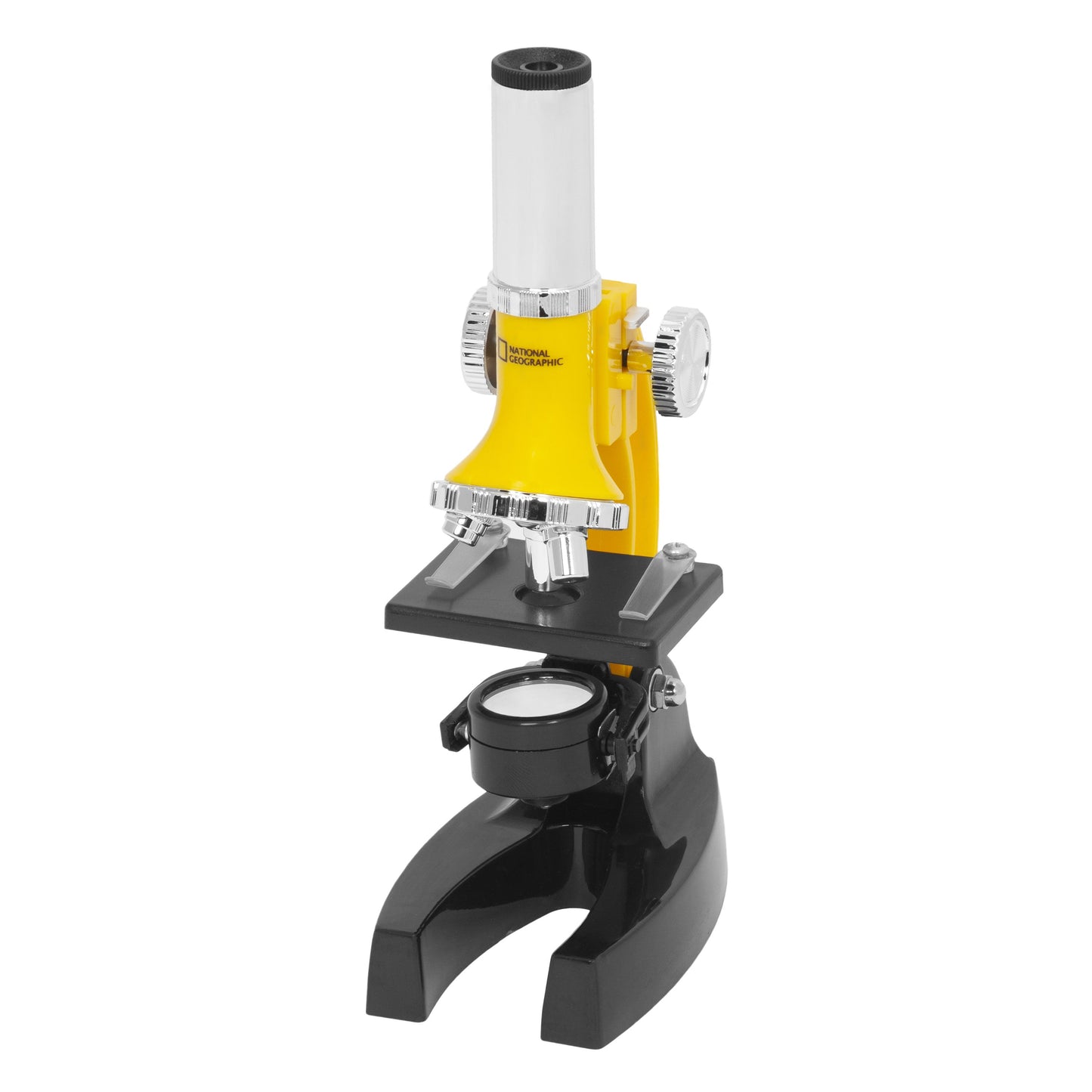
Some kids want to look up. Some want to look down. The National Geographic 40mm Telescope & 900x Microscope Discovery Set covers both — a refractor telescope for the night sky and a three-power microscope for everything too small to see with the naked eye, secured together in a durable carrying case for easy transport between backyards, classrooms, and kitchens.
Unlike buying either instrument separately, this all-in-one kit lets a curious kid (or adult) explore the full range of the observable world for the price of a single beginner telescope. The telescope shows lunar craters, planetary detail, and star clusters; the microscope reveals pond water microorganisms, plant cells, and fine biological structures at up to 900×. Prepared slides, collection tools, and a star map are included so you can start exploring both directions immediately — no additional purchases required.
What you'll see
-
The Moon — craters, lunar mare, and mountain ranges through the telescope
-
Planets — Saturn's rings and Jupiter's moons on clear nights
-
Cells and microorganisms — bacteria, pond water life, and plant cells through the microscope at up to 900×
-
Prepared specimens — the included slides give you something to look at immediately without collecting samples
What's in the box
- 40mm refractor telescope with tabletop tripod
- Two interchangeable telescope eyepieces with eyepiece diagonal
- Star map and downloadable astronomy software
- 900x microscope with three magnification levels (100×, 450×, 900×)
- Color filter wheel for microscope
- Prepared slides, blank slides, and specimen collection tools
- Durable carrying case
| Specifications — Telescope |
| Optical design |
Achromatic refractor |
| Aperture |
40 mm |
| Focal length |
400 mm |
| Mount |
Tabletop tripod |
| Model |
80-20104 |
| Specifications — Microscope |
| Magnification range |
100×, 450×, 900× |
| Color filter wheel |
Included |
| Slides |
Prepared and blank included |
Backed by Telescope Wolves' price match guarantee and free US shipping. Not sure if this is the right telescope for you? Our team is happy to help — contact us anytime.
Frequently asked questions
Is 40mm enough aperture to see anything interesting?
Yes — a 40mm telescope will clearly show the Moon's craters, Saturn's rings at suitable magnification, and Jupiter's Galilean moons. It's the minimum aperture we'd recommend for genuine astronomical views, and this set delivers them. The tradeoff compared to a 50mm or 70mm scope is a slightly dimmer image, which is most noticeable on faint deep-sky objects.
What can the 900x microscope realistically see?
At 100× you can see large cells, plant tissue cross-sections, and the structure of small insects clearly. At 450×, individual cell nuclei and bacteria become visible. At 900× you're at the limit of compound light microscopy — fine cellular detail and the largest bacteria are resolvable. For a beginner, these three levels cover a huge range of interesting specimens.
What do the prepared slides show?
Typical prepared slide sets include specimens like plant cells (onion skin, leaf cross-section), small invertebrates or their parts, and biological cross-sections. They give you something to look at and learn from immediately without needing to collect and prepare your own samples.
Is this set good for school science projects?
Yes — it's well suited for elementary and middle school science projects, especially anything involving cells, specimens, or nature observation. The color filter wheel and prepared slides give young scientists enough depth to explore beyond just looking at pre-prepared samples.
New to astronomy? Read our beginner's guide to choosing your first telescope or our Astronomy 101 guide to get started.
Watch it in action