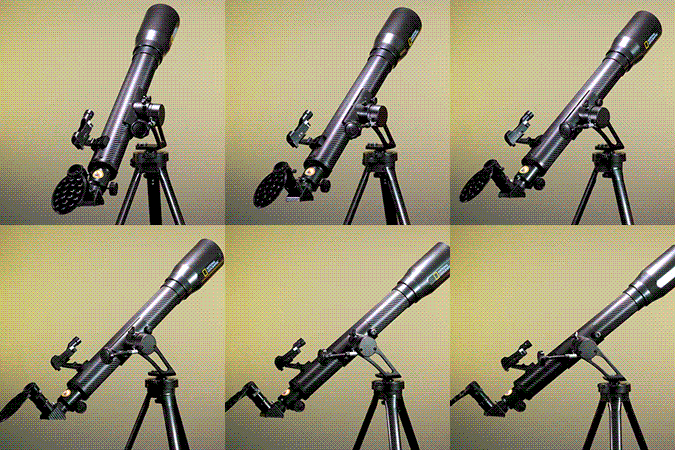
The National Geographic CF700SM is what happens when you take a capable 70mm refractor and give it everything a beginner actually needs: premium Plössl eyepieces, a 2× Barlow, slow-motion tracking controls, a smartphone adapter, and a carbon fiber-style finish that looks as sharp as it performs.
Unlike basic beginner scopes that ship with low-quality Huygens eyepieces, the CF700SM includes Plössl eyepieces — the same design used by serious amateur astronomers — giving noticeably crisper, cleaner views right out of the box. The 700mm focal length (f/10) is ideal for planets and the Moon, and the slow-motion alt-azimuth controls let you track targets smoothly rather than fighting the scope every time something drifts out of view. At 26.9× through 144×, it covers the full range from low-power sky surveys to detailed close-up planetary work.
What you'll see
-
The Moon — individual craters, mountain ranges, and the Apennine highlands in sharp relief
-
Jupiter — cloud bands, the Great Red Spot (when facing Earth), and all four Galilean moons
-
Saturn — rings and the Cassini Division clearly visible; Titan detectable
-
Deep-sky objects — the Orion Nebula, Beehive Cluster, and double stars in excellent contrast
What's in the box
- National Geographic CF700SM 70mm refractor telescope (carbon fiber-style tube)
- Two Plössl eyepieces
- 2× Barlow lens
- Alt-azimuth mount with slow-motion controls
- Full-size adjustable tripod
- Red dot finder
- Smartphone adapter
- Downloadable astronomy software
| Specifications |
| Model |
CF700SM / 80-40070 |
| Optical design |
Refractor |
| Aperture |
70 mm |
| Focal length |
700 mm (f/10) |
| Magnification range |
26.9× – 144× |
| Eyepieces |
Two Plössl eyepieces |
| Barlow lens |
2× |
| Mount type |
Alt-azimuth with slow-motion controls |
| Finder |
Red dot finder |
| Smartphone adapter |
Included |
Backed by Telescope Wolves' price match guarantee and free US shipping. Not sure if this is the right telescope for you? Our team is happy to help — contact us anytime.
Frequently asked questions
What's the difference between Plössl eyepieces and cheaper Huygens eyepieces?
Plössl eyepieces have a 4-element design that delivers sharper, more contrasty views with a wider apparent field than the 2-element Huygens/Ramsden eyepieces included with many budget scopes. Once you've looked through a Plössl, you'll notice the difference immediately — especially at the edge of the field.
What do slow-motion controls do?
Slow-motion controls let you make fine adjustments to the telescope's position, so you can track a celestial object as it drifts across the field without physically pushing the tube. It's a significant quality-of-life improvement for longer observing sessions.
Is 700mm focal length good for beginners?
Yes — a 700mm focal length with a 70mm aperture gives you f/10, which is excellent for high-power planetary and lunar work. The longer focal length means you'll get more magnification for a given eyepiece, making it great for beginners who want detailed planetary views.
Can I use the smartphone adapter for astrophotography?
Yes. The included adapter mounts your phone over the eyepiece for afocal photography. Moon shots come out very well; planet photos are possible with patience. For serious deep-sky astrophotography you'd want a dedicated camera, but this is a great way to start.
New to astronomy? Read our beginner's guide to choosing your first telescope or our Astronomy 101 guide to get started.
Watch it in action