The National Geographic NG114mm is a 114mm Newtonian reflector on a German equatorial mount — the setup that turns beginner stargazing into a real hobby. The 114mm mirror collects enough light to show the Orion Nebula's structure, resolve globular clusters at the edges, and reveal the Andromeda Galaxy as an elongated glow. The equatorial mount adds slow-motion tracking controls that keep objects centered as the Earth rotates, instead of constantly re-centering them by hand.
Unlike basic alt-azimuth 114mm scopes where objects drift out of view in seconds at high magnification, the NG114mm's equatorial mount means you can spend real time at the eyepiece studying what you found. The included Stellarium software adds a full planetarium tool for planning sessions, and two Plössl eyepieces plus a star map mean you have everything for night one in the box.
What you'll see
-
The Moon's craters and mountains — in sharp high-contrast detail across multiple magnifications
-
Saturn's rings and Jupiter's four moons — the classic targets that hook everyone on astronomy
-
Open star clusters like the Pleiades — resolved into individual stars
-
The Orion Nebula (M42) — glowing gas cloud with visible structure
-
The Andromeda Galaxy (M31) — elongated glow with a bright core
What's in the box
- 114mm Newtonian reflector OTA — fully coated mirrors
- German equatorial mount with slow-motion controls on both axes
- Full-size tripod with accessory tray
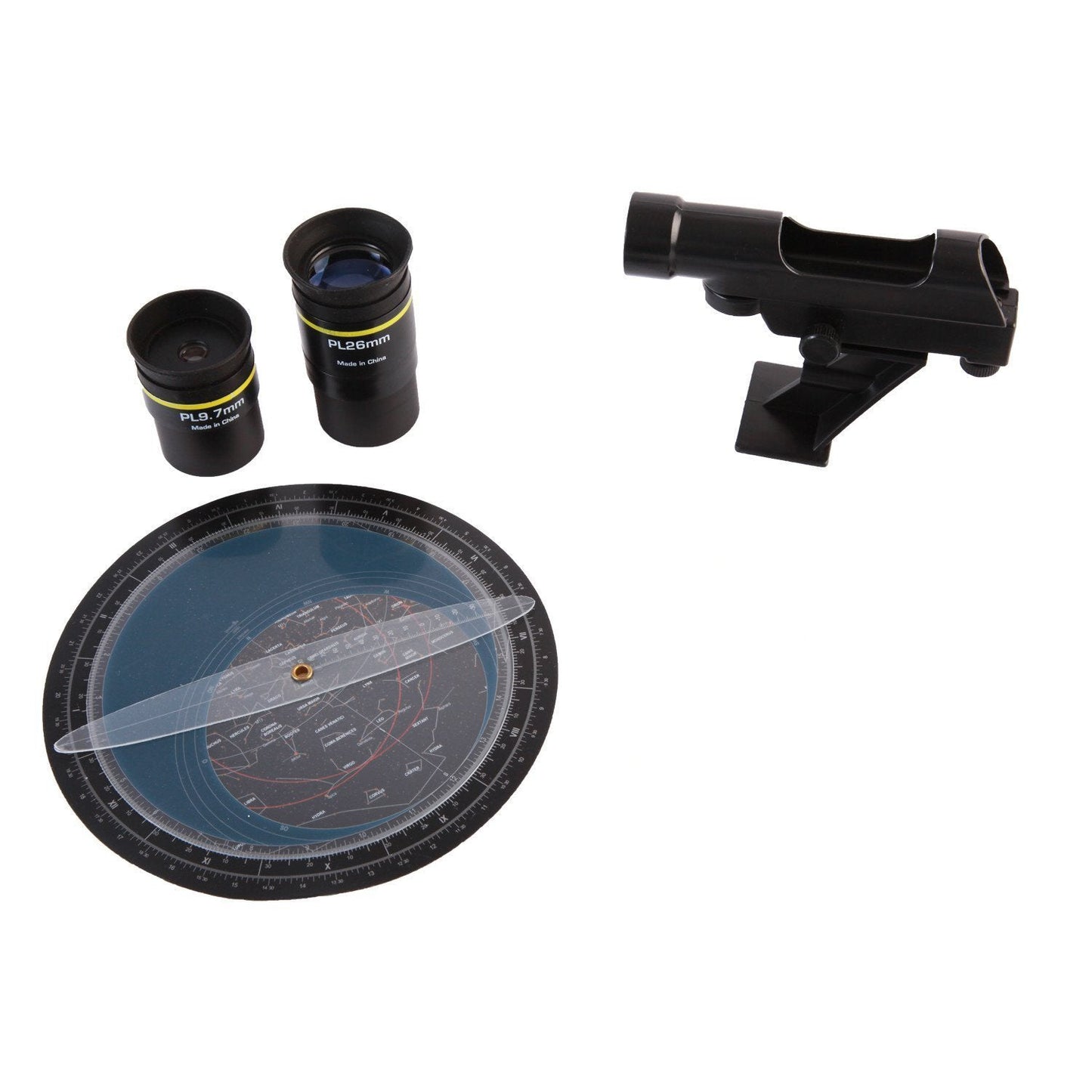
- Red-dot finder
- Two Plössl eyepieces — for different magnification levels
- Stellarium astronomy software (download)
- Star map
| Specifications |
| Optical design |
Newtonian reflector |
| Aperture |
114 mm (4.5 inches) |
| Focal length |
500 mm (f/4.4) |
| Mount |
German equatorial with slow-motion controls |
| Software |
Stellarium — full planetarium software included |
| SKU |
80-10114 |
Backed by Telescope Wolves' price match guarantee and free US shipping. Questions about equatorial mount setup? We can walk you through it.
Frequently asked questions
Why does a 114mm reflector show so much more than smaller scopes?
Aperture — the size of the mirror — determines how much light a telescope collects. A 114mm mirror collects about five times more light than a 50mm lens. That's the difference between the Orion Nebula as a faint smudge and the Orion Nebula as a glowing cloud with visible shape. For deep-sky observing, aperture is the most important specification.
Is the equatorial mount hard to use for a beginner?
The initial setup takes a little learning, but most beginners are comfortable with it after a few sessions. The key step is polar alignment — pointing the mount's RA axis toward Polaris (the North Star). After that, you track objects by turning one slow-motion knob, which is much more natural than a standard alt-azimuth once you get used to it.
What is Stellarium and how does it help?
Stellarium is free, full-featured planetarium software that shows you an accurate real-time map of the sky from your location. You can search for any object, see its current position, and plan what to observe on any given night. It's one of the most-used tools in amateur astronomy and is genuinely useful for beginners learning the sky.
Can I add a motor to track objects automatically?
Yes — German equatorial mounts like this one are compatible with single-axis motor drives that automate RA tracking. Once added, objects stay centered in the eyepiece without manual adjustment. It's a natural upgrade once you've mastered manual operation.
New to astronomy? Read our beginner's guide to choosing your first telescope or our Astronomy 101 guide to get started.
Watch it in action