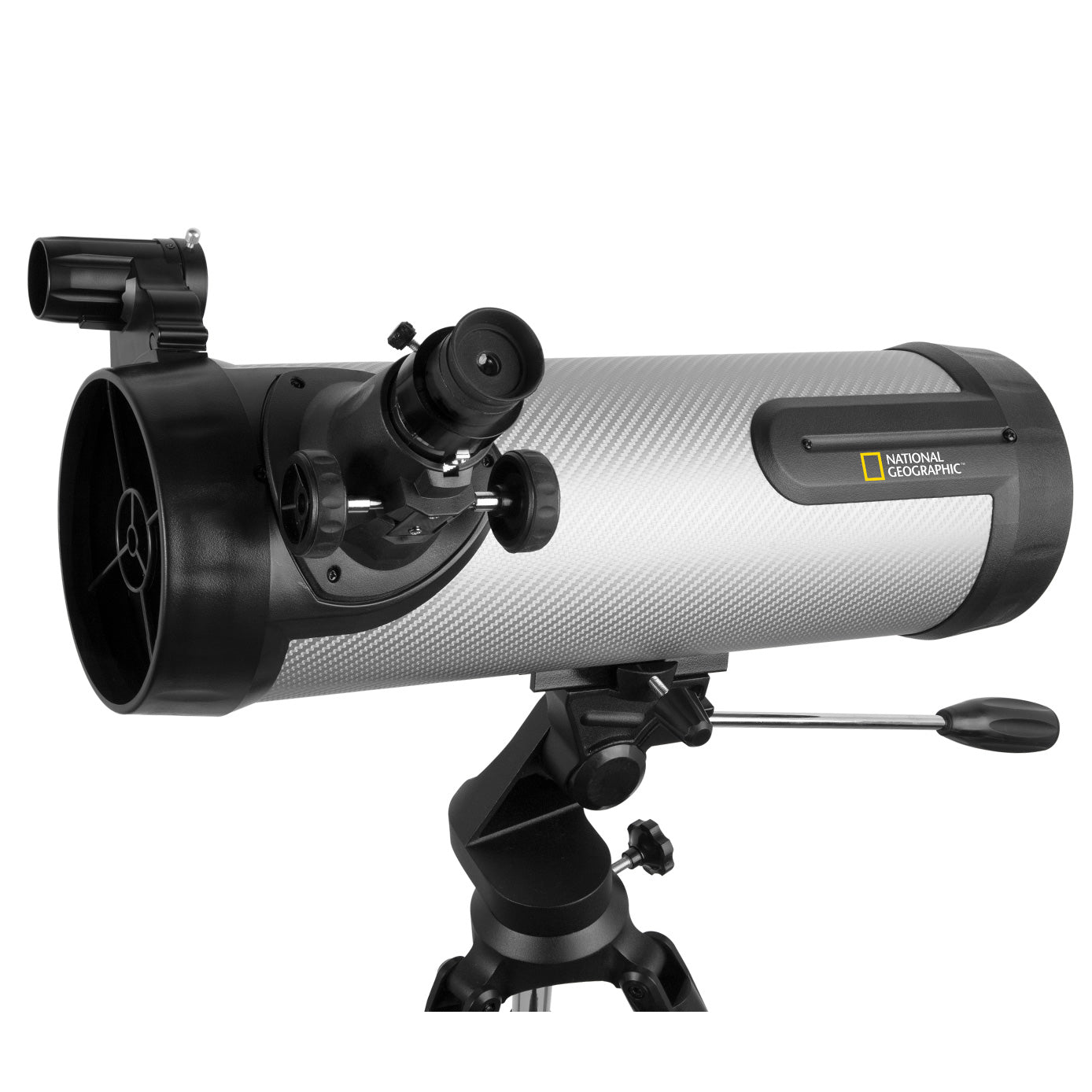
The National Geographic NT114CF is a 114mm Newtonian reflector that gives you serious light-gathering power at a beginner price — nearly five times the aperture area of a 50mm telescope — bundled with a smartphone adapter so you can photograph your first views of the Moon and planets the same night you set it up.
Unlike refractors at this price point, which top out around 70–80mm, a 114mm reflector collects enough light to reveal structure in galaxies and nebulae that smaller scopes can only hint at. The carbon fiber tube keeps the weight manageable, and the included smartphone adapter means you don't need any additional equipment to start capturing lunar photos for friends and family.
What you'll see
-
The Moon — dramatic crater detail, mountain peaks, and rilles in razor-sharp views
-
Saturn — rings clearly split with the Cassini Division visible on good nights
-
Jupiter — cloud belts, the Great Red Spot, and all four Galilean moons
-
Galaxies — the Andromeda Galaxy (M31) and the Whirlpool Galaxy (M51) as extended smudges of light
-
Nebulae — the Orion Nebula's glowing gas clouds and the Ring Nebula's distinctive smoke-ring shape
-
Star clusters — globular clusters like M13 begin to resolve into individual stars
What's in the box
- 114mm Newtonian reflector telescope (carbon fiber tube)
- Alt-azimuth mount and adjustable tripod
- Three eyepieces (different magnification levels)
- Smartphone adapter for prime-focus photography
- Red-dot finderscope
| Specifications |
| Aperture |
114mm |
| Optical Design |
Newtonian Reflector |
| Tube Material |
Carbon fiber |
| Mount Type |
Alt-azimuth |
| Smartphone Adapter |
Included |
| Finderscope |
Red-dot |
| Best For |
Beginners ready for deep-sky, astrophotography starters, anyone stepping up from a 70mm |
Backed by Telescope Wolves' price match guarantee and free US shipping. Not sure if this is the right telescope for you? Our team is happy to help — contact us anytime.
Frequently asked questions
Why choose a 114mm reflector over a 70mm or 80mm refractor?
Aperture is the single most important factor in what a telescope can show you. A 114mm reflector collects about 2.6 times more light than a 70mm refractor, which translates directly to brighter images, finer detail, and the ability to see fainter objects. If you want to see galaxies and globular clusters — not just planets and the Moon — the 114mm is the right choice.
Do reflectors require maintenance that refractors don't?
Yes — reflectors have two mirrors that may need periodic collimation (alignment) to perform at their best. It sounds daunting but takes about 5 minutes once you've done it once, and most beginners find their mirror stays aligned for months between adjustments. The NT114CF comes collimated from the factory.
How does the smartphone adapter work?
The adapter holds your smartphone over the eyepiece for afocal photography — the simplest method of telescope photography. Just align your phone's camera lens with the center of the eyepiece, focus, and tap to capture. The Moon and planets photograph well this way; long-exposure deep-sky astrophotography requires a motorized mount not included here.
Is this telescope suitable for a complete beginner?
Yes, with the understanding that a 114mm reflector is a slightly more capable — and slightly more involved — instrument than a 50mm or 70mm refractor. Setup takes a bit longer, and you'll want to read our telescope guide to get the most out of it. The reward is a substantial step up in what you can see.
New to astronomy? Read our beginner's guide to choosing your first telescope or our Astronomy 101 guide to get started.