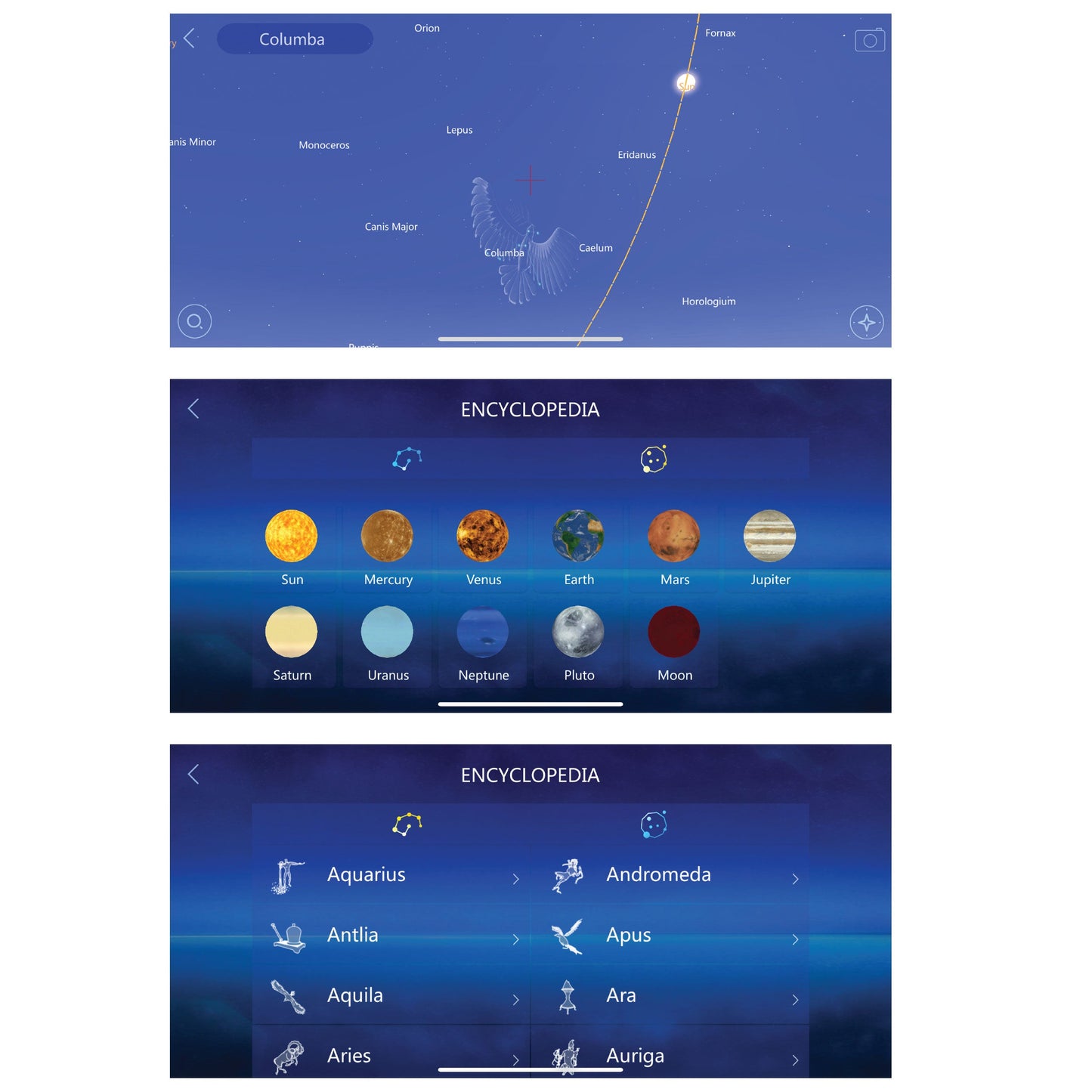
The National Geographic StarApp114 brings together a genuinely capable 114mm Newtonian reflector with the ARTelescope app, so beginners can see more and learn more at the same time. The 114mm aperture is where the night sky really opens up — nebulae, globular clusters, and galaxies become visible objects rather than theoretical targets. The ARTelescope app identifies what you're pointing at, adds context with an audio guide, and makes every observing session a discovery rather than a guessing game.
Unlike basic 114mm reflectors that leave you guessing what you're seeing, the StarApp114's smartphone integration guides you through the sky while the telescope delivers the views. Two Plössl eyepieces and a 2× Barlow give magnifications from 14× to 103× — wide enough for the Milky Way and powerful enough for planetary detail.
What you'll see
-
The Moon — craters, mountain ranges, and rilles in sharp detail at multiple magnifications
-
Saturn's rings and Cassini Division — clearly visible on steady nights at higher power
-
Jupiter's cloud bands and the four Galilean moons — all identified by the app
-
The Orion Nebula (M42) — glowing gas cloud structure visible even from suburbs
-
Globular clusters like M13 — partially resolved at higher magnification
-
The Andromeda Galaxy — a soft glow with an elongated core
What's in the box
- 114mm Newtonian reflector OTA — fully coated mirrors
- Adjustable full-size tripod with smooth pan-and-tilt mount
- Two Plössl eyepieces (for wide-field and higher-power views)
- 2× Barlow lens — doubles magnification to 103× at maximum
- Smartphone adapter — mounts your phone for app integration and astrophotography
- ARTelescope App — free for iOS and Android, sky identification with audio guide
- Red-dot finder
| Specifications |
| Optical design |
Newtonian reflector |
| Aperture |
114 mm (4.5 inches) |
| Magnification range |
14× – 103× with included eyepieces and Barlow |
| App |
ARTelescope — free iOS and Android, sky identification with audio guide |
| Includes |
Two Plössl eyepieces, 2× Barlow, smartphone adapter, red-dot finder |
| SKU |
80-40114 |
Backed by Telescope Wolves' price match guarantee and free US shipping. Not sure if 114mm is right for your observing goals? We're happy to help.
Frequently asked questions
Why 114mm instead of a smaller refractor?
At 114mm, you cross a threshold where deep-sky objects become genuinely rewarding. The Orion Nebula has visible structure, globular clusters start resolving into individual stars at the edges, and the Andromeda Galaxy shows a clear elongated shape. Smaller scopes can see these objects, but 114mm is when they become impressive.
How does the ARTelescope app work with a reflector?
The app works independently of the optics — you use your phone's GPS and motion sensors to identify objects, while the telescope does the visual work. The smartphone adapter mounts your phone to the focuser for photos, and the app identifies what you're pointing at in real time. It's especially helpful for beginners learning to navigate from one object to the next.
What does the 2× Barlow add?
It doubles any eyepiece's magnification, effectively giving you four magnification options from two eyepieces. The highest setting (103×) is good for planetary detail and lunar crater exploration on nights with steady air. Keep lower magnifications for wide nebula and star cluster views.
Is this scope good for astrophotography?
The smartphone adapter lets you take through-the-eyepiece (afocal) photos of the Moon and bright planets — a fun and easy way to share what you see. For serious deep-sky astrophotography, you'd want a motorized equatorial mount, which is a separate investment at a higher price point.
New to astronomy? Read our beginner's guide to choosing your first telescope or our Astronomy 101 guide to get started.
Watch it in action