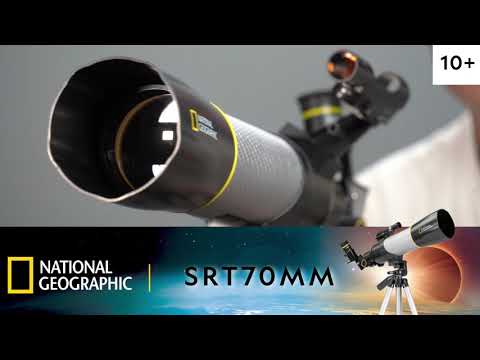
Most beginner telescopes are strictly night-only instruments. The National Geographic SRT70MM is different — it includes a solar filter right in the box, so you can safely observe the Sun in the afternoon and the Moon and planets after dark. For beginners who want to see what's happening on the Sun's surface (sunspots, solar activity), this is the straightforward way to do it without buying accessories separately.
Unlike entry-level scopes that only do one thing, the SRT70MM's 70mm aperture and panhandle mount cover both daytime solar viewing and nighttime planetary observing in one package. The two included eyepieces (20mm and 10mm) give 20× and 40× magnification — enough to show sunspot groups clearly during the day and Saturn's rings cleanly at night.
What you'll see
-
The Sun (with solar filter) — sunspots, active regions, and solar limb darkening in safe, clear detail
-
The Moon — craters, mountain ranges, and the dramatic terminator at night
-
Saturn's rings — clearly visible at 40× on steady nights
- Jupiter's cloud bands and four Galilean moons
-
Bright deep-sky objects — open clusters and wide nebulae at lower magnification
What's in the box
- 70mm achromatic refractor OTA
- Full-size tripod — stable and height-adjustable
- Panhandle AZ mount — smooth one-hand steering
- 20mm eyepiece (20×) — wide field for finding objects and solar viewing
- 10mm eyepiece (40×) — higher power for the Moon and planets
- Solar filter — fits over the objective for safe daytime Sun observation
- Red dot finder — for quick target acquisition
- Smartphone adapter — for capturing solar and celestial images
- Travel bag and dew shield cap — for storage and transport
| Specifications |
| Optical design |
Achromatic refractor |
| Aperture |
70 mm |
| Focal length |
400 mm (f/5.7) |
| Magnification |
20× (20mm eyepiece) and 40× (10mm eyepiece) |
| Mount |
Panhandle alt-azimuth on full-size tripod |
| Solar filter |
Included — fits over objective for safe Sun viewing |
| Includes |
Red dot finder, smartphone adapter, travel bag, dew shield cap |
Backed by Telescope Wolves' price match guarantee and free US shipping. Questions about solar observing? We're happy to help.
Frequently asked questions
Is the solar filter safe to use?
Yes — the included solar filter is a proper glass filter that fits over the front of the objective lens, blocking over 99.99% of sunlight before it enters the telescope. This is the correct and safe way to observe the Sun. Never observe the Sun without a proper solar filter in place, and always make sure the filter is securely seated before pointing at the Sun.
What can I actually see on the Sun?
Sunspots are the most common target — dark regions of intense magnetic activity that appear as spots or spot groups on the solar disk. During periods of high solar activity (like the current Solar Cycle 25 maximum), sunspots are frequent and visually striking. You can also see the subtle limb darkening at the Sun's edge and, with experience, solar granulation at higher magnifications.
How does the panhandle mount compare to a standard AZ mount?
Standard alt-azimuth mounts require you to separately loosen and adjust two knobs for up/down and left/right movement. A panhandle lets you grip and push in any direction with one hand, while your other hand stays free or you look through the eyepiece. For solar tracking — where the Sun moves quickly across the sky — the panhandle is significantly more comfortable.
Can I add more eyepieces?
Yes — the SRT70MM accepts standard 1.25" eyepieces. A 6mm eyepiece would give you 67× for more planetary and lunar detail. A 2× Barlow doubles any eyepiece's magnification and costs around $15-25 as an add-on.
New to astronomy? Read our beginner's guide to choosing your first telescope or our Astronomy 101 guide to get started.