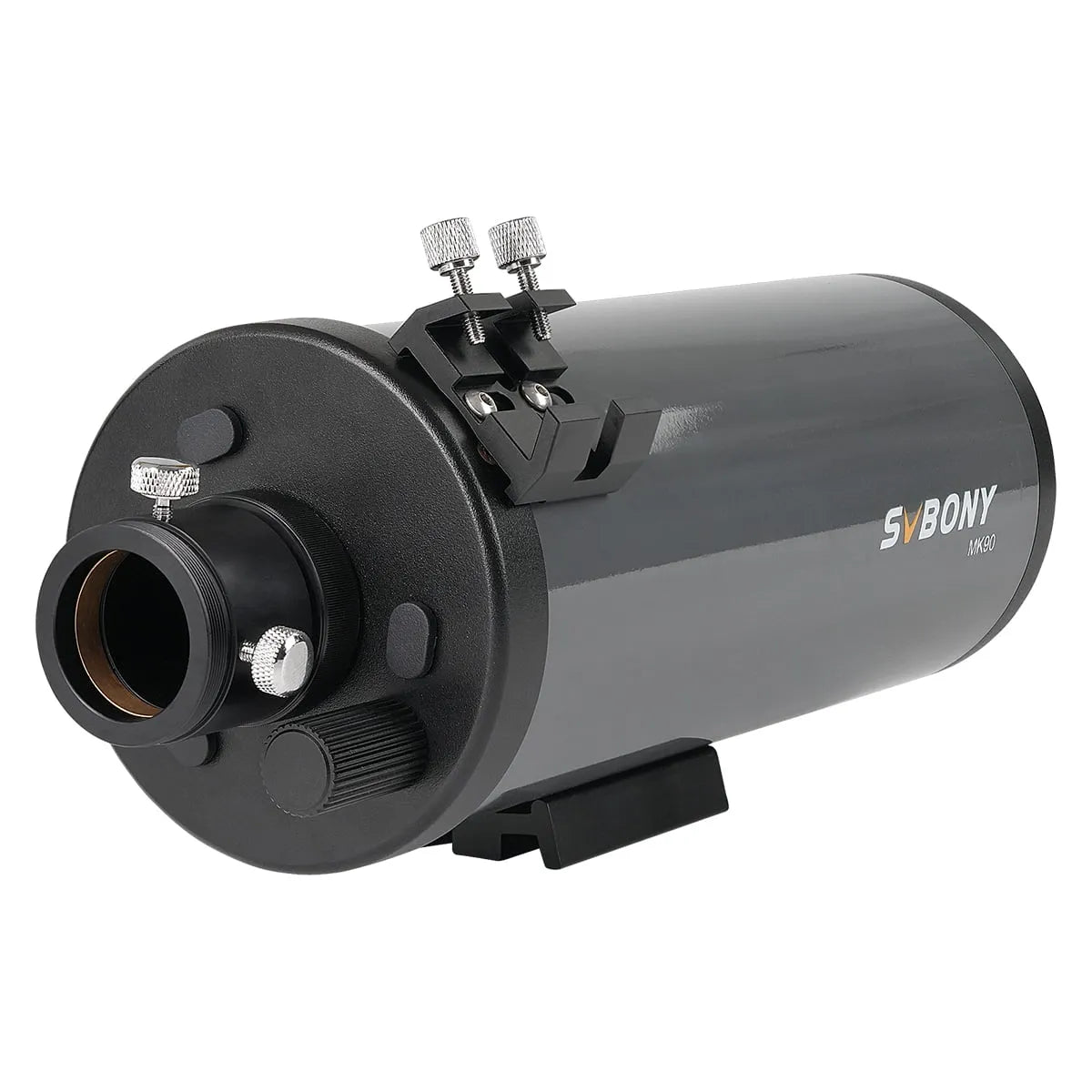
Everything about the SVBONY MK90 Maksutov is built around a single goal: maximum image sharpness and contrast in the tightest possible package. The 90mm Maksutov-Cassegrain design folds a 1250mm focal length (f/13.9) into a sealed tube less than 10 inches long — no mirror collimation needed, no cooling wait longer than a few minutes, and no exposed optics to gather dust or dew. For planetary observing and the Moon, the Mak's long focal length and sealed tube deliver views that punch well above their size and price.
Unlike short-focal-length scopes where pushing magnification past 100× makes images soft and shaky, the MK90's f/13.9 ratio means high magnification is where it's designed to live. Saturn's rings and Jupiter's cloud bands sharpen at 150–180×, and the Moon reveals crater detail that takes your breath away. The trade-off is a narrow field of view — this is a precision instrument for studying specific targets, not for sweeping wide vistas of the Milky Way.
What you'll see
-
The Moon — craters, rilles, mountain peaks, and shadow detail in extraordinary contrast
-
Saturn — rings and the Cassini Division in sharp relief; cloud belts on steady nights
-
Jupiter — equatorial cloud bands, the Great Red Spot, and the four Galilean moons
-
Mars — polar ice caps visible at opposition
-
Venus phases — the planet's disc and changing phases, like a miniature Moon
-
Tight double stars — cleanly split at high magnification
What's in the box
- 90mm Maksutov-Cassegrain OTA — sealed tube, no collimation required
- Diagonal
- Eyepiece(s)
- Finderscope
| Specifications |
| Optical design |
Maksutov-Cassegrain (sealed tube, maintenance-free) |
| Aperture |
90 mm (3.5 inches) |
| Focal length |
1250 mm (f/13.9) |
| Best for |
Planets, Moon, double stars — high magnification targets |
| Tube design |
Sealed — no mirror collimation, minimal maintenance |
| SKU |
F9382B |
Backed by Telescope Wolves' price match guarantee and free US shipping. Wondering if a Mak is right for your interests? We're happy to walk through it with you.
Frequently asked questions
What is a Maksutov-Cassegrain and why does it work well for planets?
A Mak uses a curved corrector lens at the front of a sealed tube and a pair of mirrors inside to fold a very long effective focal length into a compact package. The long focal length (f/13.9 here) means high magnification comes naturally — where a shorter telescope needs to be pushed hard to reach 150×, the Mak gets there with a comfortable midrange eyepiece. Long focal lengths also tend to deliver high contrast, which makes subtle planetary detail pop.
What does "sealed tube" mean in practice?
Unlike a Newtonian reflector where the mirrors are open to the air, a Mak's optics are enclosed behind a glass corrector plate. This means dust, dew, and moisture can't reach the primary mirror, collimation never drifts, and you spend more time observing and less time maintaining. For beginners who don't want to learn mirror alignment, this is a real practical advantage.
Is this good for deep-sky objects like nebulae and galaxies?
Not its strength. The f/13.9 focal ratio makes the Mak slow for capturing faint extended objects — a 30-second glance at the Orion Nebula will show it, but the field of view is narrow and the image dimmer than you'd get with a fast reflector. For deep-sky observing, consider a 114mm+ Newtonian reflector instead. If your main interest is planets and the Moon, the Mak is the better choice.
What mount does this scope need?
The MK90 is sold as an OTA. Its compact, lightweight tube works well on a variety of mounts. An alt-azimuth like the Twilight Nano is fine for visual observing. If you want to track objects hands-free for extended planetary sessions, an equatorial mount with a motor drive is the natural next step. Contact us and we can suggest a complete kit.
New to astronomy? Read our beginner's guide to choosing your first telescope or our Astronomy 101 guide to get started.