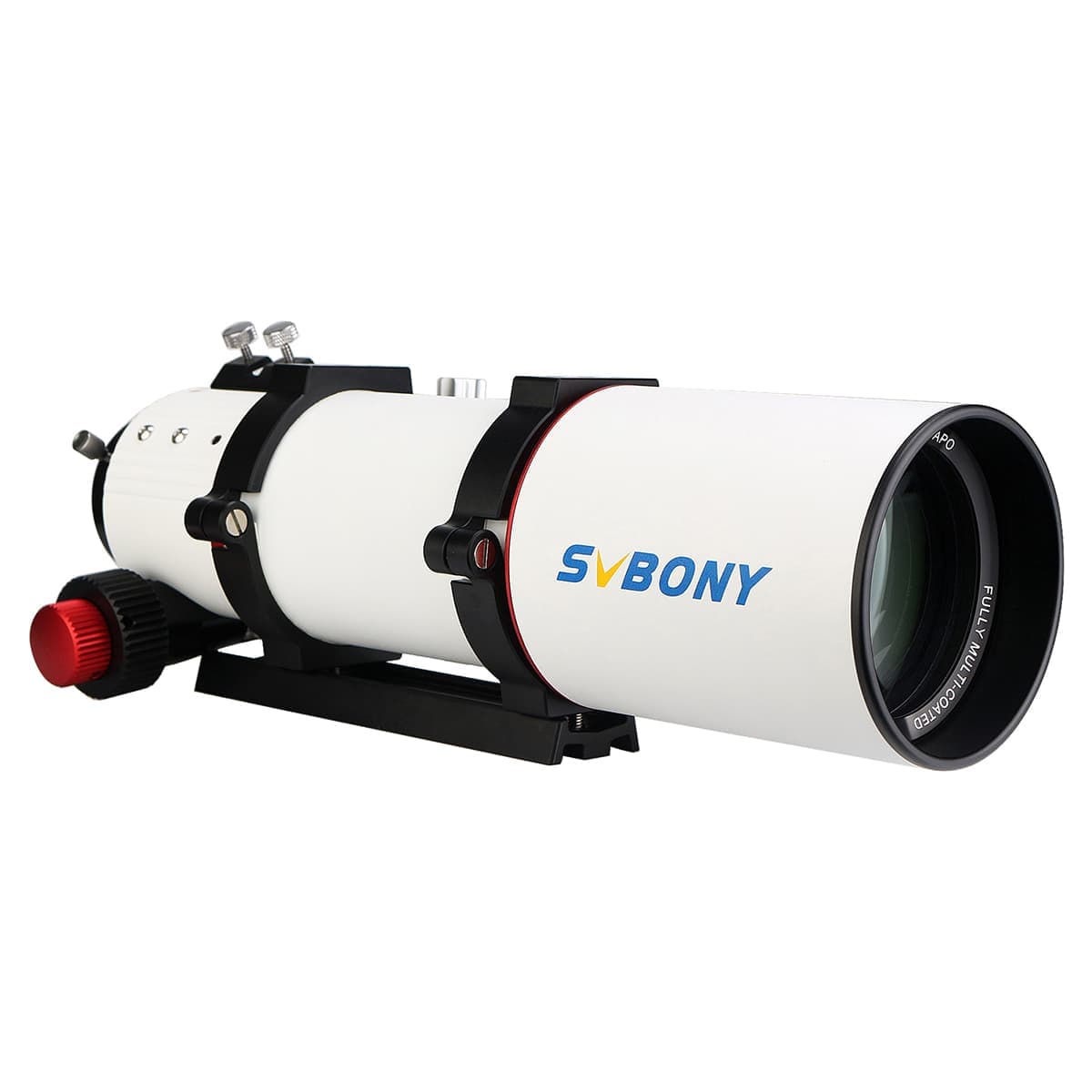
A triplet apochromatic refractor removes the color problem that plagues most beginner refractors — completely. The SVBONY SV550 80mm Triplet APO (F9381A) uses three glass elements, selected and spaced to bring red, green, and blue light to the same focal point. Stars look like stars: sharp white points, not blue or purple halos. This matters for visual observing at the eyepiece, and it matters even more for astrophotography where color errors accumulate across long exposures.
Unlike doublet ED refractors at this price
Most ED refractors in this range use two elements — an ED doublet. Doublets are better than standard achromats, but they don't achieve full apochromatic correction; there's still residual secondary spectrum (color fringing) visible on bright targets. A triplet APO adds a third element to bring three wavelengths — not two — to common focus. The result is measurably sharper and more color-accurate, particularly on the Moon, planets, and bright stars. If you're planning serious visual or photographic work, the triplet design matters.
What you'll see (and capture)
At 560mm and f/7, the SV550 sits at a comfortable middle focal length — long enough for good planetary detail, short enough for wide deep-sky fields. The Moon shows razor-edged crater walls and rilles without color fringing on the bright limb. Saturn's rings appear clean and white rather than tinged. For astrophotography, wide emission nebulae fit within the field at reasonable image scales, and the color accuracy means your Ha/OIII/SII signals record cleanly without cross-channel contamination from chromatic error.
What's in the box
- SV550 80mm Triplet APO OTA
- 2-inch rack-and-pinion focuser with 1.25-inch adapter
- Tube rings
- Dust caps
| Spec |
Value |
| SKU |
F9381A |
| Optical Design |
Triplet Apochromatic Refractor |
| Aperture |
80mm (3.1 inches) |
| Focal Length |
560mm |
| Focal Ratio |
f/7 |
| Focuser |
2-inch rack-and-pinion with 1.25-inch adapter |
| Included |
OTA, tube rings, dust caps (mount not included) |
Price Match, Shipping & Questions
We price-match any authorized Canadian or US retailer. Ships free to the contiguous US. Questions? Email us at support@telescopewolves.com or visit our contact page.
Frequently Asked Questions
Does this come with a mount?
No — the SV550 is sold as an optical tube assembly (OTA). You'll need a separate mount and tripod. It's compatible with any Vixen-style or Losmandy saddle, including alt-az mounts for visual use and equatorial mounts for tracking and astrophotography.
How does this compare to the SVBONY SV503 quadruplet also sold here?
The SV503 is a 70mm quadruplet designed specifically for flat-field astrophotography — the four elements are optimized to flatten the image circle across a large sensor. The SV550 is a classic triplet APO that performs well for both visual and photographic use. If your primary goal is wide-field imaging, add a field flattener to the SV550 or consider the SV503 with its built-in flatness. For visual observing or all-around use, the SV550's extra aperture (80mm vs 70mm) is an advantage.
Will I need a field flattener for astrophotography?
For APS-C sensors, a field flattener is recommended to maintain star sharpness at the corners. Without one, stars at the edges may show some field curvature. A matched flattener (sold separately) brings the entire field to flat focus.
Is f/7 fast enough for deep-sky imaging?
f/7 is moderate — not as fast as dedicated imaging scopes at f/4–5, but manageable for shorter exposures on bright nebulae and galaxies. Adding a 0.8x focal reducer would bring it to approximately f/5.6 and shorten exposure times accordingly.
New to telescopes?
Our beginner guides walk you through everything — from setting up your first scope to finding objects in the night sky.