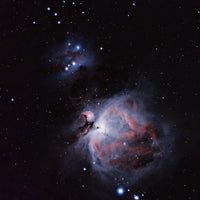
Point your phone at the sky, tap a target, and the Vespera Pro handles everything else. The Vaonis Vespera Pro (ES-VEP50) is a self-contained automated astronomy system — it aligns itself, slews to targets, focuses, stacks images, and delivers processed deep-sky photos to your phone in real time. No eyepiece, no manual pointing, no dark-adaptation, no complex software. If you've ever wanted to share a live view of the Orion Nebula with someone who's never looked through a telescope, this is the instrument that makes that happen.
Unlike traditional telescopes
A traditional telescope requires learning to polar align, star-hop to targets, focus manually, and understand imaging workflows before you see a compelling image. The Vespera Pro eliminates every one of those barriers. The built-in Sony sensor, onboard processing, and automatic alignment mean setup takes minutes — open it, connect to the app, let it align, choose a target. The live stacking feature shows you a progressively improving deep-sky image on your phone as exposures accumulate. You can share the live view link with anyone, anywhere, watching the same image build in real time. RAW saving and manual camera controls serve experienced astrophotographers who want to process images themselves.
What you'll image
The Vespera Pro resolves nebulae, galaxies, and star clusters with sufficient detail to impress anyone looking at their first astronomical image. The Orion Nebula shows its full extent with the Trapezium resolved. The Andromeda Galaxy shows the spiral arms and satellite galaxies. Globular clusters resolve into thousands of individual stars. Emission nebulae — the Lagoon, the Trifid, the North America — fill the frame with color and structure that visual telescopes require dark sites and dark-adapted eyes to appreciate at all. The Vespera Pro does this under suburban skies, automatically, while you watch on your phone.
What's in the box
- Vaonis Vespera Pro telescope system with built-in Sony IMX585 sensor
- Tripod and carrying case
- Power supply
- Stellina companion app (iOS and Android)
| Spec |
Value |
| SKU |
ES-VEP50 |
| Optical Design |
Cassegrain-type |
| Aperture |
50mm |
| Focal Length |
250mm |
| Focal Ratio |
f/5 |
| Sensor |
Sony IMX585 color CMOS |
| Connectivity |
Wi-Fi (app-controlled, iOS and Android) |
| Alignment |
Fully automatic (no user input required) |
Price Match, Shipping & Questions
We price-match any authorized Canadian or US retailer. Ships free to the contiguous US. Questions? Email us at support@telescopewolves.com or visit our contact page.
Frequently Asked Questions
Do I need any astronomy experience to use this?
None at all. The Vespera Pro is designed for complete beginners. Setup involves placing it on a level surface, connecting to the app, and letting the system align automatically. Target selection is done through the app's sky map. The system focuses, slews, and stacks automatically. The only learning curve is choosing which objects to image first.
Can experienced astrophotographers use this productively?
Yes. RAW image saving, manual control over gain, exposure, and stacking, and the ability to access raw frames for post-processing in tools like PixInsight or Astro Pixel Processor make the Vespera Pro useful to experienced imagers as a grab-and-go system when setting up a full rig isn't practical. The onboard Wi-Fi control also makes it useful for remote sessions.
How does this compare to a traditional telescope and camera setup?
A traditional setup offers larger aperture, full sensor control, and the ability to image at any focal length — but requires significant time, equipment, and expertise. The Vespera Pro offers plug-and-play operation, live sharing, and consistent results without technical investment. Many astronomers own both: the Vespera Pro for casual sharing and spontaneous sessions, a full rig for dedicated imaging nights.
Does it work under light-polluted skies?
Better than traditional visual observing. The live stacking process accumulates signal over time, effectively increasing the signal-to-noise ratio beyond what a single exposure shows. Under moderate light pollution (Bortle 5–6), the Vespera Pro produces usable images of bright nebulae, galaxies, and clusters. Results improve significantly under darker skies.
New to telescopes?
Our beginner guides walk you through everything — from setting up your first scope to finding objects in the night sky.