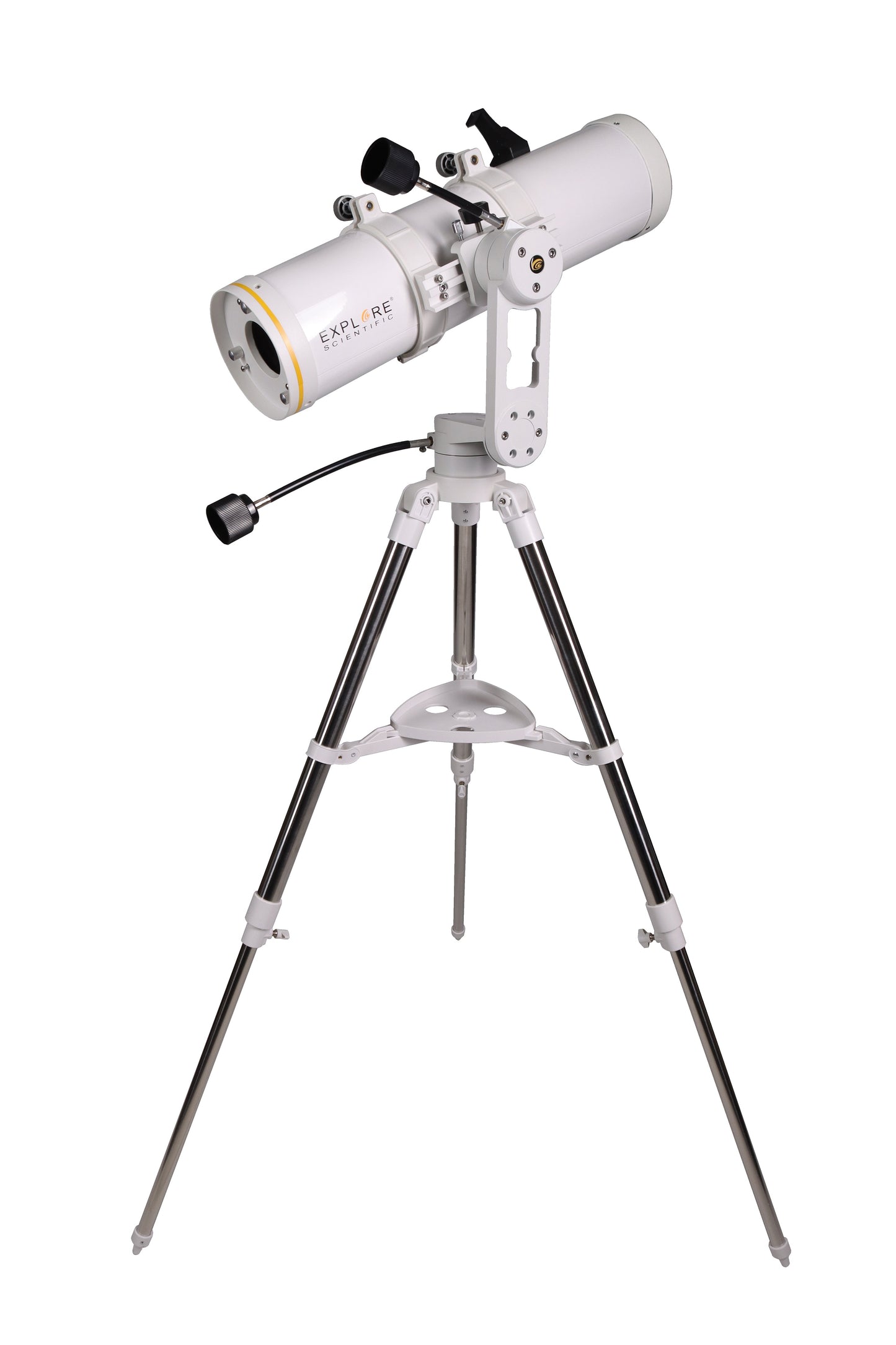
The Sidara Essential 130mm Newtonian Reflector is one of the most capable beginner telescopes in this price range — a 5.1-inch mirror paired with the SkyAssist smartphone-guided mount that points you to any object in the sky without knowing the constellations first. Open the app, search for the Orion Nebula or Saturn, follow the on-screen arrows, and the object appears in your eyepiece. With 130mm of aperture doing the heavy lifting, what you find is worth finding.
Unlike the equatorial version of the 130mm FirstLight, the SkyAssist mount is simpler: no polar alignment, no counterweights, no learning curve on mount mechanics. You point and follow arrows. The trade-off is that tracking at high magnification requires periodic manual nudging — the EQ3 version is better for sustained planetary sessions. For beginners focused on exploration and discovery across the whole sky, the SkyAssist 130mm is the faster path to enjoying astronomy.
What you'll see
-
The Moon — craters, valleys, and mountain ranges in sweeping wide-field views
-
Saturn's rings and Cassini Division — clearly resolved on steady nights
-
Jupiter's cloud bands and the four Galilean moons
-
The Orion Nebula (M42) — the four Trapezium stars resolved at the nebula's core
-
Globular clusters like M13 — partially resolving into individual stars at the edges
-
Galaxy pairs like M81/M82 — both visible in the same field of view
What's in the box
- 130mm f/5 Newtonian reflector OTA — large aperture, wide-field viewing
- SkyAssist alt-azimuth mount — app-guided target finding
- Tripod
- Eyepieces
- Red-dot finder
- SkyAssist App — free for iOS and Android
| Specifications |
|---|
| Optical design |
Newtonian reflector |
| Aperture |
130 mm (5.1 inches) |
| Focal length |
650 mm (f/5) |
| Mount |
SkyAssist alt-azimuth — app-guided, no polar alignment required |
| App |
SkyAssist — free for iOS and Android |
| SKU |
ES-N130650-MAZ01-ST10 |
Backed by Telescope Wolves' price match guarantee and free US shipping. SkyAssist vs. equatorial mount for a 130mm Newtonian — not sure which is right? We'll help you choose.
Frequently asked questions
How is the SkyAssist mount different from an equatorial mount?
An alt-azimuth mount (like the SkyAssist) moves up-down and left-right — very intuitive to use, no setup required. The SkyAssist app then uses your phone's GPS and sensors to guide you to any target. An equatorial mount is aligned to Earth's axis and tracks objects with one smooth motion, making it better for sustained high-magnification viewing and astrophotography. The SkyAssist is the better beginner choice for exploration; the EQ3 version is better for focused planetary sessions or future astrophotography.
Why does 130mm make such a noticeable difference over smaller beginner scopes?
Light-gathering power scales with the square of the aperture. A 130mm mirror collects about 88% more light than a 90mm telescope — enough to transform faint deep-sky objects from vague hints into genuine targets. At 130mm, the Orion Nebula's internal structure becomes visible, globular clusters start resolving at the edges, and galaxies like M81 take on distinct shapes rather than just a faint glow.
Does the SkyAssist app work in a light-polluted suburb?
Yes. SkyAssist guides you using your phone's GPS and motion sensors, not sky brightness — it works just as well under suburban skies. Light pollution will limit which faint deep-sky objects you can see clearly, but the app will still point you correctly to any target. For targets that are realistically visible from your location, 130mm of aperture does a lot to overcome moderate light pollution.
How often does the 130mm Newtonian need collimation?
Collimation (aligning the mirrors) is something all Newtonian reflectors need occasionally. The 130mm ships collimated and typically holds alignment for many sessions. If you transport it frequently or bump it, a quick check before observing is good practice. It's a 5-minute process once learned — and we have guides to help first-timers through it.
New to astronomy? Read our beginner's guide to choosing your first telescope or our Astronomy 101 guide to get started.