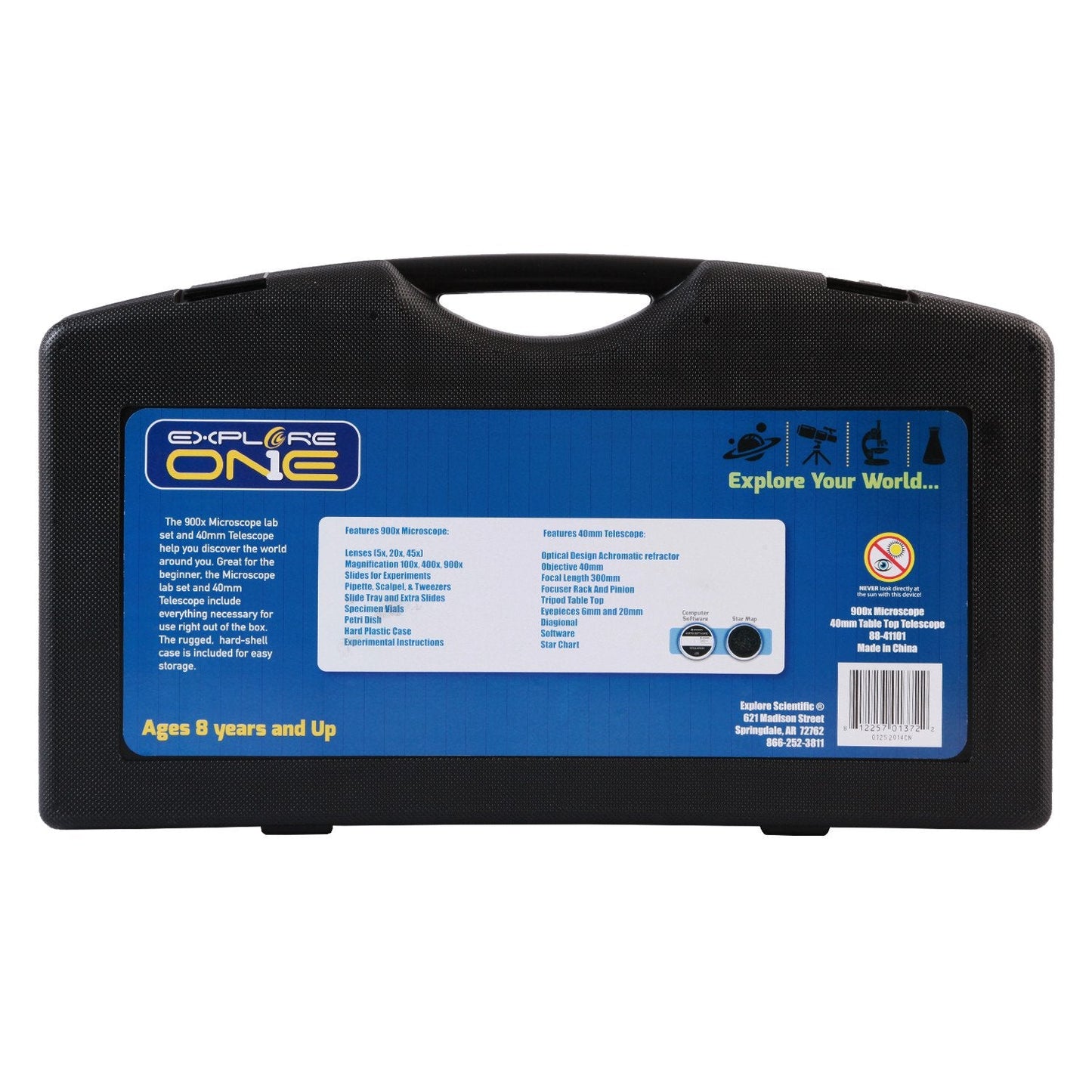
Two instruments, one box, endless curiosity. The Explore One Apollo set pairs a 50mm refractor telescope with a 900x microscope so kids can explore everything from the Moon's craters at night to the structure of a leaf under the lens in the afternoon. Neither instrument is a toy — both are real optical tools that work, and both come with enough accessories to get started immediately without any extra purchases.
Unlike single-instrument kits that leave kids wanting to do more, the Apollo set covers both ends of the scale. Star-gaze after dark, then flip to microscopy to look at slides, pond water, or fabric fibers before dinner. For a STEM kid who wants to explore everything, this is the first kit that doesn't ask them to choose.
What you'll see
-
Through the telescope — the Moon's craters and mountain ranges, Saturn's rings, Jupiter's four Galilean moons, and bright open star clusters like the Pleiades
-
Through the microscope — plant cells, fiber structures, microorganisms, and anything on the included prepared and blank slides, up to 900× magnification
What's in the box
- 50mm refractor telescope OTA with coated optics
- Tabletop tripod with alt-azimuth mount
- Two interchangeable eyepieces for varied magnification
- 900× microscope with three objective lenses and built-in color filter wheel
- Prepared and blank slides
- Sample collection tools and materials
- Complete accessory pack for both instruments
| Specifications |
|---|
| Telescope aperture |
50 mm achromatic refractor |
| Telescope mount |
Tabletop alt-azimuth |
| Microscope max magnification |
900× with three objective lenses |
| Microscope features |
Built-in color filter wheel for specimen contrast |
| Includes |
Slides, sample tools, and full accessory pack for both instruments |
| Best for |
Kids, STEM learners, families exploring nature and night sky |
Backed by Telescope Wolves' price match guarantee and free US shipping. Questions about which kit is right for your kid? We're happy to help.
Frequently asked questions
What age is this set designed for?
The Apollo set works well for kids roughly 8 and up. Younger kids will enjoy it most with a parent helping aim the telescope and prepare microscope slides. The instruments are sturdy and designed for everyday handling, not fragile shelf pieces.
What can the microscope actually see?
At lower magnifications (40×–100×), kids can look at fibers, hair, insects, and prepared slides. At higher magnifications (up to 900×) they can see individual cells in thin plant material and examine microorganisms in pond water. The color filter wheel makes transparent specimens easier to see clearly.
Can the telescope be used on a full-size tripod?
The telescope is designed for the included tabletop setup. For extended observing sessions or use by older kids who want to view from standing height, any standard camera tripod with a ¼"-20 thread will work as an alternative support.
Does it come with everything needed to start?
Yes — the Apollo set includes eyepieces, slides, sample materials, and accessories for both instruments. Kids can start observing and experimenting the same day without any extra purchases. The only thing to bring is curiosity.
New to astronomy? Read our beginner's guide to choosing your first telescope or our Astronomy 101 guide to get started.