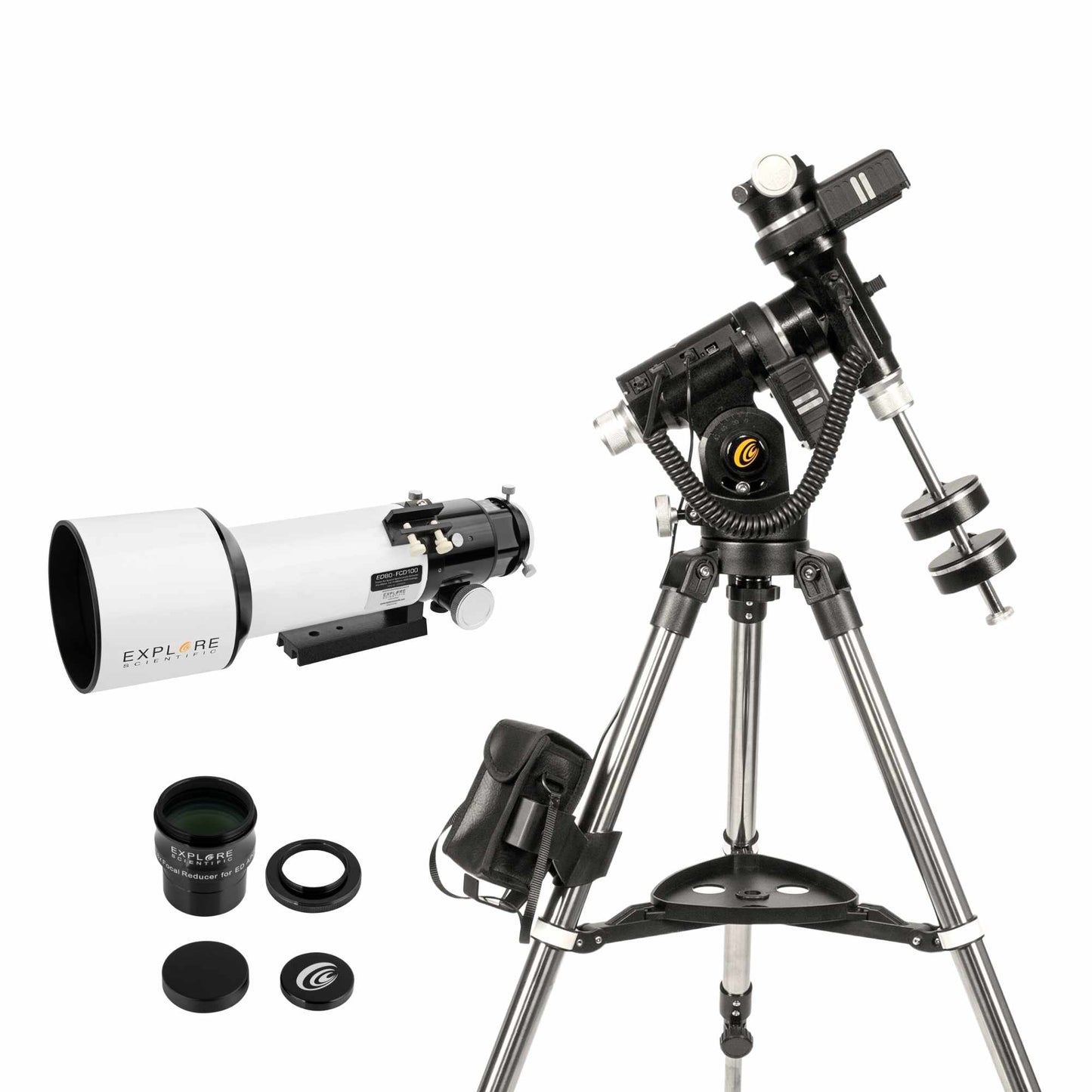
Fluorite-grade glass, a triplet air-spaced design, and a matched field flattener in one bundle — the Explore Scientific 80mm FCD100 APO (ES-FCD100-0806-FF) is a compact, travel-ready astrophotography refractor that eliminates the two biggest obstacles to sharp wide-field images: chromatic aberration and field curvature. HOYA FCD100 glass is among the highest-performing optical materials available for refractors; the included field flattener corrects the focal plane for sharp stars from center to corner. Everything you need for imaging is in the box except the camera and mount.
Unlike standard ED doublets or achromats
Achromats produce visible color fringing on bright stars in images. ED doublets reduce it substantially. FCD100 fluorite-grade triplets go further than either — color correction reaches a level where chromatic aberration becomes essentially invisible in broadband color images. Combined with the included field flattener, which pulls edge stars into round, tight points rather than the elongated shapes that appear without correction, the imaging performance of this bundle is reference-class for its aperture. For an 80mm refractor, it delivers image quality that used to require much larger formats or premium focal ratios.
What you'll see (and image)
For visual use, the FCD100 triplet delivers exceptional contrast — planet colors are accurate, star fields are snappy without halos, and the Moon shows fine detail without any limb fringing. For imaging, wide-field targets like the North America Nebula, the Rosette Nebula, and large nebula complexes fit comfortably in the field on most cameras. At 480mm focal length (with the included flattener factored in), it's an excellent pairing with full-frame cameras for Milky Way panoramas and large nebulae. Under narrowband filters, the FCD100 glass produces clean background and tight star profiles even on demanding Ha targets.
What's in the box
- 80mm FCD100 ED triplet APO refractor OTA
- Matched field flattener
- 2-inch dual-speed Crayford focuser with 1.25-inch adapter
- Tube rings and Vixen-style dovetail bar
- Dust caps
| Spec |
Value |
| SKU |
ES-FCD100-0806-FF |
| Optical Design |
FCD100 ED Triplet Apochromat Refractor |
| Aperture |
80mm |
| Focal Length |
480mm |
| Focal Ratio |
f/6 |
| Glass Type |
HOYA FCD100 fluorite-grade ED |
| Included |
Matched field flattener, OTA only — mount not included |
Price Match, Shipping & Questions
We price-match any authorized Canadian or US retailer. Ships free to the contiguous US. Questions? Email us at support@telescopewolves.com or visit our contact page.
Frequently Asked Questions
How does FCD100 compare to standard ED glass?
HOYA FCD100 is a fluorite-equivalent extra-low dispersion glass — one step above standard ED materials in terms of refractive index and Abbe number. In practice, the color correction in a well-designed FCD100 triplet approaches or matches natural fluorite, with better mechanical stability and lower cost than actual fluorite elements. It outperforms most standard ED doublet designs on chromatic aberration by a meaningful margin.
What camera connections are compatible with the field flattener?
The included field flattener uses standard 2-inch nosepiece connections compatible with most DSLR T-ring adapters. Check the Explore Scientific documentation for camera-specific back-focus distance requirements — this is important for achieving correct flattening on your specific sensor size.
Is it suitable for visual use as well as imaging?
Yes. The FCD100 triplet delivers excellent visual performance — sharp stars, accurate color on planets, high contrast. The field flattener can be left off for visual use with a standard diagonal and eyepieces. This is a capable visual planetary and deep-sky scope in addition to its imaging capabilities.
How does this compare to the SVBONY SV550 80mm triplet APO?
Both are 80mm triplet APOs designed for quality imaging. The key difference in this bundle is the included field flattener — for imaging use, the flattener is essential for sharp corner stars and adds significant value over buying them separately. For visual use only, both scopes deliver excellent performance at their respective price points.
New to telescopes?
Our beginner guides walk you through everything — from setting up your first scope to finding objects in the night sky.