Long focal length refractors are the traditional planetary telescope — and the Explore Scientific FirstLight 102mm Refractor (FL-AR1021000MAZ01) is that instrument on a mount that does it justice. At 1000mm focal length and f/9.8, the optics are tuned for high magnification and high contrast on the Moon, planets, and binary stars. The Twilight I alt-azimuth mount is a substantial, smooth-bearing manual mount — not a budget entry-level design — that holds the view steady at the powers this telescope is built for.
Unlike the Nano-mount version of this same telescope
The same 102mm, 1000mm focal length optical design is available on the lighter, lower-cost Nano EQ3 equatorial mount. That version is a reasonable entry-level setup. The Twilight I is a different class of mount: heavier bearings, more stable platform, and noticeably smoother motion. At 200x and higher — which this f/9.8 refractor handles well — mount quality directly determines image steadiness. Shaky mounts ruin high-magnification views; a well-damped mount like the Twilight I holds the image.
What you'll see
Long focal length refractors are planetary instruments, and this one excels there. Saturn's rings show the Cassini Division cleanly; the crepe ring (C ring) is visible on excellent nights. Jupiter at 150–200x reveals at least four distinct cloud bands, the Red Spot, and four Galilean moons in various configurations depending on the night. The Moon at high power is extraordinary — crater walls, rilles, mountain chains, and shadow detail across the terminator at maximum sharpness. Double stars with separation down to about 1 arcsecond are achievable. The 25mm Plossl at 40x gives a beautiful wide-field view for star clusters and the brighter nebulae.
What's in the box
- 102mm f/9.8 achromatic doublet refractor OTA
- Twilight I alt-azimuth mount
- Tripod
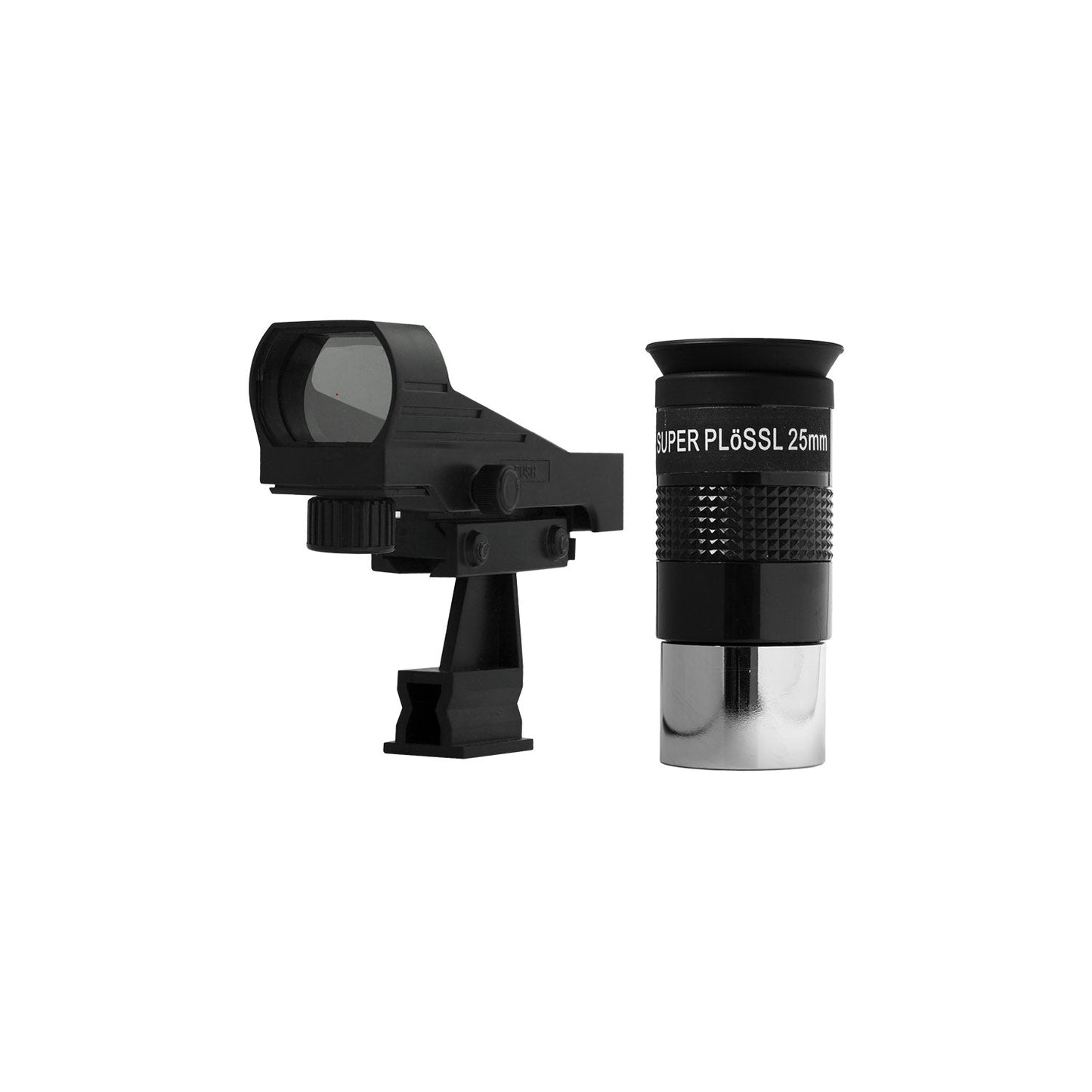
- Plossl eyepiece
- 2-inch diagonal
- Red dot finder scope
- Smartphone adapter
| Spec |
Value |
| SKU |
FL-AR1021000MAZ01 |
| Optical Design |
Achromatic Doublet Refractor |
| Aperture |
102mm (4 inches) |
| Focal Length |
1000mm |
| Focal Ratio |
f/9.8 |
| Mount Type |
Twilight I Alt-Azimuth (manual, premium bearings) |
| Included |
Plossl eyepiece, 2" diagonal, red dot finder, smartphone adapter |
Price Match, Shipping & Questions
We price-match any authorized Canadian or US retailer. Ships free to the contiguous US. Questions? Email us at support@telescopewolves.com or visit our contact page.
Frequently Asked Questions
Is this scope primarily for planets, or can it do deep sky too?
Primarily planets and lunar. The 1000mm focal length produces narrower fields of view, which suits point sources (planets, double stars, globular clusters) over extended nebulae or galaxies. For wide deep-sky fields, shorter focal length scopes are better suited. For lunar-planetary detail, long focal length is an advantage.
Why does the Alt-Az Twilight I version cost so much more than the EQ3 version?
The Twilight I is a significantly heavier and more precisely machined mount than the budget Nano EQ3. Smoother azimuth and altitude bearings, better damping, and a more rigid overall platform make a real difference at high magnification. The EQ3 is a good starting point; the Twilight I is a mount you won't feel the need to upgrade.
Is this an achromat — won't there be chromatic aberration?
Some residual color fringing is present in achromatic doublet refractors on the brightest targets (the Moon, Venus, bright stars). At f/9.8, the aberration is well-controlled and much less visible than in short-focal-length achromats. Most observers at this focal ratio describe the color correction as acceptable to good for visual planetary work. For zero-fringe performance, look at our APO triplet options.
What magnification can this telescope reach?
A practical maximum is roughly 200–250x on good nights (about 2× per millimeter of aperture). With a 5mm eyepiece you reach 200x; a 4mm gives 250x. High magnification requires steady atmospheric seeing — nights with still air produce sharp, detailed planetary views; turbulent nights limit useful magnification regardless of telescope size.
New to telescopes?
Our beginner guides walk you through everything — from setting up your first scope to finding objects in the night sky.