Five inches of aperture at f/9.4, 1200mm focal length, and a complete observation kit built around the Twilight I alt-az mount — the Explore Scientific FirstLight 127mm refractor (FL-AR1271200MAZ01) is the largest aperture achromatic refractor in the FirstLight lineup. At this focal length, the telescope bridges planetary detail and deep-sky reach, offering more versatility than the longer-focal-length Mak-Cass while delivering noticeably more aperture than the 102mm kits. This is the kit for the observer who wants one telescope that does it all, at the upper end of the beginner-to-intermediate range.
Unlike the 127mm Maksutov-Cassegrain kit
The two 127mm telescopes in this lineup solve different problems. The Mak-Cass (FL-MC1271900MAZ01) is optimized for high-power planetary viewing at f/14.96 — a superb planetary scope, limited on wide-field deep-sky. The 127mm refractor runs at f/9.4, which is long enough for focused planetary views but short enough for genuine wide-field performance on star clusters and nebulae. It's the more versatile instrument. The achromatic doublet design will show some chromatic aberration on bright targets — the Moon's limb, Venus — but at f/9.4 it's well-controlled for visual work. If you want one telescope that performs across all target types, the refractor wins. If planets and the Moon are the primary goal, the Mak-Cass wins.
What you'll see
At 1200mm focal length, a 10mm eyepiece gives 120×, a 6mm gives 200× — both well within what the 127mm resolves on planets. Jupiter's cloud belts and the Great Red Spot are crisp. Saturn's rings show the Cassini Division, and the planet's disc shows subtle atmospheric banding. The Moon is spectacular — crater floors, central peaks, and mountain ranges in fine detail. For deep sky, the 127mm opens up the fainter Messier objects: globular clusters resolve to the core, and galaxies in Virgo and Leo show distinct morphology. Wide-field clusters and nebulae benefit from a low-power wide eyepiece in the 2-inch focuser.
What's in the box
- 127mm f/9.4 achromatic doublet refractor OTA
- Twilight I alt-az mount with slow-motion controls
- Steel tripod with accessory tray
- 2-inch diagonal and 1.25-inch adapter
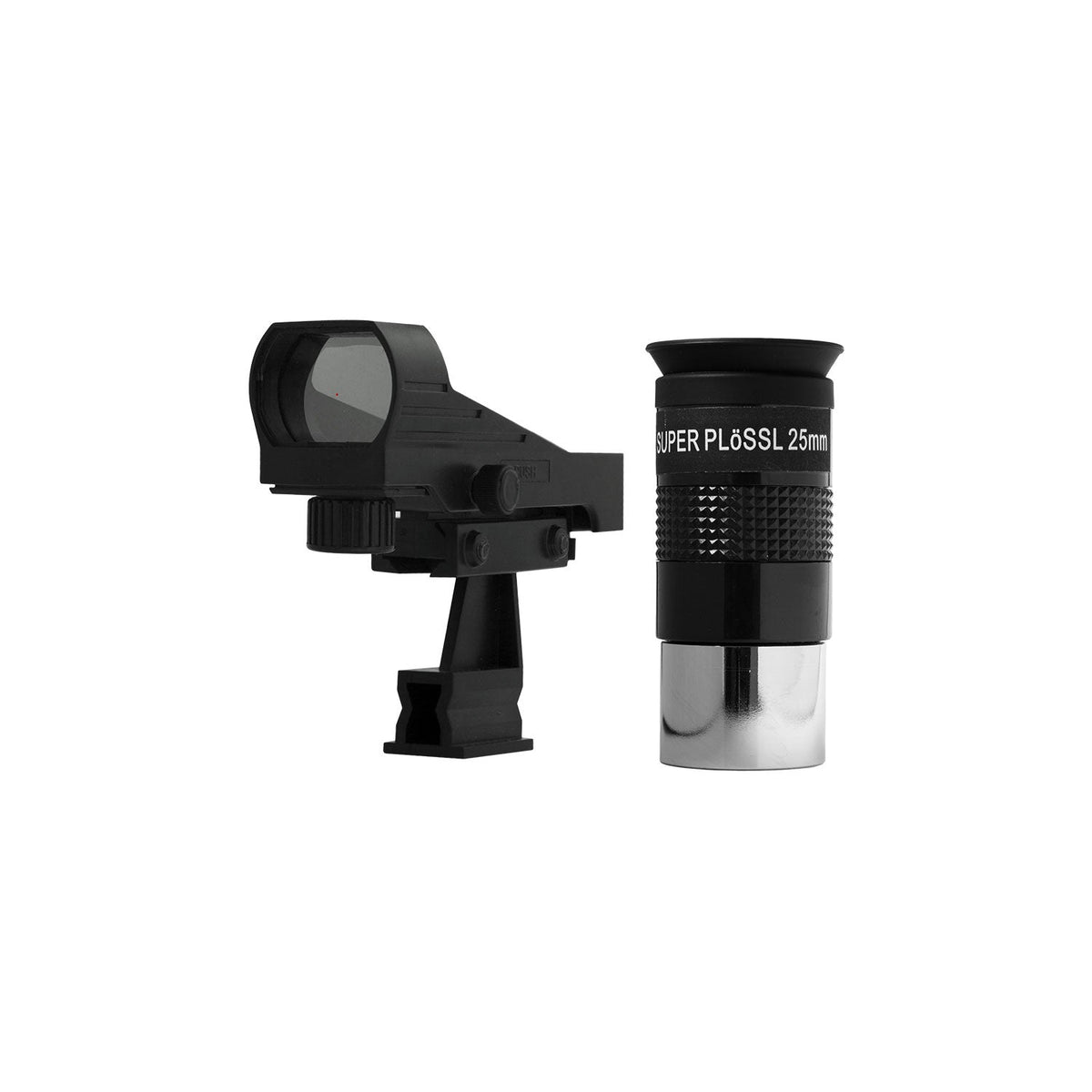
- Two 1.25-inch eyepieces
- Red dot finderscope
| Spec |
Value |
| SKU |
FL-AR1271200MAZ01 |
| Optical Design |
Achromatic Doublet Refractor |
| Aperture |
127mm (5 inches) |
| Focal Length |
1200mm |
| Focal Ratio |
f/9.4 |
| Mount Type |
Twilight I Alt-Az with slow-motion controls |
Price Match, Shipping & Questions
We price-match any authorized Canadian or US retailer. Ships free to the contiguous US. Questions? Email us at support@telescopewolves.com or visit our contact page.
Frequently Asked Questions
How does this compare to the 102mm FirstLight refractor kit?
The 127mm has 55% more aperture by diameter and roughly 2.4× more light-collecting area than the 102mm. This means consistently brighter views, more resolution on tight targets like double stars and globular cluster cores, and the ability to reach fainter deep-sky objects. The 127mm tube is heavier and longer, but the Twilight I mount handles it comfortably. If budget allows, the 127mm is a meaningful step up.
Will chromatic aberration be a problem at f/9.4?
At f/9.4, chromatic aberration in an achromatic doublet is well-controlled for visual use. You may see a thin purple fringe on the Moon's limb and bright stars, but it's not intrusive. For casual planetary and deep-sky observing, most users find it entirely acceptable. If you want zero chromatic aberration, our ED doublet or APO triplet options eliminate it, at a higher price.
What's the difference between this and the 127mm OTA (DAR127065-02)?
The OTA-only DAR127065-02 is a 127mm at f/6.5 (826mm FL) — shorter focal length, more wide-field oriented, sold without mount. This kit (FL-AR1271200MAZ01) is a 127mm at f/9.4 (1200mm FL) — longer focal length, more planetary-capable, sold as a complete ready-to-use kit with mount, tripod, and eyepieces. The kit is the better choice if you don't already have a mount.
Can I do astrophotography with this setup?
The Twilight I is a manual alt-az mount — there's no tracking or motorization, so long-exposure astrophotography isn't practical on this mount. For planetary and lunar imaging with a short-exposure camera (planetary imager or phone adapter), the combination works well. For deep-sky imaging, a motorized equatorial mount would be required.
New to telescopes?
Our beginner guides walk you through everything — from setting up your first scope to finding objects in the night sky.