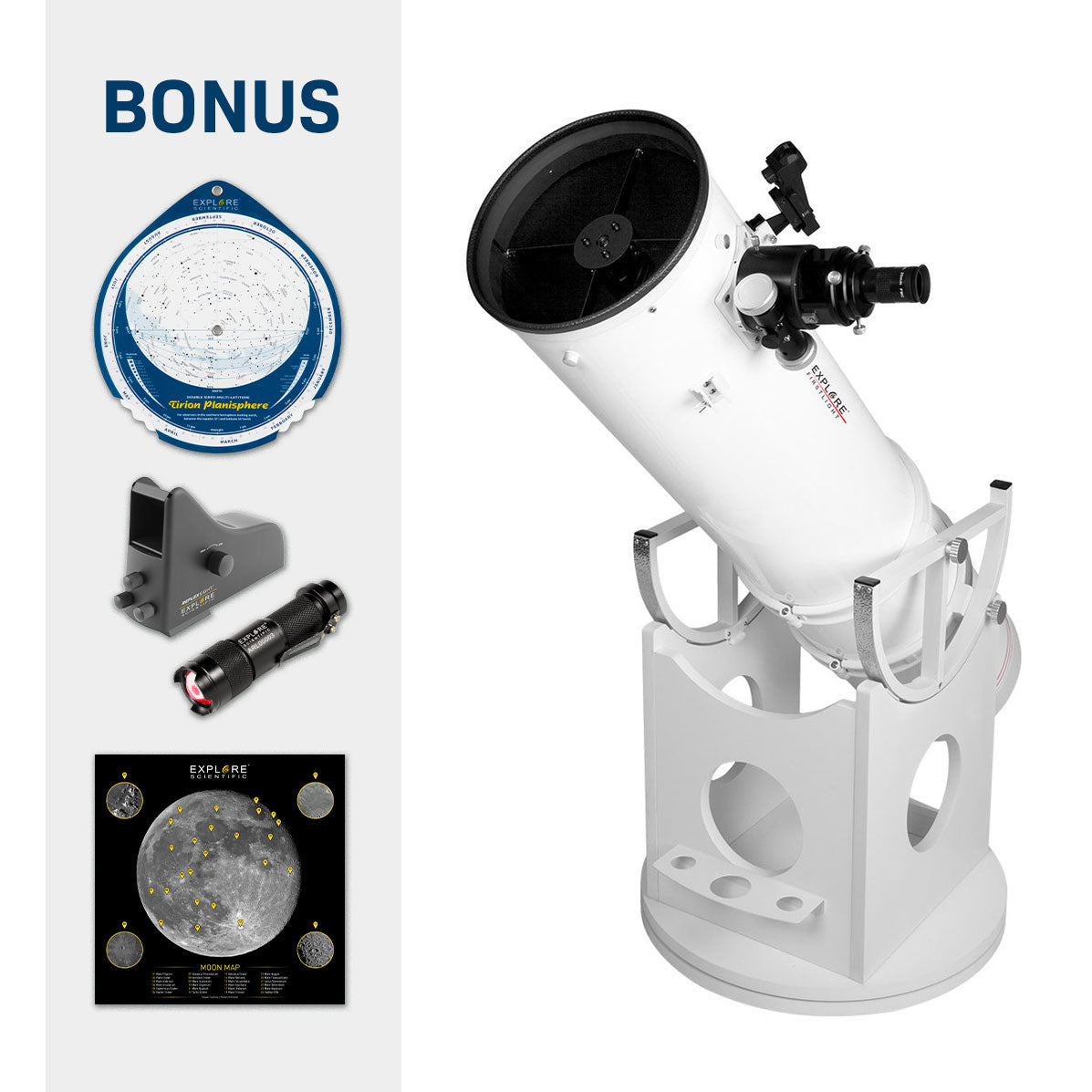
Eight inches of solid-tube Dobsonian for $699.99 — and the package means you start observing from the first night, not after a parts run. The Explore Scientific FirstLight 8-Inch Solid Tube Dobsonian (FL-DOB0806-02-PK) pairs a 203mm primary mirror and f/6 optical system with a rocker-box mount that sets up in minutes and stays rock-steady through high-magnification sessions.
Unlike lighter or smaller Dobs at this price
The solid tube design matters at 8 inches. Open-truss Dobsonians at this aperture can flex between observations, requiring careful handling to maintain collimation. The solid tube keeps the optical path enclosed — better thermal stability, better protection from stray light, and consistent collimation session to session. The 203mm mirror at f/6 also delivers a longer focal length than f/5 designs, producing higher magnification per eyepiece and somewhat more forgiving collimation tolerances.
What you'll see
Eight inches opens the deep sky properly. The Andromeda Galaxy shows distinct structure — core brightness, disk extent, and on good nights the satellite galaxy M32 in the same field. The Orion Nebula reveals the Trapezium cluster surrounded by wispy nebulosity and dark patches. Globular clusters like M3, M5, and M13 fully resolve to pinpoints of light across the entire cluster. Jupiter shows five or more distinct cloud features; Saturn's rings are crisp with the Cassini Division always visible. The Ring Nebula shows a clearly hollow disc. Markarian's Chain — a string of galaxies in Virgo — is a single-field showpiece from dark sites.
What's in the box
- 8-inch (203mm) f/6 solid tube Dobsonian telescope
- Dobsonian rocker-box mount
- Complete accessory package
| Spec |
Value |
| SKU |
FL-DOB0806-02-PK |
| Optical Design |
Newtonian Reflector (Solid Tube Dobsonian) |
| Aperture |
203mm (8 inches) |
| Focal Ratio |
f/6 |
| Mount Type |
Dobsonian rocker-box (alt-azimuth, manual) |
Price Match, Shipping & Questions
We price-match any authorized Canadian or US retailer. Ships free to the contiguous US. Questions? Email us at support@telescopewolves.com or visit our contact page.
Frequently Asked Questions
What's the difference between this and the 10-inch Dobsonian?
The 10-inch has 56% more light-collecting area than the 8-inch, which means brighter images and more detail on faint objects. The 8-inch is smaller and lighter — easier to move and store, with faster cool-down time. If portability matters or your observing site has a short walk, the 8-inch is a more practical choice. If raw aperture is the goal, the 10-inch wins.
Does a solid tube Dobsonian need collimation?
Yes, but solid tube Dobsonians hold collimation better between sessions than open-truss designs. After initial setup, many observers go weeks without adjustment. A collimation cap (inexpensive) or laser collimator makes the process fast when needed.
How portable is an 8-inch Dobsonian?
The tube and rocker-box typically weigh 35–45 lbs combined. Most people transport it in two pieces in a car trunk or SUV. It's a scope you take to a dark-sky site, not a grab-and-go for balcony use. The 6-inch tabletop Dobsonian is the more portable option if that's your priority.
Can I do astrophotography with it?
Smartphone and DSLR eyepiece projection works well for the Moon and bright planets. Long-exposure deep-sky imaging requires a motorized equatorial mount. As a pure visual instrument, the 8-inch Dob excels — it's one of the best bang-for-aperture designs in amateur astronomy.
New to telescopes?
Our beginner guides walk you through everything — from setting up your first scope to finding objects in the night sky.
Watch it in action