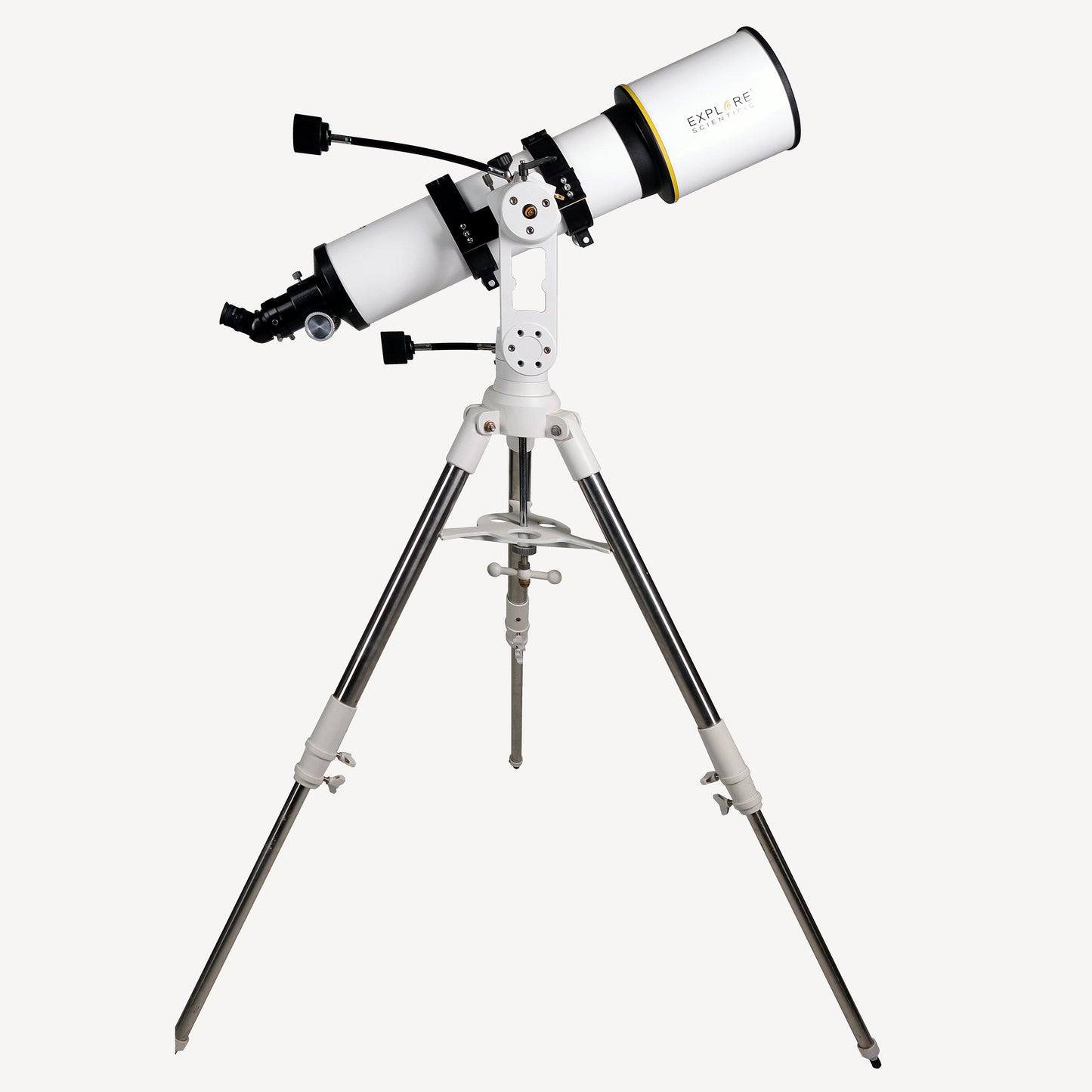
Five inches of aperture with a smartphone-guided mount that tells you exactly where to point — the Explore Scientific Sidara Plus 127mm (ES-AR127820-MAZ01) is the step up from smaller beginner refractors that leaves you wondering what more aperture feels like. The SkyAssist alt-azimuth mount pairs with an app that turns your phone into a guide: follow the on-screen arrows and the scope arrives at its target. No star charts required. No GoTo motor required. Just you, the app, and 127mm of light-gathering.
Unlike smaller app-guided beginner scopes
Our 80mm and 102mm SkyAssist kits are excellent entry points — but the 127mm delivers a genuinely different experience at the eyepiece. The jump from 102mm to 127mm is 55% more aperture diameter and roughly 2.4× more light-collecting area. Fainter deep-sky objects become visible. Globular clusters resolve further into individual stars. Galaxies show nuclei and extent rather than just a smudge. Planetary detail — Jupiter's cloud belts, Saturn's Cassini Division — is more defined and consistent. At f/6.5 and 820mm focal length, the Sidara Plus is versatile enough for both wide-field sweeping and focused planetary viewing.
What you'll see
Jupiter's Great Red Spot and equatorial belts are crisp at 80–120×. Saturn's rings open beautifully, with the Cassini Division visible at medium power. The Moon's craters and mountain ranges fill the view at high magnification. M42 (Orion Nebula) shows the Trapezium quadruple star system and surrounding nebulosity. M45 (Pleiades) is a stunning wide-field spectacle. M13 and M5 resolve into salt-and-pepper points across the entire globular. M31 fills the field with its nucleus and halo. Under suburban skies, dozens of Messier objects are accessible in a single evening.
What's in the box
- 127mm f/6.5 achromatic refractor OTA
- SkyAssist alt-azimuth mount (app-guided pointing)
- Aluminum tripod with accessory tray
- Two 1.25-inch eyepieces
- 1.25-inch diagonal
- Red dot finderscope
| Spec |
Value |
| SKU |
ES-AR127820-MAZ01 |
| Optical Design |
Achromatic Doublet Refractor |
| Aperture |
127mm (5 inches) |
| Focal Length |
820mm |
| Focal Ratio |
f/6.5 |
| Mount Type |
SkyAssist Alt-Azimuth (app-guided) |
Price Match, Shipping & Questions
We price-match any authorized Canadian or US retailer. Ships free to the contiguous US. Questions? Email us at support@telescopewolves.com or visit our contact page.
Frequently Asked Questions
How does the SkyAssist app guidance work?
After a brief star alignment, the app shows directional arrows on your phone screen. You move the telescope manually in the direction the app indicates until it tells you you've arrived — then look through the eyepiece. It's not motorized GoTo (the mount doesn't move itself), but it removes the need to interpret star charts and dramatically reduces the time spent searching.
How does this compare to the 127mm GoTo Mak-Cass (ES-MC1271900-SAGT-SA10)?
The Sidara Plus 127mm refractor is the more versatile all-around scope — f/6.5 gives better wide-field performance for deep-sky objects and clusters. The 127mm Mak-Cass GoTo has a longer focal length (1900mm vs 820mm) optimized for planetary work, plus fully motorized GoTo (the mount moves automatically). The refractor is the better choice for all-around observing; the Mak-Cass GoTo is better if planets and the Moon are the primary focus.
Is this good for astrophotography?
The SkyAssist mount is a manual alt-az — it doesn't track or motor. For planetary and lunar imaging with a phone adapter or short-exposure camera, it works. For long-exposure deep-sky photography, you'd need a motorized equatorial mount. This kit is designed for visual observing.
What's the difference between this and the 127mm refractor on the Twilight I mount (FL-AR1271200MAZ01)?
The FL-AR1271200MAZ01 is at f/9.4 (1200mm FL) — longer focal length, more planetary-focused, heavier tripod, no app guidance. The Sidara Plus is at f/6.5 (820mm FL) — wider field, app-assisted pointing, lighter overall setup. For beginners who want the app assistance and a more portable kit, the Sidara Plus is the better starting point.
New to telescopes?
Our beginner guides walk you through everything — from setting up your first scope to finding objects in the night sky.