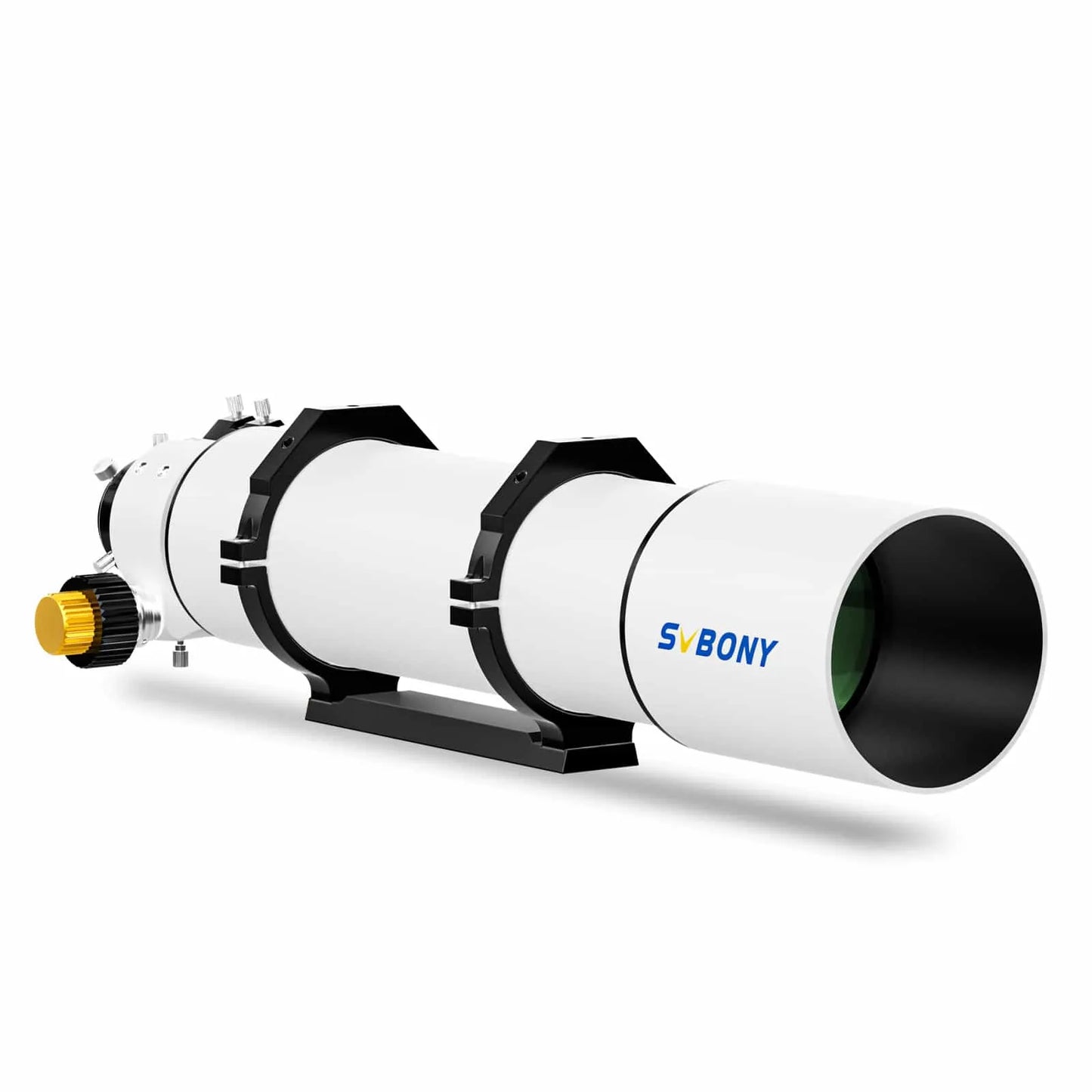
The SVBONY SV48P is a 4-inch aperture achromatic refractor that sits in a sweet spot most beginners overlook: big enough to show genuine deep-sky detail, fast enough at f/6.5 to be usable for astrophotography, and priced well below comparable aperture alternatives. The 102mm lens collects significantly more light than the 70–80mm refractors that dominate the beginner market — the Orion Nebula shows structural detail, globular clusters begin resolving, and planetary views are noticeably brighter and sharper.
Unlike smaller beginner refractors where you quickly hit the ceiling of what the optics can show, the SV48P has room to grow. Add an equatorial mount, a camera adapter, and a simple DSLR and it becomes a capable lunar and planetary imager. Start with visual observing and grow into astrophotography as your interest deepens — without buying a second telescope.
What you'll see
-
The Moon — high-contrast detail of craters, valleys, and mountain ranges; the terminator line in sharp relief
-
Saturn — rings clearly separated, the Cassini Division visible on steady nights
-
Jupiter — distinct equatorial cloud bands and the four Galilean moons
-
The Orion Nebula (M42) — glowing gas cloud with visible inner structure
-
Open clusters like the Pleiades and Hyades — resolved into individual stars in wide-field views
-
Globular clusters like M13 — beginning to resolve at the edges at higher magnification
What's in the box
- 102mm f/6.5 achromatic doublet refractor OTA — multi-coated optics
- 2-inch focuser — accepts 2" eyepieces and camera adapters
- Eyepieces for multiple magnifications
- Finderscope
- Diagonal
| Specifications |
|---|
| Optical design |
Achromatic doublet refractor |
| Aperture |
102 mm (4 inches) |
| Focal ratio |
f/6.5 |
| Focuser |
2-inch — accepts standard accessories and camera adapters |
| Astrophotography |
Yes — f/6.5 fast enough for lunar and planetary imaging |
| SKU |
F9341C |
Backed by Telescope Wolves' price match guarantee and free US shipping. Questions about refractor vs. reflector at this aperture? We're happy to help you choose.
Frequently asked questions
What's the advantage of 102mm over a 70–80mm refractor?
Aperture determines how much light a telescope collects. Going from 80mm to 102mm gives you about 63% more light-gathering — enough to push deep-sky objects from vague hints into genuine targets. The Orion Nebula shows structural detail, globular clusters begin resolving at the edges, and planetary images are noticeably brighter at higher magnification.
What does f/6.5 mean for astrophotography?
Focal ratio (f-number) works like a camera aperture. A faster ratio like f/6.5 means shorter exposure times compared to f/9 or f/10 scopes — an important practical difference when you're starting out and working against atmospheric turbulence. The SV48P at f/6.5 is genuinely capable for lunar and bright planetary imaging, and even wide-field deep-sky work with the right camera setup.
Does an achromatic refractor show chromatic aberration?
Some, particularly at fast focal ratios. The SV48P at f/6.5 will show a small amount of color fringing around bright objects like the Moon and Venus — a faint purple/blue halo. This is normal for achromatic doublets at this price. It's visible if you look for it, but most observers barely notice it during casual viewing. For zero false color, you'd need an APO refractor at a higher price point.
What mount should I pair this with?
The SV48P is sold as an OTA (optical tube assembly). For visual observing, an alt-azimuth mount like the Explore Scientific Twilight Nano is a comfortable starting point. For astrophotography, an equatorial mount is recommended. We carry mounts separately — contact us and we'll match you with the right combination for your goals.
New to astronomy? Read our beginner's guide to choosing your first telescope or our Astronomy 101 guide to get started.