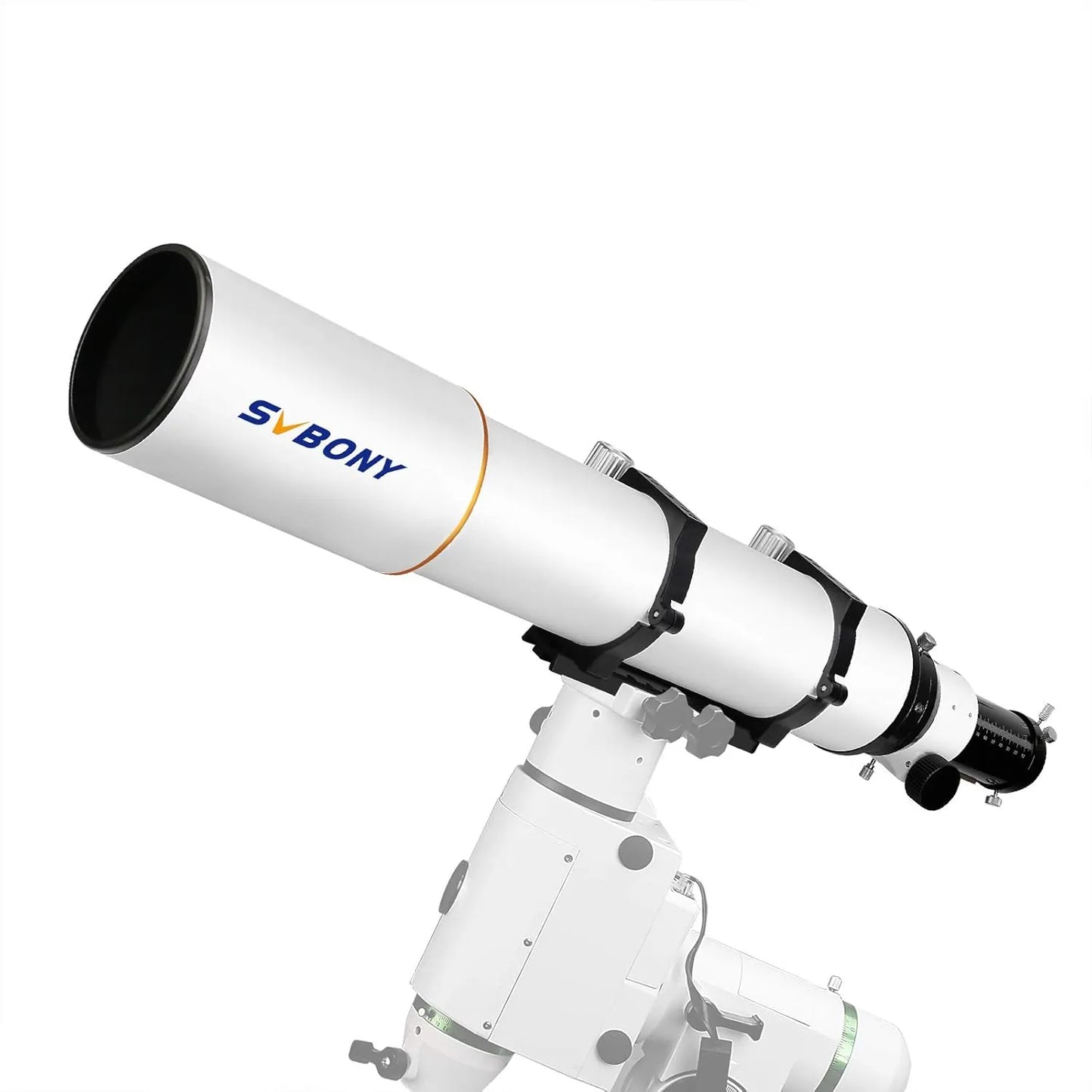
Four inches of ED glass at f/7 — a focal ratio where color correction is clean and the view through the eyepiece is sharp from edge to edge. The SVBONY SV503 102mm f/7 ED Doublet (F9359D) is an OTA-only refractor built for observers and imagers who already have a mount and want high-quality optics without paying the premium of a name-brand APO. The extra-low dispersion glass controls chromatic aberration to near-APO levels, making this a versatile scope for both high-power planetary viewing and wide-field deep-sky imaging.
Unlike standard achromatic refractors
A 102mm achromat at this aperture runs into chromatic aberration — the blue-purple fringing that appears around bright targets like the Moon, Venus, and Jupiter. The SV503's ED doublet glass significantly reduces this, bringing the false color down to barely perceptible levels on visual targets and near-imperceptible levels in most imaging scenarios. At f/7 (714mm focal length), it's slow enough for good correction and fast enough to be usable with a wide range of mounts and accessories. This is not the same as a fluorite triplet APO — but for the price, it punches well above its class.
What you'll see
102mm resolves fine double stars cleanly and shows lunar craters and rilles in crisp detail without the color fringe of an achromat. Jupiter shows the equatorial belts and distinct cloud structure. Saturn's Cassini Division is consistent at medium power. The Orion Nebula and other bright emission nebulae take color-narrowband filters well. For visual deep-sky, the f/7 focal ratio means you'll want a 2-inch wide-field eyepiece for best performance on large targets. Galaxies in Virgo and Ursa Major show nuclei and some extent under dark skies.
What's in the box
- 102mm f/7 ED doublet refractor OTA
- 2-inch dual-speed focuser with 1.25-inch adapter
- Vixen-style dovetail bar
- Tube rings
- Dust caps (objective and focuser)
| Spec |
Value |
| SKU |
F9359D |
| Optical Design |
ED Doublet Refractor |
| Aperture |
102mm (4 inches) |
| Focal Length |
714mm |
| Focal Ratio |
f/7 |
| Focuser |
2-inch dual-speed Crayford with 1.25-inch adapter |
| Included |
OTA only — mount not included |
Price Match, Shipping & Questions
We price-match any authorized Canadian or US retailer. Ships free to the contiguous US. Questions? Email us at support@telescopewolves.com or visit our contact page.
Frequently Asked Questions
What mount do I need for this OTA?
The SV503 102mm is light enough for a capable alt-az — the iOptron AZ Mount Pro, Sky-Watcher AZ-EQ5, or similar will handle it well for visual use. For astrophotography with tracking, an EQ5-class or better equatorial mount (Sky-Watcher HEQ5, iOptron CEM26) is recommended. The tube weight is manageable; balancing is straightforward with the included Vixen dovetail.
How does the ED glass compare to a full APO triplet?
An ED doublet reduces chromatic aberration significantly over a standard achromat but doesn't fully eliminate it the way a high-end fluorite or FPL-53 triplet does. For visual use, the difference between this and a triplet APO is minimal at f/7. For imaging, a quality field flattener/reducer is recommended; tight stars edge-to-edge will require correction regardless of doublet vs. triplet.
Is it good for astrophotography?
Yes, with a field flattener. At native f/7, stars toward the edges of a large sensor will elongate without correction. Pair it with a compatible 0.8× reducer/flattener for both a flatter field and faster f/5.6 ratio. For narrowband nebula imaging (Ha, OIII, SII), the color correction is excellent — chromatic aberration is a non-issue with narrowband filters.
How does this compare to the SVBONY SV550 80mm Triplet APO?
The SV550 is a smaller-aperture fluorite triplet — technically superior color correction, but with 20% less aperture. The SV503 102mm ED has more light-gathering power and resolution. For visual planetary use, the SV503's 102mm wins on detail. For pure astrophotography with demanding color accuracy, the SV550's triplet correction may be preferable if aperture isn't the priority.
New to telescopes?
Our beginner guides walk you through everything — from setting up your first scope to finding objects in the night sky.