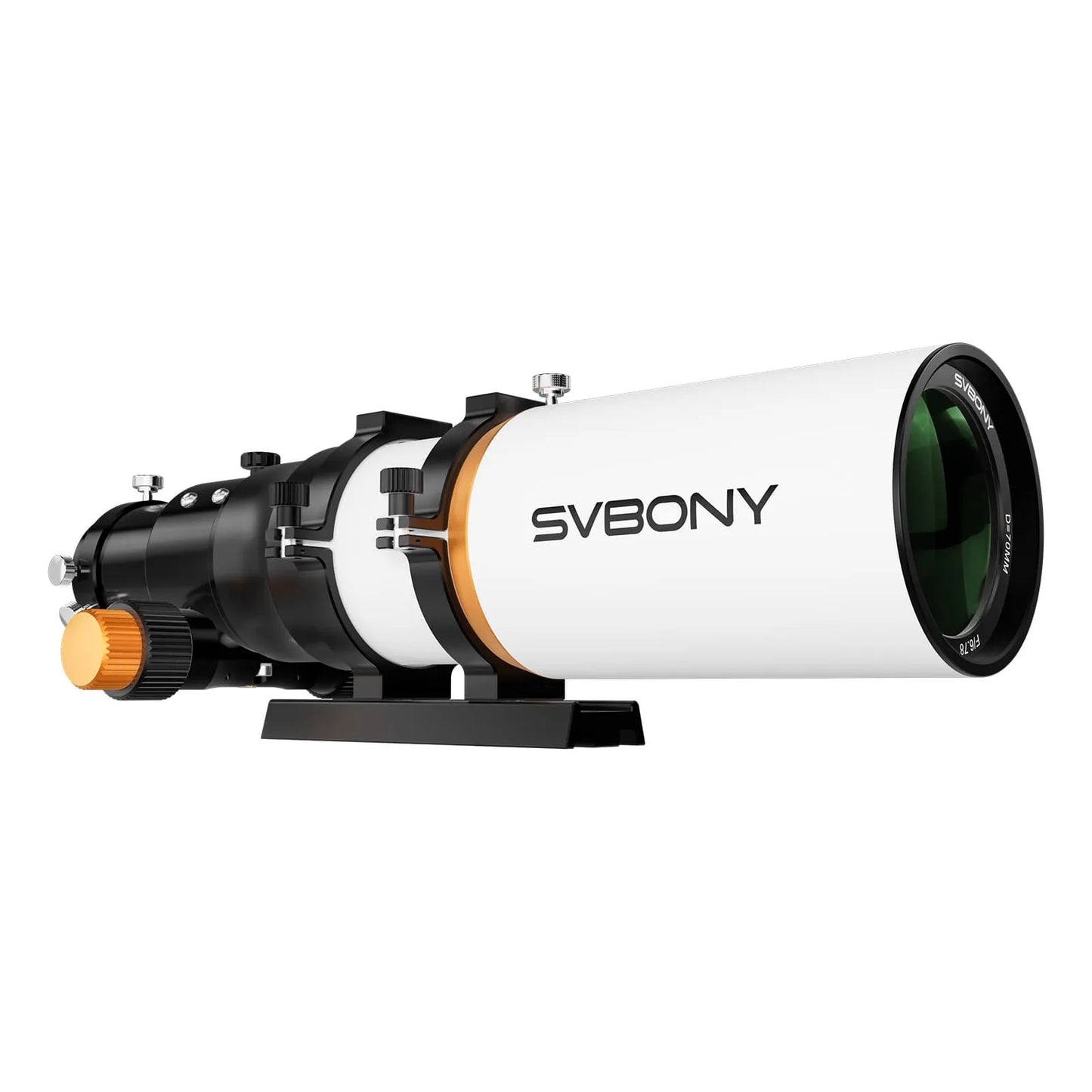
The SVBONY SV503 70mm Quadruplet is a purpose-built astrophotography refractor — four optical elements designed to deliver a flat, well-corrected image circle from edge to edge at f/6.78. Where achromatic doublets and even triplets show coma and field curvature at the image corners (a real problem for full-frame camera sensors), the SV503's quadruplet design corrects these aberrations across the full field. At 475mm focal length, it captures wide nebula fields in shorter exposures than a longer focal length scope requires.
Unlike visual telescopes adapted for imaging, the SV503 is engineered from the start for camera use: a 2-inch dual-speed focuser with a 1:10 fine-focus ratio for precise focus lock, a built-in rotator to orient your camera without rotating the whole tube, and multi-coated FPL-53 glass for color correction that matches dedicated apochromatic designs. For wide-field nebula imaging from a suburban backyard or a dark-sky site, this scope covers targets the way they deserve to be covered.
What you'll capture
-
Large nebulae — the Orion Nebula, California Nebula, Rosette Nebula fit fully in frame at native focal length
-
Galaxy groups — Virgo Cluster, Leo Triplet, and other wide-field galaxy fields
-
Open clusters — the Pleiades, Beehive, and other large clusters beautifully framed
-
Milky Way fields — wide, flat, well-corrected star fields for landscape astrophotography
-
Visual observing — sharp planetary and lunar views are also possible, though imaging is the SV503's primary strength
What's in the box
- 70mm f/6.78 quadruplet apochromat OTA — FPL-53 glass, multi-coated
- Dual-speed 2-inch focuser — 1:10 fine-focus ratio, built-in rotator
- Dovetail plate — compatible with Vixen and Losmandy-style mounts
- Carry case
| Specifications |
|---|
| Optical design |
Quadruplet apochromat — four-element flat-field design |
| Aperture |
70 mm (2.75 inches) |
| Focal length |
475 mm (f/6.78) |
| Glass |
FPL-53 extra-low dispersion — APO-grade color correction |
| Focuser |
Dual-speed 2-inch with 1:10 fine focus and built-in rotator |
| Best for |
Wide-field astrophotography — flat field, short exposures |
| SKU |
F9359E |
Backed by Telescope Wolves' price match guarantee and free US shipping. Comparing this to a triplet APO or longer focal-length imaging scope? We'll help you match the right scope to your targets.
Frequently asked questions
What's the practical difference between a doublet, triplet, and quadruplet refractor for imaging?
Doublets are the entry point — they control chromatic aberration reasonably well but show field curvature at the image edges. Triplets (APO refractors) add a third element for better color correction and slightly flatter fields. A quadruplet adds a fourth element specifically to flatten the field across the full image circle — critical for full-frame sensors where edge stars would otherwise appear bloated or elongated. The SV503 quadruplet delivers corner-to-corner sharpness that doublets and many triplets can't match.
Why only 70mm aperture for an imaging scope?
For wide-field astrophotography, aperture matters less than focal length, focal ratio, and optical quality. The 475mm f/6.78 focal length captures large nebulae in a single frame, and the fast ratio keeps exposure times short. Adding aperture increases weight, cost, and thermal management challenges. The SV503's 70mm quadruplet is optimized for its role: wide-field imaging with short exposures, maximum portability, and flat field — not maximum light-gathering.
What mount does this scope need?
An equatorial tracking mount is required for astrophotography — alt-azimuth mounts cause field rotation during exposures. The SV503's compact, lightweight design is compatible with mid-range EQ mounts. The Vixen/Losmandy dual dovetail works with most imaging mounts. Contact us for a recommendation based on your imaging goals and target sensor size.
Can I use this scope for visual observing?
Yes. The 70mm aperture delivers sharp, well-corrected views of the Moon, planets, and star clusters. It's not optimized for visual use (the focuser and tube design are camera-first), but it's a capable visual scope. Most SV503 owners use it primarily for imaging; a traditional Newtonian or refractor would be a better choice if visual observing is your main interest.
New to astronomy? Read our beginner's guide to choosing your first telescope or our Astronomy 101 guide to get started.