Skip to product information
1 of 10

Explore Scientific

Explore Scientific L-eNhance Dual Narrowband Filter 2" — Boost Nebula Contrast for Wide-Field Imaging

Explore Scientific L-eNhance Dual Narrowband Filter 2" — Boost Nebula Contrast for Wide-Field Imaging

Regular price $229.00
Regular price Sale price $229.00
Sale Sold out
Shipping calculated at checkout.
Quantity

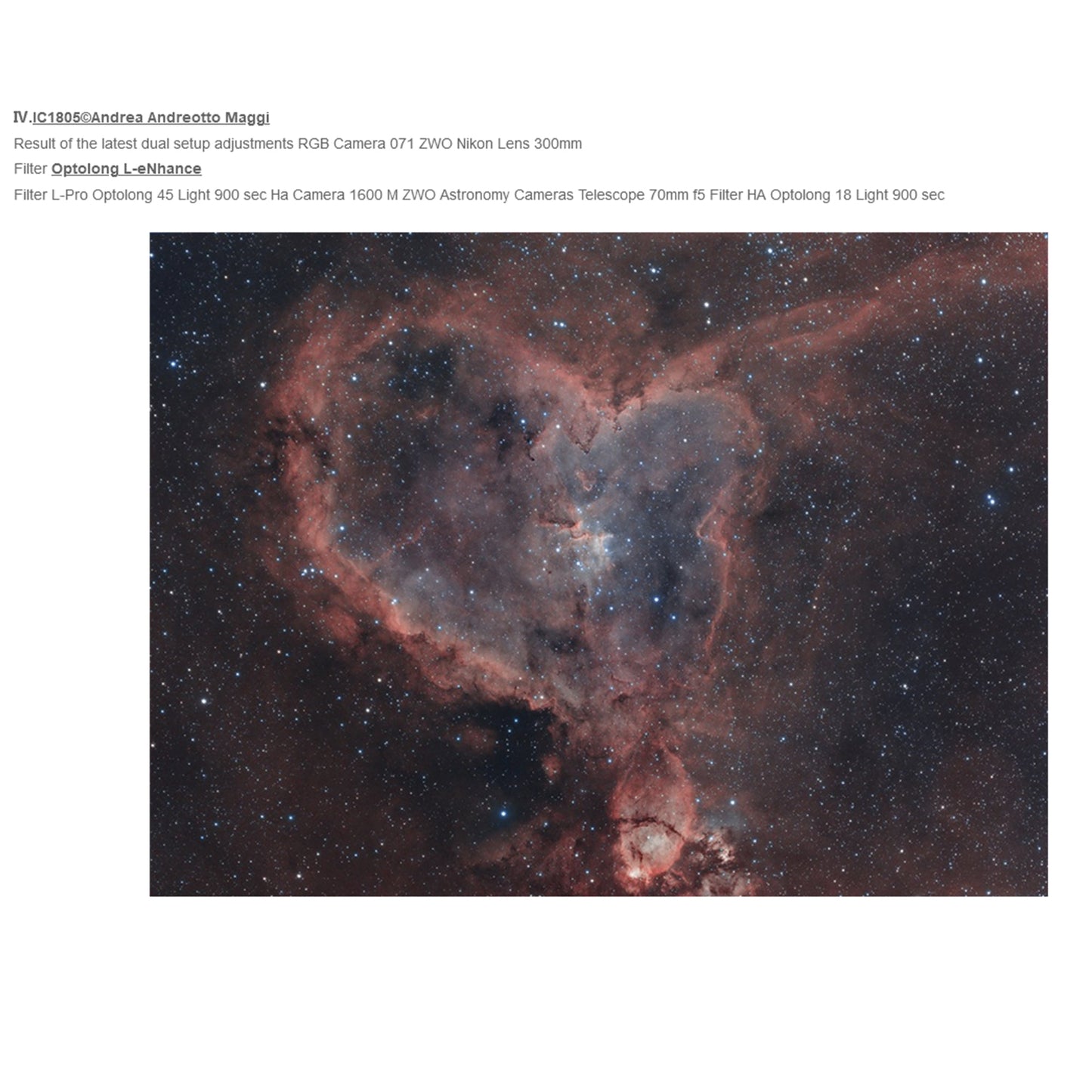
The Explore Scientific L-eNhance 2-inch dual narrowband filter is a light pollution filter built to boost nebula contrast for wide-field astrophotography. It works by passing only the key wavelengths that emission nebulae glow at — hydrogen and oxygen — while blocking most artificial skyglow, so faint nebulosity stands out even from the suburbs.

This Optolong-made multi-band filter transmits H-alpha and H-beta along with an OIII band, letting one-shot color cameras capture rich nebula detail without needing a dark-sky site.

Who it's for

Ideal for astrophotographers with DSLR or one-shot-color cameras who want stronger nebula images from light-polluted skies. New to imaging? See our astronomy 101 stargazing basics guide.

Key features

  • Dual/tri-band narrowband design isolating H-alpha, H-beta, and OIII emission lines.
  • Strong light-pollution suppression for higher nebula contrast from the city.
  • One-shot-color friendly — works well with DSLRs and color astro cameras.
  • Standard 2-inch threaded cell that fits 2-inch filter wheels and accessories.
  • Wide-field emission nebula performance for targets like the Orion and North America nebulae.
Specifications
Brand Explore Scientific (Optolong)
Model 310160
Type Dual/tri-band narrowband nebula filter
Passbands H-alpha ~10 nm; OIII/H-beta ~24 nm
Size 2-inch threaded
Best for One-shot-color emission nebula imaging

Frequently asked questions

How is the L-eNhance different from the L-eXtreme?
The L-eNhance has wider passbands (about 10 nm Ha and 24 nm for OIII/H-beta) and includes H-beta, while the L-eXtreme is a narrower 7 nm dual-band filter. L-eNhance passes a bit more light; L-eXtreme suppresses light pollution more aggressively.

Does it work with a DSLR?
Yes, it's designed for one-shot-color cameras including DSLRs and color astro cameras.

Will it help with galaxies?
It's optimized for emission nebulae. Broadband targets like galaxies benefit more from a broadband light-pollution filter such as the L-Pro.

View full details

Frequently Asked Questions

With a beginner telescope you can see a surprising amount — the craters and mountains on the Moon, the rings of Saturn, the moons of Jupiter, and star clusters like the Pleiades. As you get more comfortable, you can also spot nebulae and distant galaxies. Not sure which beginner telescope is right for you? Check out our Telescope Buying Guide.
Most orders ship within 5 business days. You'll receive tracking information within 24 hours of your order leaving the warehouse. For full details, visit our Shipping Policy.
Orders cancelled after 48 hours are subject to a $20 administration fee. If your order has shipped, you are responsible for return shipping costs. Refunds are issued to the original payment method. See our full Refund Policy for details.
Yes! If you find a lower price at another authorized online retailer within 6 months of your purchase, we'll refund the difference. Learn more on our Price Match Guarantee page.
All telescopes on Telescope Wolves are hand-picked with beginners in mind. If you're unsure which telescope is right for you, check out our Telescope Buying Guide.
Please inspect your package on arrival and note any damage when signing for delivery. Send photos to info@telescopewolves.com and we'll process a claim on your behalf.
Absolutely. Our team is available Monday to Friday, 9am–5pm EST. The best way to reach us is by live chat (in the bottom right hand corner) or by email at info@telescopewolves.com. You can also visit our Contact Us Page.