

Best Meteor Showers to Watch in 2027 (Full Calendar)
Meteor showers are the most accessible astronomy events of the year — no telescope, no equipment, no experience required. You just go outside, lie on your back, and watch the sky. But knowing when and where to look, and what conditions to expect, is the difference between a magical night and a disappointing one.
This is your complete 2027 meteor shower guide: every major shower, peak dates, moon conditions, U.S.-specific viewing tips, and honest gear recommendations for the best experience possible.
Meteor Shower 101: What’s Actually Happening
When a comet travels through the inner solar system, it leaves behind a trail of rocky debris — tiny particles ranging from sand-grain sized to marble-sized. Earth’s orbit crosses these debris trails at the same point every year. When that happens, those particles slam into our atmosphere at 30,000 to 160,000 mph and burn up in a flash of light. That’s a meteor.
The meteors appear to radiate outward from a single point in the sky called the radiant — which is the direction Earth is traveling into the debris stream. Each shower is named after the constellation where its radiant sits: Perseids radiate from Perseus, Geminids from Gemini, Leonids from Leo.
The number you’ll see is expressed as ZHR (Zenith Hourly Rate) — the theoretical maximum if the radiant were directly overhead under a perfect dark sky. In practice from a good dark site in the U.S., expect to see roughly 25–60% of the listed ZHR.
The #1 Factor: Moon Phase
More than your location, more than the time you stay out, the single biggest variable is the Moon. A full Moon in the sky cuts visible meteor rates in half or more, washing out fainter meteors with its reflected light. A new Moon gives you the darkest possible skies. Always check the moon phase before planning a meteor shower night.
Good news for 2027: the Quadrantids in January are expected to fall near new moon, making this year’s Quadrantids unusually favorable. Verify exact phases at NASA’s moon phase calendar (moon.nasa.gov) or any astronomy app before each shower.
2027 Meteor Shower Calendar
All times below are approximate. Peak activity typically runs from about 11 PM local time through 3 AM — after midnight is almost always the best window for any shower. All dates apply to viewing from the continental United States.
| Shower | Peak (2027) | ZHR | Parent Body | Notes |
|---|---|---|---|---|
| Quadrantids | Jan 3–4 | 50–100 | Asteroid 2003 EH1 | Very brief 6-hr peak; near new moon in 2027 — excellent conditions |
| Lyrids | Apr 22–23 | 10–20 | Comet Thatcher | Occasional bright fireballs; pleasant spring temperatures |
| Eta Aquariids | May 6–7 | 40–60 | Halley’s Comet | Better from southern U.S. (Florida, Texas, Arizona); pre-dawn best |
| Delta Aquariids | Jul 29–30 | 20 | Comet 96P Machholz | Often overlooked; pairs nicely with early Perseids in late July |
| Perseids ⭐ | Aug 12–13 | 80–100 | Comet Swift-Tuttle | Most popular U.S. shower; warm summer nights; check 2027 moon phase |
| Draconids | Oct 8–9 | 5–10+ | Comet 21P Giacobini-Zinner | Usually low; can produce surprise outbursts of hundreds/hr — watch forecasts |
| Orionids | Oct 21–22 | 20 | Halley’s Comet | Fast, bright meteors; pleasant fall nights across most of the U.S. |
| Leonids | Nov 17–18 | 15–20 | Comet Tempel-Tuttle | Potential for outbursts; historically produced storms of thousands/hr |
| Geminids ⭐⭐ | Dec 13–14 | 120–150 | Asteroid 3200 Phaethon | Best annual shower; multicolored slow meteors; bundle up — it’s cold |
| Ursids | Dec 22–23 | 5–10 | Comet 8P/Tuttle | Radiant near Polaris — visible all night from northern U.S.; closes the year |
The Big Three: Deep Dives on 2027’s Best Showers
🌠 Quadrantids — January 3–4, 2027
The Quadrantids open the year with a bang — but only if you’re awake for the brief peak window. Unlike most showers whose peaks spread across 1–2 days, the Quadrantids peak lasts just 6 hours. Miss it and you miss the show. Set your alarm: the peak typically falls in the pre-dawn hours on January 3rd or 4th. Radiant rises from the northeast in Bootes (near the handle of the Big Dipper). The expected ZHR is 50–100, and if 2027 falls near new moon as anticipated, conditions will be exceptional. Dress for real winter cold — this is January, and even in the South you’ll want a heavy jacket, hat, and gloves.
🌠 Perseids — August 12–13, 2027
The Perseid Meteor Shower is the most watched astronomy event in America, and with good reason: it peaks on warm August nights when people are actually outside, it’s reliable (80–100 meteors/hr at peak), and it frequently produces spectacular bright fireballs that light up the entire sky. The debris comes from Comet Swift-Tuttle, which last passed through the inner solar system in 1992 and won’t return until 2125 — but it left behind enough material to keep the Perseids going for centuries.
The radiant rises from the northeast (the constellation Perseus) after about 10 PM local time across the continental U.S. Activity builds through the night, peaking in the hours around 2–3 AM. You don’t need to stare at Perseus — meteors will appear across the whole sky, streaking away from that direction. This is a perfect shower for families: the warm summer temperatures mean you can comfortably watch from 10 PM onwards, even with kids. Check the 2027 moon phase — if it’s near new moon, this could be an exceptional year.
Best U.S. viewing spots for the Perseids: Cherry Springs State Park (PA), Adirondack Park (NY), Great Smoky Mountains (TN/NC), Big Bend National Park (TX), or any National Forest far from urban light pollution. See our guide to finding dark skies near you for how to locate a dark site in your state.
🌠🌠 Geminids — December 13–14, 2027 (The Best of the Year)
Astronomers consider the Geminids the best annual meteor shower — and have for the past decade. At 120–150 meteors per hour under ideal conditions, it outpaces even the Perseids. What makes the Geminids unusual is their parent body: unlike every other major shower, which comes from comets, the Geminids originate from an asteroid — 3200 Phaethon. That means the debris particles are denser and produce slower, more colorful meteors: whites, yellows, blues, and occasional reds that take a full second to arc across the sky. They’re easier to photograph and easier to see even from moderately light-polluted skies.
The radiant (constellation Gemini) is up by about 9–10 PM across the U.S., so you don’t need to stay up until 2 AM to see good rates — the Geminids are generous earlier in the evening than most showers. The trade-off: it’s December. Dress accordingly. Layering for temperatures of 20–40°F is realistic for most of the country. A sleeping bag in a reclining chair, hand warmers, and a thermos of coffee are not optional — they’re how you make it to 1 AM when the rates are best.
Get Your Free Beginner Stargazing Starter Guide
Weekly tips, dark sky guides, and meteor shower alerts. No spam — unsubscribe any time.
Gear That Actually Makes a Difference
You don’t need a telescope for a meteor shower. In fact, don’t bring one — the field of view is far too narrow. Here’s what actually helps.
1. Protect Your Night Vision — Red Light Headlamp

National Geographic LED Rechargeable Headlamp
$29.99
Your eyes take 20–30 minutes to fully dark-adapt, and a single flash of white light resets the whole process. A red-light headlamp lets you find your gear, check your watch, and set up without destroying your night vision. Hands-free design is essential when you’re wrangling blankets and adjusting your chair in the dark. One of the most-used pieces of astronomy gear you’ll own.
2. Scan the Milky Way Between Bursts — Binoculars
While you’re waiting for meteors, binoculars transform the time between bursts. The Milky Way, star clusters, nebulae, and the radiant constellation all look spectacular through even a modest pair. You’re not trying to catch meteors through them — just enriching the experience.

Explore One 6x21 Compact Binoculars
$29.99
Lightweight and compact — easy to slip into a jacket pocket for a late-night meteor watch. Good wide-field views of star clusters and the Milky Way between meteor bursts. A great entry-level option for families watching together.

SVBONY SV202 8×32 ED Binoculars
$119.99
A step up in optical quality with extra-low dispersion glass for sharp, color-accurate views. The 8x magnification and 32mm objective give excellent contrast for scanning the Milky Way and radiant constellation. Also outstanding for birdwatching and daytime use — a genuinely versatile pair that earns its place in any kit.
3. Know What’s Up — Planisphere

Explore Scientific Tirion Planisphere
$19.99
Great for locating the radiant constellation before the shower starts and identifying what else is up during the wait. Covers the entire U.S. (0–60° North latitude). Set the dial to the current date and time and it shows exactly what’s in the sky. No batteries, no glowing screen — just red-light-friendly cardboard that won’t destroy your dark adaptation.
4. Capture the Show — WiFi Astronomy Camera

SVBONY SC002 WiFi Astronomy Camera
$67.99
Want to photograph meteors? This WiFi camera connects to your phone and streams live sky views. Set it up on a tripod with a wide-angle view of the radiant, enable long-exposure mode, and let it run while you watch with your eyes. A fun way to capture the night and share fireball catches on social media. Pairs with any 1.25" telescope focuser for post-shower deep-sky sessions too.
Browse our full star maps & flashlights collection and astronomy binoculars collection for more viewing essentials.
How to Watch a Meteor Shower: Step-by-Step
Find a dark location. This is the most important thing you can do. Get away from city lights. A state park, national forest, or rural area rated Bortle 4 or lower will dramatically increase what you see. In suburban areas, even driving 30–45 minutes away from your city center makes a visible difference. Read our guide to finding dark skies to locate a good spot near you.
Set up a reclining chair or lay a blanket on the ground. You need to look straight up for extended periods. Craning your neck upward for two hours is miserable — a reclining lawn chair or camping sleeping pad solves this completely. This is the most underrated piece of meteor shower gear there is.
Dress warmer than you think you need to. Even on a warm August night for the Perseids, you’ll be sitting still in the dark after midnight. Temperatures drop. Bring a hoodie, a light jacket, and a blanket even in summer. For the Geminids and winter showers, treat it like a winter camping trip: base layer, mid layer, insulated outer layer, hat, gloves, and hand warmers.
Allow 20–30 minutes for dark adaptation. When you first step outside, the sky looks almost empty. Give your eyes time to adjust. After 20 minutes you’ll see far more stars. After 30 minutes you’ll see the Milky Way if you’re at a dark site. This is when the meteor rates become really impressive.
Face away from the Moon. If the Moon is up, position yourself so it’s behind you or behind a tree. The Moon itself won’t ruin everything, but looking in its direction will reduce contrast against the sky.
Don’t stare at the radiant. It seems counterintuitive, but staring directly at the radiant produces shorter, less impressive meteors because you’re seeing them head-on. Instead, look about 45–90 degrees away from the radiant direction. The meteors streak across a wider arc and look much more dramatic.
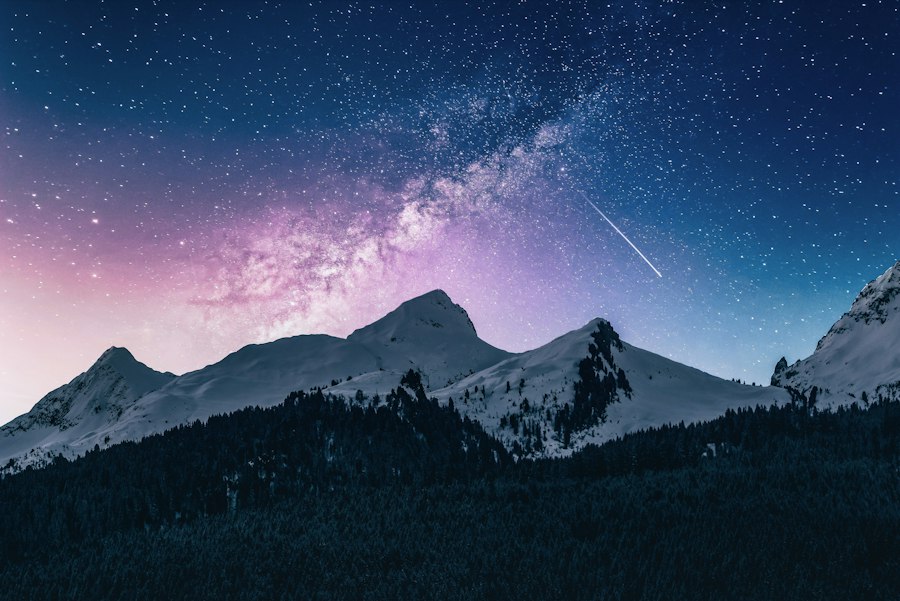
The Perseid Meteor Shower over a dark mountain site — one of the best summer astronomy experiences in the U.S.
Frequently Asked Questions
What are the best meteor showers to watch in 2027?
The three best in 2027 are the Geminids (December 13–14, up to 120–150/hr), the Perseids (August 12–13, 80–100/hr), and the Quadrantids (January 3–4, 50–100/hr). The Geminids are the most productive annual shower, with slow multicolored meteors visible even from moderately light-polluted skies. The Perseids are the most popular because they fall on warm August nights. The Quadrantids have a very brief 6-hour peak but can be spectacular if you catch it.
Do you need a telescope to watch a meteor shower?
No — and in fact you shouldn’t use one. Telescopes have a very narrow field of view and will cause you to miss almost every meteor. Meteor showers are strictly a naked-eye event. Binoculars are useful between bursts for scanning the Milky Way and radiant constellation, but for the meteors themselves, just look up with your own eyes.
What time of night is best for watching a meteor shower?
The hours between midnight and 3 AM local time almost always produce the highest rates, because that’s when your location on Earth rotates to face directly into the incoming debris stream. For most showers, going out between 11 PM and 3 AM will catch peak activity. The Geminids are an exception — their radiant is high enough by 9–10 PM that you can see good rates before midnight.
Where is the best place to watch a meteor shower in the United States?
Any dark location rated Bortle 4 or lower. Top options include Cherry Springs State Park (PA), Big Bend National Park (TX), Death Valley National Park (CA), Great Basin National Park (NV), and Natural Bridges National Monument (UT). Even driving 30–45 minutes outside your city to a rural area makes a big difference. Use our light pollution guide or lightpollutionmap.info to find a dark site near you.
How do I prepare for a meteor shower?
Check the peak date and moon phase. Find a dark location away from city lights. Bring a reclining chair or camping pad (you’ll be looking up for hours), warm layers for after midnight, a red-light headlamp, and a hot drink. Arrive early, let your eyes dark-adapt for 20–30 minutes, and look up. That’s really it.
Do meteor showers happen at the same time every year?
Yes — annual meteor showers occur when Earth’s orbit crosses the same debris trail left by a comet or asteroid, and that crossing happens at the same point in Earth’s orbit every year. The Perseids always peak around August 11–13; the Geminids around December 13–14. Intensity varies year to year based on moon phase and debris field density, but the timing is consistent.